Why Core Values Matter—and How to Define Them
From employee engagement to business performance and customer connection, company core values help build the trust organizations need to grow.
Sara Braun
Editorial Strategist, HR
Workday
From employee engagement to business performance and customer connection, company core values help build the trust organizations need to grow.
Sara Braun
Editorial Strategist, HR
Workday
Every organization has values—whether they’re clearly defined or simply reflected in daily decisions. Employees learn what matters to a company by watching how leaders act, recognize performance, respond to challenges, and treat others.
Strong core values also shape how successful businesses attract talent. Eighty-one percent of job seekers say they’re more likely to apply when an employer includes its values in a job posting, according to a 2026 iHire survey.
When clearly defined and consistently reinforced, company core values do more than describe culture. They guide decisions, shape collaboration, build trust, and set the standard for how work gets done.
Report
Eight in ten job seekers are more likely to apply for a job when core values are included in the posting.
Company core values are the shared principles that guide how people make decisions, collaborate, serve customers, and represent the organization. They set expectations for the behaviors and standards that shape the employee experience and influence how people show up every day.
While a mission statement explains why a company exists and a vision describes where it’s going, core values define how people work together to get there. They influence how employees collaborate and how organizations hire, develop, and recognize talent. Values are only impactful when they’re specific enough to guide behavior and navigate cultural shifts. The strongest values answer practical questions:
When values are clear and consistently reinforced, they become more than words on a careers page or office wall. They give employees a shared foundation for making confident decisions and create a common standard for how work gets done as the organization grows and evolves.
To define company core values, leaders can start by examining how teams make tough choices, build customer relationships, respond to change, and work together. The goal is to identify principles that are specific enough to guide action and authentic enough for employees to recognize in daily work.
Six key steps to defining company core values include:
2. Identify behaviors that drive success
3. Gather employee perspectives
Start by clarifying why the organization exists and how it creates value for customers, employees, and stakeholders. A clear sense of purpose provides context for the principles that guide everyday work and clarifies what the company stands for.
For example: An organization that competes through innovation may emphasize experimentation and continuous learning, while one built on long-term customer relationships may prioritize accountability and social responsibility. Tying values to purpose and strategy helps them stay relevant as the business evolves.
Instead of asking which values sound inspiring, look at behaviors already helping the organization succeed. High-performing employees and effective teams often reveal existing actions, habits, and decision-making patterns that values should reinforce.
For example, if top-performing teams consistently share information early, follow through on commitments, and take ownership when priorities change, those behaviors may point to values such as transparency, accountability, and adaptability.
Those patterns often help identify more authentic values than a brainstorming session alone. They also help ensure the final values reflect how people actually create impact—not just how the organization wants to describe itself.

Involving employees builds credibility and creates a shared ownership of company core values once they’re finalized.
Once patterns begin to emerge, test them with the people who experience the culture every day. Employees can determine whether proposed values reflect how the organization actually operates or simply describe how leaders hope it will operate.
Use workshops, surveys, interviews, and listening sessions to surface employee sentiment, including which behaviors people associate with long-term success, where expectations may feel unclear, and which values feel most authentic.
Involving employees early also builds credibility and creates a shared ownership of company core values once they’re finalized. Employees will always be the driving force behind a strong company culture.
After gathering input, narrow the list to the guiding principles that best represent the organization. Trying to capture every positive trait often leads to lengthy lists that employees struggle to remember or apply.
A focused set of three to six core values is easier to recall and use in everyday decision-making. A useful test: Can employees name the values without looking them up? If not, there may be too many to meaningfully put into practice.
Single-word values leave room for interpretation. Once values are established, define the behaviors that bring each one to life so employees understand how they should influence daily decisions.
For example, if accountability is a core value, share with employees what that looks like in practice: following through on commitments, communicating proactively when priorities change, taking ownership of mistakes, and focusing on solutions rather than blame. Behavioral examples help turn abstract concepts into practical expectations employees can put into action.
Defining company core values is only the beginning. Their long-term impact depends on employees experiencing them consistently through every stage of the employee lifecycle.
Use those values to guide the moments that shape the employee experience, from who gets hired and recognized to how managers give feedback and teams make decisions. That is how values move from statements to everyday standards.
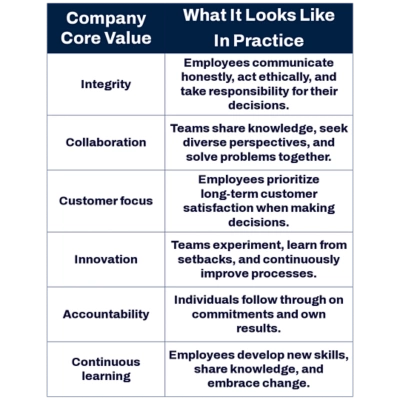
Once core values are defined, the next step is turning them into everyday expectations. People need to understand what each value looks like in real interactions, customer conversations, tradeoffs, and moments of pressure.
The examples below show how broad company values can translate into practical behaviors leaders can coach and teams can apply.
The specific values will vary by organization, but each one should offer practical guidance for how people are expected to think, act, and work together. When values are defined through observable behaviors, they become standards employees can use every day—not broad ideals left open to interpretation.
Employees need to see that the same principles that appear in a culture statement also influence the choices leaders make.
Company core values earn credibility through use. Employees need to see that the same principles that appear in a company culture statement also influence the choices leaders make, the behavior managers reinforce, and the standards teams are held to when work gets complicated.
That consistency is what turns values into something practical. They become a way to make judgment calls, align around expectations, and maintain trust as the business grows and changes.
Over time, the strongest values become part of the organization’s operating rhythm. They are not separate from the work. They shape how the work gets done.
Feeling the strain of rapid market changes on your talent strategy? Develop a plan to unlock workforce potential with the right skills technology in this Workday Buyer's Guide.
Report