Human Resources
Are Jobs Report Headlines Missing the Plot?
Four labor market trends revealed in new Workday data

Aaron Terrazas
Contributing Economist for Workday


Four labor market trends revealed in new Workday data
Aaron Terrazas
Contributing Economist for Workday
The October Jobs Report from the U.S. Bureau of Labor Statistics (BLS) does little to quell the debate among economists about the labor market. After a stronger than expected summer, September data looked soft. Payroll gains slowed but were well within most estimates of balanced labor supply and demand. Looking at the past few months, Jobs Report headlines have been especially volatile.
This has made the labor market hard to read recently, clouded by a mix of unsettled payroll growth and a historically unprecedented mix of slower population growth, major policy shifts, and declining response rates to official government surveys. Meanwhile, the unemployment rate has been unusually stable, with non-participation, gig work and self-employment absorbing more job market slack.
Even if the market were easier to read, it’s rare for labor market data to give us visibility into what’s happening between posting a job, hiring, and onboarding a new employee. That’s where private sector data like Workday’s research comes in.
It’s rare for labor market data to give us visibility into what’s happening between posting a job, hiring, and onboarding a new employee. That’s where Workday’s research comes in.

Report
Workday’s new Global Workforce Report, which the company will release Monday, is more important than ever as we try to figure out what conclusions to draw from official numbers. I got an early look at the report, which sheds light on stories that government metrics were never designed to track. Hiring times, promotion rates, the application funnel and hiring by company size all point to a labor market where the headline numbers miss the plot.
Here are four labor market trends you’ll see next week in the Workday report that aren’t captured in official data.
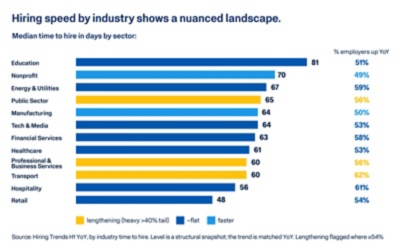
Workday data show that the median number of days to fill open roles has been flat overall at 60 days, but also that a majority of employers are taking longer to hire compared to a year ago in 10 of 12 industries.
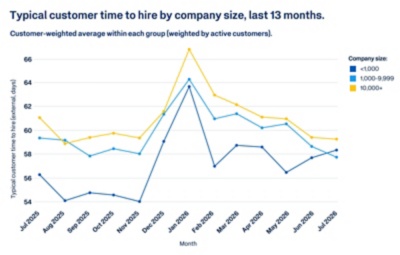
Company-size data explains the anomaly: The large companies that hire the most people are getting a little bit faster, while the long-tail of smaller companies that do less hiring are taking quite a bit longer. Hiring times generally increase in a tight job market, because companies have a hard time finding suitable candidates.
So this data suggests large and small companies are facing very different labor market conditions: The job market is a little bit softer for big companies, but substantially tighter for small companies.
Hiring times are increasing across the board in three sectors:
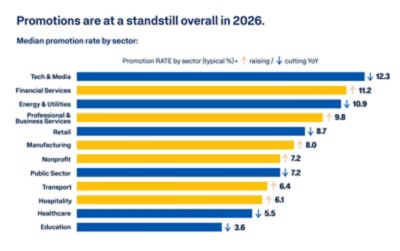
Promotions are a powerful workplace incentive for many workers and companies, second only to pay. But, they are a blind spot in official labor market data and an often-overlooked pulse on the dynamism of the job market.
In official labor market data, promotions only sometimes appear as job openings if the roles are posted publicly and are mixed into economy-wide wage gains, but they almost never show up in the official government payroll numbers. Almost no official data set reports them separately.
Workday data show promotions are becoming less common in industries where promotion rates were high in the past—most prominently in tech and media, but also in energy and utilities and in retail. Meanwhile, promotions are becoming more common in financial services and in professional and business services. We’re also seeing higher promotion rates in small- and mid-sized businesses (SMBs).
It’s possible that companies feel less urgency to promote employees in a softer labor market, or perhaps an AI-driven flux in job responsibilities make formal promotions less of a focus. Regardless, this important workplace incentive is becoming less common—and economists should expect spillover into wage gains and job tenure.
One source of noise in the job market has been a shift in how some candidates apply to open jobs. The proliferation of consumer AI tools have made it easier to customize resumes and cover letters, leading applicants to apply to more jobs than they could in the past. By some accounts from both job candidates and hiring companies, the labor market is congested rather than imbalanced.
Workday data offers support for this idea, but the story is more nuanced. The industries with the sharpest rise in applications per offer are in tech and media (+40.4% YoY), nonprofit (+37.4%) and financial services (27.2%). These are also industries where job seekers lean on AI the most. Meanwhile, in retail (-1.1% YoY), the public sector (-4.5% YoY), and education (-6% YoY), Workday data shows declines in the number of applications per offer. In other words, the “congestion” story of the job market is not universal.
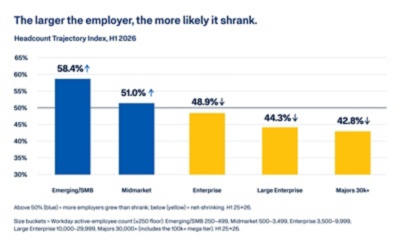
The BLS monthly jobs report does not publish payroll gains by company size, but there’s a growing body of data suggesting that small, medium and large businesses are on different headcount trajectories.
Workday data show that the larger a company’s payroll was, the less likely it was to be growing its headcount. Companies with 250-499 employees were most likely to have growing payrolls while companies with 30,000-plus employees were least likely to be growing their payrolls.
(The Census Bureau’s Quarterly Census of Employment and Wages reports employment by company size, though with a 5 to 9 month reporting lag. Workday data does not cover businesses with fewer than 250 employees.)
The fact that smaller companies are leading a recovery is a marked shift. For the past few decades, large companies have been a reliable bellwether for economic conditions in the entire market.
The signals that economists and businesses from Wall Street to Capitol Hill to Main Streets across the United States have long relied on to inform their decisions are becoming more difficult to read.
As the enterprise AI platform for HR, finance and IT, Workday has a unique capacity to shed light on otherwise hidden or overlooked corners of the labor market. On balance, it shows a labor market where high-level data increasingly miss the real decisions that businesses are confronting and the real experiences of individual employees.
Report

A gap between effort and impact is the real ROI problem. Discover the solution.