Audio also available on Apple Podcasts and Spotify.
It’s a Tuesday afternoon. Your inbox is clear, your reports are generated in seconds, and your AI assistant has scheduled your entire week. By every traditional metric of productivity, you’ve won. But perhaps, despite your cleared to-do list, you feel a nagging sense of isolation. You’ve had fifty digital interactions today, but not a single human connection.
There’s a lot of enthusiasm around what AI can do for work: faster answers, greater efficiency, new levels of productivity. In equal measure, there’s an underlying question: Are we designing workplaces that bring us together, or pull us further apart?
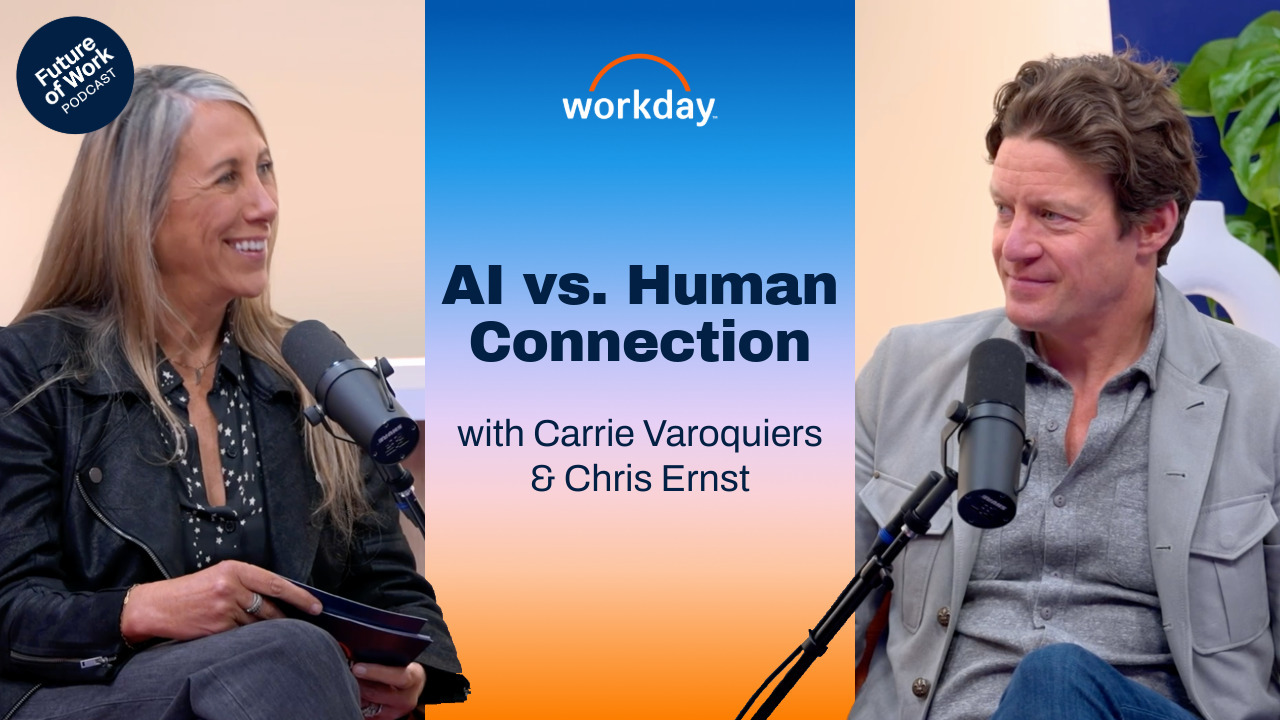
This tension guided a thoughtful conversation on the Future of Work podcast between Workday Chief Learning Officer Chris Ernst and Chief Philanthropy Officer Carrie Varoquiers. The two discussed how the real opportunity isn't just using AI to help us do more, it’s using AI to help us connect more.
Report
In a modern work environment often defined by technology and automation, the importance of human connection can be easily overlooked.
Varoquiers describes an ongoing “crisis of loneliness and disconnection.” This characterization is strongly backed by data, as Ernst points to research like Cigna’s Loneliness in America 2025 report, which found that loneliness remains pervasive throughout the population, with employees experiencing its effects in various ways.
Varoquiers notes that this issue is far from a minor HR concern: “It’s not as soft and squishy [as people think]. It [is] a bottom-line issue.”
Among the negative impacts: Workers who are lonely are more likely to miss work or seek new roles, and less likely to accomplish their work goals. From disengagement and attrition to reduced innovation, disconnection carries real organizational costs. Innovation, Ernst notes, “thrives on connection and withers without it.”
When people feel isolated, ideas stall; when they feel connected, creativity compounds.
Given these stakes, leaders should be categorizing human connection as a strategic priority. It’s hard work, but that’s a good thing.
“Innovation thrives through connection, and it withers through disconnection.”
—Chris Ernst, Chief Learning Officer at Workday
AI is remarkably good at delivering answers—often the very one we need, in an instant. But there’s a flip side to the speed and convenience.
Varoquiers points out that bypassing the "struggle" of finding an answer can shut down collaborative opportunities. She notes that we learn deeply from colleagues when "thrown together on a project that's cross-functional," learning not just about the task but about the business as we innovate across divides. "If I go to AI and just get the answer immediately, I'm kind of losing that opportunity," she warns.
“It’s those moments of challenge and struggle where we learn, grow, and connect the most,” Ernst adds.
When AI removes every bit of friction, organizations risk losing the very experiences that build capability and confidence. This doesn’t mean leaders need to slow down adoption, but they should be intentional about how AI shows up in the flow of work.
To offer a practical model for intentional design, Ernst references a well-known learning framework: 70-20-10. It posits that roughly 70% of learning comes from experience, 20% from relationships, and 10% from formal instruction.
Through the 70-20-10 lens, it’s easy to see how much can get lost in an ask-and-receive exchange with an LLM. Studies like this one from the MIT Media Lab, suggesting that over-reliance on AI solutions may contribute to cognitive atrophy and erode critical thinking skills, only serve to hammer this point home.
“If we think that the ultimate aim of AI is just to help us do another 10 things on Thursday, we've missed the opportunity,” explains Ernst. “The real opportunity is how AI can elevate all of us together to do amazing things: to learn, to lead, to create, to problem-solve.”
AI shouldn’t collapse learning into a purely transactional exchange. Instead, it should:
When AI applications are designed this way, you can mitigate the risks and maximize the opportunity for human growth.
At Workday, some of the most successful AI initiatives were shared experiences: prompt-a-thons, games, team challenges, and town halls where employees tell their own AI stories.
These methods are not only helping employees connect with one another, but also with new opportunities. Another conduit is the AI-powered “gigs” marketplace, which matches employees to projects where their skills can be helpful, even outside the scope of their normal role.
“It really stretches workmates to get out of their comfort zone, to work on a problem in a different part of the company,” Ernst says.
He breaks down the data to show how these experiences are mobilizing the workforce and opening new doors. Over 18 months, more than 5,000 employees have participated in a gig; this group saw a 42% increase in internal mobility compared to non-participants, and a 33% reduction in attrition.
“The real opportunity is how AI can elevate all of us together to do amazing things: to learn, to lead, to create, to problem-solve.”
—Chris Ernst, Chief Learning Officer at Workday
Efficiency gains are important. No one disputes that. But Ernst challenges leaders to widen the lens.
“We shouldn’t just ask how AI helps us do more,” he says. “We should ask how it helps us connect more.”
You can’t automate your way to innovation, so the real focus should be on using AI to unleash the capabilities of people and maximize their talents. Productivity gains only matter if they create space for the kind of work that drives real impact: thinking, collaborating, and strategizing as a team.
In an increasingly lonely world, let’s treat AI as a solution rather than the problem.
On average, 27% of employees are at risk of burnout—decreasing overall engagement levels and increasing the probability of turnover. Download this report to address organizational burnout at the source.
Report