August Is the Top Month For Quitting Your Job
New Year, new job? Not so fast. Workday data reveals a late-summer resignation spike—and how to tell a seasonal rise from a real risk.
Ross Brooks
Senior Research Writer
Workday
New Year, new job? Not so fast. Workday data reveals a late-summer resignation spike—and how to tell a seasonal rise from a real risk.
Ross Brooks
Senior Research Writer
Workday
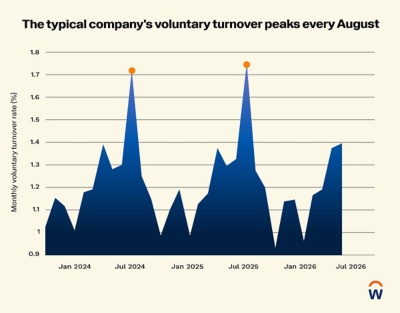
More people quit their jobs in August than any other month of the year, according to Workday data, a pattern that holds across every industry. Even accounting for seasonality, the August quit rate for the typical firm runs about 47% above the rest of the year.
Employees are least likely to quit in February, with November close behind. From there, the year builds gradually. A slow climb through spring into a broad summer plateau across May, June and July, before the sharp August peak—then a quick fall back through the autumn.
Despite the narrative that the new year is the best time for a fresh professional start, Workday's analysis found no January bump at all.
Despite the narrative that the new year is the best time for a fresh professional start, Workday's analysis found no January bump at all. The real surge comes seven months later.
That pattern can be easy to miss labor market headlines, which typically focus on seasonally adjusted data. But for people leaders planning hiring, succession and retention, the unadjusted rise still creates a real and predictable operational challenge.
In August 2025, the close of summer marked a voluntary job change for roughly 1 in 57 employees at the typical company. The late-summer spike appears year after year, which begs the question: When does a seasonal rise become a genuine retention concern?
Report
“The most plausible explanation is likely a human one,” said Dr. Liz Pavese, Workday’s Workplace Psychologist. “A decision to leave rarely happens overnight—it builds quietly over months, through small frustrations and passing thoughts. What people wait for is a natural finish line before they act: the bonus that finally lands, the school term that ends, the vacation that's been in the calendar since spring.”
"A decision to leave rarely happens overnight — it builds quietly over months, through small frustrations and passing thoughts."
Dr. Liz Pavese
Behavioral scientists like Pavese call these "temporal landmarks"—moments like a new season or a return from leave that psychologically separate the old chapter from the new, and make people far more likely to act on a change they've been mulling.
The summer break is one of the most powerful of all. In fact, studies of holidays show they lead us to reflect on our lives, but not on the first day back from vacation. Rather, the holiday effect happens around two weeks later—just long enough for a vague "maybe" to harden into a firm "now." So departures that took shape slowly, in ones and twos across the first half of the year, surface together in a single late-summer wave.
Employee motivations are often structural as well as personal. Annual bonuses and equity often vest early in the year, giving employees a clear incentive to wait until they've collected before moving on. And the pull matters as much as the push—hiring budgets often refresh at the start of a fiscal year, so roles opened in spring turn into offers accepted over the summer.
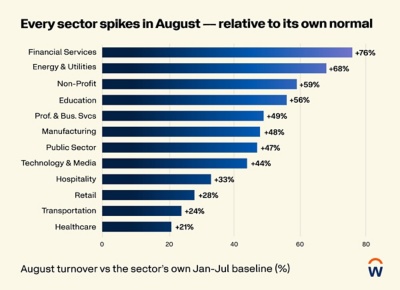
The August effect shows up across industries, although baseline rates of employee departures vary.
Measured against each sector's own normal, the lift appears everywhere—a modest bump in already-churny Healthcare and Retail, a jump of two-thirds or more in steadier sectors like Financial Services and Energy & Utilities. A turnover rate that would be alarming in Manufacturing is an ordinary Tuesday in Hospitality.
For people leaders wondering whether the annual August exodus represents a problem, read the August result against three comparisons:
1. Compare August with August. Start with the same month last year, not the previous month. A July-to-August jump probably reflects the annual pattern; an August-to-August increase is more likely to mean your underlying position has changed.
2. Adjust for the workforce. Compare against employers in a similar industry and, where possible, a similar workforce profile. A single global average hides large structural differences between sectors.
3. Look beneath the company-wide rate. A familiar headline can still conceal a real local problem. Check whether departures are concentrated among high performers or critical roles, recent hires, a particular function or location, a tenure band, or a single manager's team. A seasonally normal headline shouldn't override evidence that the wrong people are leaving.
Seasonality should only change the first question companies ask—it shouldn't become an excuse for complacency. An August rise still deserves escalation when:
It's materially larger than last August's increase.
It starts earlier, or lasts longer, than the normal seasonal window.
The rate stays elevated after the usual peak.
Departures concentrate in high-value or hard-to-replace roles.
One team, location or group is moving sharply against the company-wide pattern.
Exit feedback points to a common, preventable cause.
Other signals — promotion, internal mobility, engagement — are deteriorating at the same time.
That's the line between a predictable operational event and a genuine retention warning. The former you plan for; the latter you act on.

The August spike tempts you to overreact. The quiet months tempt you to do the opposite—to read low turnover as a healthy, happy workforce. Both are misreads of the same number.
Some argue the market is in a phase of "job hugging"—people staying put not because the work is going well, but because moving feels too risky. A turnover rate alone can't tell you which it is. A low, steady quit figure could reflect a contented workforce or a stuck one.
Peakon employee-sentiment data shows a quiet divergence. People are staying, but they've grown less likely to recommend their employer as a place to work. Loyalty, in other words, is holding—but advocacy is softening. It's a small signal, and we'll say more about it in our upcoming Global Workforce Report, but it's a useful reminder that a calm turnover number can sit on top of a workforce that's staying without thriving.
The number worth watching isn't the August spike; it's why your people are staying the rest of the year—and a turnover rate won't tell you.
That's the deeper point. The number worth watching isn't the August spike; it's why your people are staying the rest of the year—and a turnover rate won't tell you. So the most useful response to a calm figure isn't relief or alarm. It's a better question: are people staying because they want to, or because they feel they can't leave yet? Answering that requires the things a rate can't see—engagement, exit conversations, what your best people say when you ask.
Getting the diagnosis wrong carries a cost either way. Read a seasonal rise as an emergency and it's easy to over-invest—an unplanned retention budget, counteroffers, a task force spun up to chase what was only ever noise. Treat every August rise as harmless and you may miss a real problem hiding beneath the aggregate.
The better approach is to prepare early and diagnose carefully:
Front-load stay conversations. Hold career and growth conversations in the first half of the year, while managers can still act on what they hear. By the time a departure is recorded in August, the decision may have been forming for months.
Bring pay and progression decisions forward. Where business cycles allow, position reward and promotion conversations before the summer window. People shouldn't have to resign to get clarity about their future.
Use spring as an early-warning system. Watch engagement, internal applications, promotion activity and regrettable turnover through Q2—they reveal pressure before it reaches the resignation rate.
Plan operationally for August. Even predictable turnover creates work. Identify vulnerable roles, strengthen succession plans and account for recruitment demand before the peak.
The August resignation spike is real. A familiar seasonal rise should prompt analysis, not panic. If it's consistent with your history and broadly distributed, plan for it; if it's larger, more persistent or more concentrated than usual, investigate. Either way, the most effective retention work begins before the resignation letter arrives.
Methodology: Monthly voluntary turnover is voluntary terminations divided by average active headcount, across matched employers with at least 50 employees. Global figures are equal-weighted by industry. Employers with persistent all-zero termination records are excluded as likely incomplete reporting. The analysis covers 2024 and 2025, and identifies a repeated seasonal pattern within that period. Figures are not seasonally adjusted.
Report