AI Literacy as the New Operating System for HR
AI success depends less on tools and more on helping employees build the confidence and understanding to use them effectively.
Emily Faracca
Multimedia Content Writer
Workday
AI success depends less on tools and more on helping employees build the confidence and understanding to use them effectively.
Emily Faracca
Multimedia Content Writer
Workday
If you’re ever traveled to another country where you don’t speak the native language, then you know what a confusing and isolating experience it can be. You might struggle to ask for directions to the coffee shop, let alone order your preferred beverage when you get there.
It’s enough to make the most intelligent and capable person feel helpless.
For many employees, working in the age of rapidly advancing AI can feel similarly disorienting. New tools, new terminology, new expectations, new workflows—and it’s all arriving at a pace few organizations are fully prepared to absorb.
“It really is a lot,” says Kyle Lagunas, founder and principal analyst at Kyle & Co. “Especially for functions like HR, which are not normally super adaptive and not super change-ready. And so I think it's creating a lot of friction for our friends. I know that it's creating a lot of stress and anxiety for people that are in my direct network.”
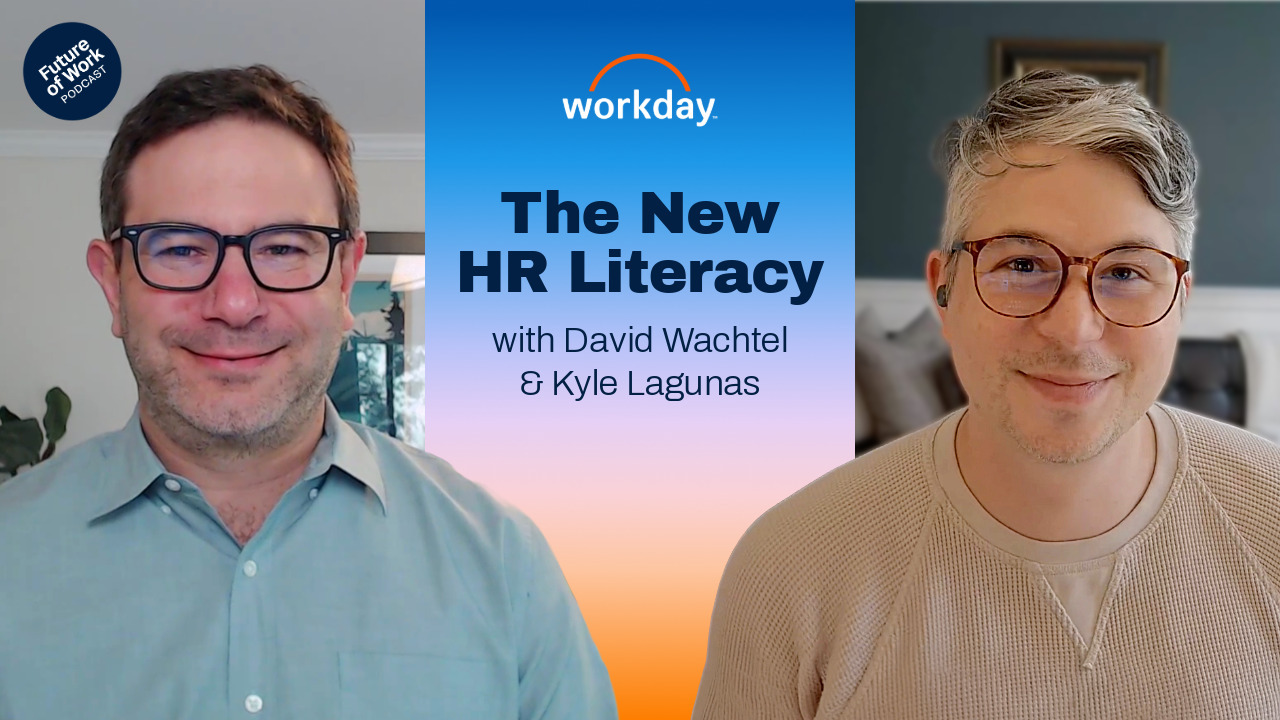
In a conversation with David Wachtel, general manager of HCM products at Workday, for the Future of Work podcast, Lagunas shared his perspective on why HR leaders need to focus on developing a shared language, context, and understanding that enables teams to thrive.
Report
Workday’s Global Enterprise AI research reveals that a staggering 83% of employees report having busy days with little to no real progress. This "productivity mask" is often a symptom of structural friction: 62% of workers now spend half their time or more coordinating between disconnected systems and teams, essentially functioning as human APIs rather than focusing on high-value work.
“If you're an HR leader being asked to move at the speed of AI, but you're watching AI pilots stall despite your team citing higher productivity, you might not have a technology problem,” says Wachtel. “You might have a literacy problem".
Indeed, there’s a difference between deploying AI and operationalizing it. The research shows that while 83% of employees feel the pressure to work faster, over 4 in 10 do not agree that this speed leads to improved outcomes. Literacy is the missing link that moves an organization from mere activity to actual efficacy.
The good news? HR is taking action to address the underlying system rigidity that hinders change. Workday's findings indicate that 87% of employees agree that AI increases their confidence when they can trust the underlying system and data.
“HR is responding to immense pressure from business leadership to find every path to better, bigger business outcomes through the utilization of AI,” Lagunas observes.
“If you're an HR leader being asked to move at the speed of AI, but you're watching AI pilots stall despite your team citing higher productivity, you might not have a technology problem. You might have a literacy problem.”
- David Wachtel, General Manager, HCM Products at Workday
Imagine again you’re that traveler, standing on a crowded street corner in an unfamiliar city. You don’t need to be fully fluent in the language to interact with people and find your way around. You just need to have a solid grasp on the language and cultural norms.
The same goes for navigating AI in business. Advanced technical mastery takes a back seat to fundamental understanding that enables confident participation in decision-making. Think along the lines of financial literacy or digital literacy, which are not the same as specialization.
“We don’t have to be experts,” Lagunas explains. “We have to be AI literate, and that way we can be a part of the conversation with our colleagues who are in legal and compliance and privacy and in IT.”
The lowering of communication barriers grows more important as AI moves from a standalone productivity tool into a force shaping how organizations operate. HR leaders are now being asked to help guide governance, workforce planning, skills development, and change management efforts tied directly to AI adoption.
Without a shared language and understanding, it becomes difficult to contribute meaningfully to those discussions, much less lead them. And that’s why literacy is so critical. It builds confidence. It creates alignment. Most importantly, it instills trust.
“People don’t trust things that they don’t understand,” Lagunas notes.
“We don’t have to be experts. We have to be AI literate, and that way we can be a part of the conversation with our colleagues who are in legal and compliance and privacy and in IT.”
- Kyle Lagunas, Founder and Principal Analyst at Kyle & Co.
If AI is transforming how work gets done and becoming the new “business grammar,” then literacy is what determines whether people can actually participate in that transformation.
As such, AI literacy is increasingly an operating system for modern work. Not a technical layer, but a foundational one. It shapes how employees interpret information, collaborate across functions, and make decisions in environments where AI is embedded into everyday workflows.
Organizations that recognize this shift are starting to treat literacy less as a training consideration and more as a pillar of infrastructure. They’re embedding AI into team conversations, encouraging hands-on experimentation, and creating space for employees to ask questions without fear of getting it wrong.
“What I have seen that has been working really well,” says Lagunas, “is HR leaders doing something as simple as requiring any team meeting, whether it is the CHRO's town hall or it's a group meeting for a project, AI has to be on the agenda. And quite literally, that just means that somewhere on that bulleted list of things to cover, someone's gonna say something about AI and somebody might share how they're using it.”
The companies seeing real value from AI aren’t necessarily the ones with the most advanced tools. They’re the ones where people understand how to use those tools, where to trust them, and when to challenge them.
As technology evolves, you need your people to evolve with it. That starts with making AI literacy the standard.
Four in five employees still suffer from process stress even in organizations actively scaling AI. Download this report to discover insights from 6,100 global professionals on why task-oriented AI is failing the enterprise.
Report