4 Types of Business Funding for Growth
How a business is funded matters just as much as the amount it raises. Explore the top four types of funding and how to choose the right one for growth.
Blaise Radley
Editorial Strategist
Workday
How a business is funded matters just as much as the amount it raises. Explore the top four types of funding and how to choose the right one for growth.
Blaise Radley
Editorial Strategist
Workday
Securing capital is one of the most consequential decisions a business makes. Funding determines how quickly a company can grow, how financial risk is distributed across the organization, and how much flexibility leaders have to pursue new opportunities.
In 2025, global corporate debt issuance reached a record high $13.7 trillion, underscoring just how central debt financing has become to business growth strategies.
But raising capital isn’t a one-size-fits-all process. How a business raises funds can shape its trajectory as much as the amount raised. Different types of business funding can influence cash flow ownership, governance, obligations, and long-term strategic flexibility in distinct ways.
Report
Global corporate debt reached a record high $13.7 trillion in 2025—underscoring how central financing has become to growth strategies.
Once a business determines it needs to raise capital, the focus shifts to how to get funding and what methodology to follow. Some funding relies on internally-generated resources, and other models use lenders or investors.
Research shows a balanced prevalence for both internal and external sources, with about a quarter using external lenders and 34% leaning on internal funding options.
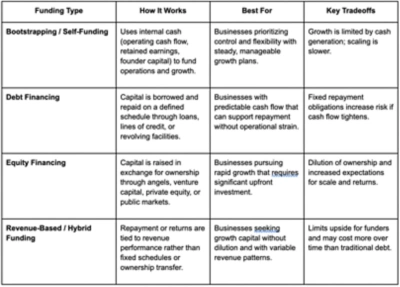
The key difference is the mechanism through which capital flows into the business, whether through borrowed funds, retained earnings, ownership stakes, or revenue participation. The four most common types of funding models businesses use are:
Bootstrapping and self-funding
Debt financing
Equity financing (raising capital)
Bootstrapping (or self-funding) relies on internally generated cash—such as retained earnings, operating cash flow, or founder capital—to fund operations and growth. This approach preserves full control and avoids external obligations, but it tightly links growth to the business’s ability to generate cash.
Example: A professional services firm expands headcount gradually, adding capacity only as revenue grows. The business maintains flexibility and full ownership, but growth moves at the pace of cash generation. Risk stays low, while rapid scale remains constrained.
Debt financing provides capital that’s repaid on a defined schedule, typically through bank loans, lines of credit, or revolving facilities. It works best when cash flow is predictable enough to support repayment without limiting day-to-day operations.
Example: A manufacturer secures a line of credit to purchase inventory ahead of a seasonal sales spike. The debt bridges the timing gap between production costs and customer payments, then is repaid as revenue comes in, allowing the business to retain ownership while taking on manageable repayment obligations.
Choosing the right funding model is a decision about what the business can—or is willing to—trade in exchange for capital.
Equity financing involves raising capital in exchange for ownership, often through angel investors, venture capital, private equity, or public markets at scale. This model shifts risk away from near-term cash flow and toward long-term business performance.
Example: A software company raises venture capital to fund product development and market expansion. The new capital enables faster growth than internal cash could support. Short-term cash pressure ease but expectations for growth and scale increase significantly.
Revenue-based and hybrid funding models sit between debt and equity. Repayment or returns are tied to revenue performance rather than fixed schedules or ownership transfer.
Example: A subscription-based business uses revenue-based financing to fund marketing investment. Repayment scales with revenue, allowing for growth without dilution or rigid repayment terms, while still capping upside for the funder.
Choosing the right funding model is a decision about what the business can (or is willing to) trade in exchange for capital. It also shapes how to manage business cash flow as the company grows. Some models require fixed repayment. Others reduce founders’ ownership. Others preserve control but limit how quickly a business can scale.
The best path depends on which tradeoffs the company is positioned to absorb at its current stage. When evaluating funding options, business owners should consider:
Cash flow predictability: Businesses with stable, recurring revenue can typically support debt repayment schedules. Companies with uneven or early-stage revenue are better suited for equity or revenue-based models that don’t require fixed payments during growth periods.
Capital intensity of the growth plan: Debt is often better suited to investments with clear timelines and payback periods (e.g. building infrastructure), while equity is usually a better fit for longer-term growth initiatives (e.g. market expansion) where returns may take more time to materialize.
Tolerance for ownership dilution: Equity financing introduces new stakeholders who share in governance and decision-making. Founders who want to retain control may prefer debt or bootstrapping, even if growth happens more gradually.
Risk distribution: Debt concentrates risk in near-term cash flow through repayment obligations, while equity distributes risk across investors who will benefit only if the business grows successfully.
Future financing flexibility: Every funding decision affects the next one. Heavy debt can limit borrowing capacity later, while certain equity structures complicate future investment rounds or exits.
A strong funding decision matches the structure of the capital to the realities of the business—an alignment that’s crucial to future stability. When it’s wrong, costs show up later in repayment pressure or limited strategic options. But when it’s right, businesses are positioned to grow without constraining cash flow or future opportunities.
Unbalanced budgets lead to missed goals and lost opportunities. Achieve a 'just right' budget that motivates teams and protects your business by downloading this whitepaper.

Report