A Guide to the 5 Stages of Business Growth
Growing a business successfully requires more than increasing revenue—it demands intentional leadership, scalable technology, and sharp market insight.
Blaise Radley
Editorial Strategist
Workday
Growing a business successfully requires more than increasing revenue—it demands intentional leadership, scalable technology, and sharp market insight.
Blaise Radley
Editorial Strategist
Workday
Every company—from brand new startups to global enterprises—goes through recognizable business growth stages. And they’re not just about increasing revenue. At every stage, growth brings on new leadership priorities, operational complexity, and more critical decisions.
The U.S. Small Business Administration estimates that about half of small businesses fail within their first five years, and about 65% by their tenth year of operation, often because they struggle to adapt as they move on from one growth phase to the next.
That’s why it’s crucial to understand the inevitability of each growth stage and how to navigate it with intention. This guide breaks down the five most important stages of the business life cycle, what to prioritize to succeed, and how to prepare effectively for what’s next.
Guide
More than half of small businesses fail in their first 5-10 years—often because they don’t adapt as they grow.
Any business, big or small, goes through different periods of growth, stability, and decline. Understanding how to change your business growth strategy to meet the new challenges each development presents is the key to maximizing growth.
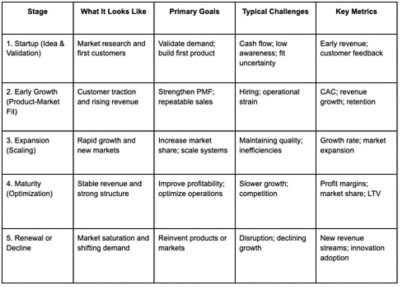
These are the five most significant stages of business growth:
Startup: Idea and validation
Early growth: Finding product-market fit
Expansion: Scaling the business
Maturity: Operational optimization
Renewal or decline: Reinvent or plateau
The startup stage is defined by market research and the quest for a viable business model. At this point, the company typically has limited resources and a small customer base.
Primary Goals: The focus is on market validation to ensure there is actual demand for the business idea. Founders work to build their first product or service and establish a business plan for the future.
Typical Challenges: Cash flow is often the biggest hurdle, alongside limited market awareness and the uncertainty of whether the product truly fits the market.
Key Metrics: Success is measured by early revenue, direct customer feedback, and market validation signals.
In the early growth or startup phase, the business begins to see real customer traction. Revenue starts increasing, and the entrepreneurial team slowly begins to expand to meet demand.
Primary Goals: Companies aim to strengthen product-market fit and build repeatable sales processes to expand their customer base.
Typical Challenges: Scaling operations becomes a priority, which requires hiring the right people and managing rapid organizational change.
Key Metrics: Focus shifts to customer acquisition costs, consistent revenue growth, and retention rates.
The expansion stage is characterized by rapid growth and entry into new markets. Demand is strong, but the growing company faces significant operational complexity.
Primary Goals: The objective is to increase market share, launch new products, and build long-term, scalable systems and processes.
Typical Challenges: Maintaining quality while scaling is difficult. Operational inefficiencies often surface as resource management becomes more complex.
Key Metrics: Leaders track the revenue growth rate, the long-term success of market expansion, and overall operational efficiency.
Mature businesses have a stable market presence and established market share. At the maturity stage, revenue is consistent, and the company usually has strong organizational structures in place.
Primary Goals: The focus shifts from rapid expansion to improving profitability and optimizing existing operations. Companies look to reinvest in their competitive advantages.
Typical Challenges: Growth naturally slows down, and the business may face increased competition and internal resistance to change.
Key Metrics: Vital signs include profit margins, market share, and customer lifetime value.
In the final phase of the business life cycle, a company reaches market saturation. Demand may drop due to changing consumer preferences, leading to a potential decline if the business does not innovate.
Primary Goals: To avoid a plateau, the company must reinvent its business model, enter entirely new markets, or launch innovative new products.
Typical Challenges: Competitive disruption and declining growth are major threats.
Key Metrics: Success is found in innovation adoption, new revenue streams, and maintaining market relevance.
Diagnosing your current growth stage requires an honest look at your company's internal health and market position. Use the following framework to assess your maturity:
Revenue Growth Patterns: Is your revenue non-existent (Stage 1), increasing rapidly (Stage 3), or stabilizing (Stage 4)?
Customer Base Maturity: Are you still searching for your first customer base, or do you have a loyal, predictable following?
Organizational Structure: Is the founder still making every decision, or do you have formal organizational structures and department heads?
Operational Complexity: Are processes informal, or have you invested in cost-effective, scalable systems?
Capital Requirements: Are you seeking seed stage investment, or are you generating enough profitability to reinvest internally?
Once you’ve answered these questions, you should be able to spot clear patterns, whether you’re still proving demand, scaling what works, or shifting from growth at all costs to sustainable performance. The goal isn’t to “graduate” as fast as possible from one stage to the next but to align your priorities with the reality of where the business is at this moment.
Correlate the answers you find with the attributes laid out in the table above. When you’re honest about your stage, it becomes much easier to choose the right hires, systems, and targets for your business as it currently is without looking backward or too far ahead into the future.
Growing a business is never a linear path. It demands the ability to pivot quickly as things change and be flexible in the face of new market demands and challenges. These best practices help business owners scale with momentum without losing long-term direction or control.
Align Leadership Structure: As a business grows, founders have to shift from doing to leading. Their role requires less hands-on work and more focus on putting systems and structures in place so the business can run without their direct sign-off. Assign accountable leaders for each function and establish a regular cadence for priorities and metrics. When leadership structure evolves at the right time, growth becomes repeatable.
Invest in Scalable Systems: Manual processes can break down gradually through missed handoffs, inconsistent follow-up, and a growing number of exceptions. To avoid this, invest in scalable systems early—like ERP, CRM, or HRM systems, ideally within an integrated platform that connects your data and workflows across teams and functions.
Reinforce Financial Discipline: Growth creates more decisions, and most of them carry financial implications. As headcount rises and costs become less flexible, financial discipline helps leaders manage expansion with confidence. In all stages, be sure to track cash flow closely, maintain clear visibility into profitability, and evaluate major hires, investments, or acquisitions against realistic financial scenarios.
Monitor Market Signals: Scaling requires continuous awareness of market conditions. Competitor moves, shifting customer expectations, and changes in demand can all influence growth plans quickly. Review sales pipeline health, customer feedback, and competitive activity on a regular basis to stay informed. Leaders who monitor these signals in real time can quickly pivot to address risks or pursue opportunities as they emerge.
Growth doesn’t reward a fixed playbook; it demands prioritizing what the business needs now while staying ahead of the next inflection point.
Growth doesn’t reward a fixed playbook. Tactics that helped you validate demand won’t necessarily carry you through scaling—and the processes that worked at 10 customers can strain (or snap) at 1,000. The important work is staying ahead of the next inflection point, before growth forces rushed decisions.
That starts with an honest diagnosis of your current stage, then matching your priorities to what that stage actually requires: leadership that can delegate and decide fast, systems that create consistency as volume rises, and financial discipline that keeps your expansion sustainable instead of fragile or reactive.
Just as crucial, keep looking outward. Markets shift, competitors adapt, and customer relationships evolve—sometimes faster than internal plans. When you combine stage awareness with long-term strategic planning, you stop reacting to growth and start steering it, making today’s decisions easier to scale tomorrow.
The number 1 priority for SMBs globally is increasing technology investments—but why? Explore this SMB Group report for key insights on how unified finance and HR systems are helping streamline operations and drive growth.

Guide