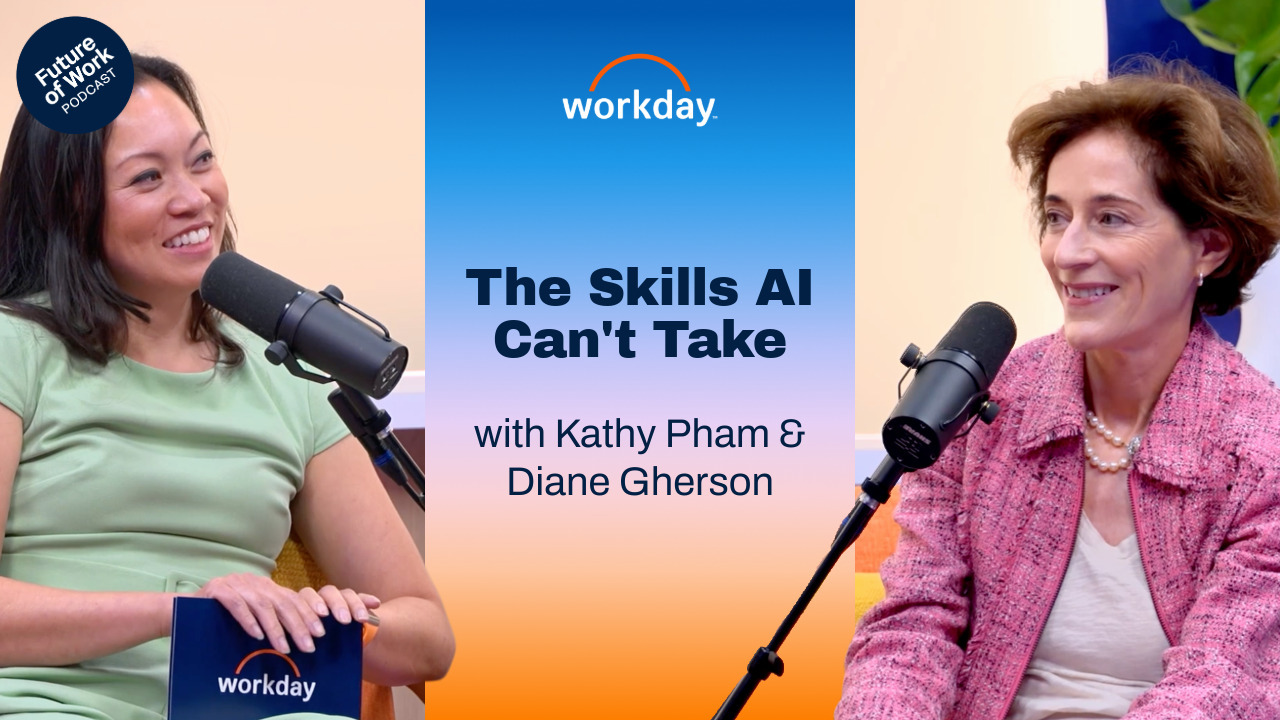
Audio also available on Apple Podcasts and Spotify.
If you spend any time in conversations about AI and work right now, you can feel two emotions intermingling: excitement and unease.
On the one hand, AI is taking on tedious tasks and giving people back something priceless: time. On the other hand, there’s a very real question hanging in the air: What happens to my job in all of this?
Workday’s vice president of AI and open technology Kathy Pham sat down with Diane Gherson—former CHRO at IBM, and one of the first leaders to bring AI into HR at scale—to explore that tension.
What emerged was a hopeful, clear-eyed vision for how we can design work in the age of AI so it becomes more meaningful, not less.
Report
Gherson has been living this journey for nearly a decade. When she first introduced AI at IBM back in 2015, the benefits felt straightforward.
In her words, this first phase of AI has been about work augmentation: the tedious parts of our jobs get automated, and “you get to spend more time on the stuff that you enjoy.” Employees gain reflection time, more agency, and a chance to use their skills in different ways. “All of those things are good,” she notes.
But she also gives voice to the question many people are quietly asking themselves:
“This is a lovely period that we're going through, but are we going to be replacing my job? And what does that mean for me?”
As Pham notes, “research at Workday reveals as people gain direct experience with AI, their trust with the technology significantly increases.” However, for Gherson, that trust relies on leaders being explicit—providing a level of clarity and transparency that opens the door to more ambitious uses.
“We need to be really clear about, why are we using AI? What are the business problems we're trying to solve with it?” she says. “And be transparent about what that means for jobs.”
If you want AI to elevate work, Gherson says, invite people into the redesign.
“It's sitting down with them and saying, let's look at how the work is getting done and let's capture where things aren't going as well as they should.”
She shares an example from Zapier, where leadership connected directly with customer service reps to figure out how AI could help them scale. It turned out the biggest bottleneck wasn’t in customer service at all—it was in how those reps interacted with the engineers building the product. By changing the workflow (including putting an engineer on call), they improved their Net Promoter Score and found better ways to use AI.
“We need to be really clear about, why are we using AI? What are the business problems we're trying to solve with it? And be transparent about what that means for jobs.”
- Diane Gherson, Former CHRO, IBM
Stories like this show the value of taking a step back. When looking at the broader flow of work and not just a single job description, you unlock very different solutions.
“In the end,” Gherson says, “you get a higher-performing company, but you also get jobs that are more meaningful.”
That sweet spot—the intersection between better outcomes and more fulfilling work—is where every organization should be setting their sights.
To contextualize the gravity of our current moment, Gherson calls back to the early 20th century, before the rise of factories and industrialization. Back then, she explains, craftspeople worked in guilds. One person might make an entire shoe from start to finish. They learned as an apprentice, took pride in their craft, and owned the final product.
Then came Frederick Winslow Taylor and scientific management. By breaking work into microtasks and standardizing every motion, Taylor helped usher in the assembly line. And with it, a profound trade-off: “Jobs that lost meaning, jobs that lost pride, jobs that lost identity.”
These lessons of the past weigh heavily for AI leaders like Gherson, who urges a mindful approach to navigating AI’s impact on white-collar work. She expresses concern that so many entry-level jobs being created today are focused on “babysitting AI”: prompting, labeling, auditing.
“All of these things aren't necessarily what someone went to college to do,” Gherson says.
“Is that deepening their mastery as professionals? Is it preparing them for leadership roles?”
To avoid repeating these kinds of trade-offs of the industrial era, Gherson argues we must fundamentally alter our approach: “We've got to rethink the architecture of work because it was designed for a different era. We need a methodology to do that. We need principles. We need agreement on how we're going to go about making the change.”
The power of AI opens up a world of possibilities for reimagining work in the next decade. In their conversation, Pham and Gherson zeroed in on a few ambitious possibilities for convention-breaking steps forward:
The emerging role of Chief Work Officer, a leader who takes responsibility for designing work itself.
The evolution of middle management to a more strategic and relationship-centered focus.
Revisiting the paradigm of a five-day work week (itself a byproduct of industrialization).
“We've got to rethink the architecture of work because it was designed for a different era. We need a methodology to do that. We need principles. We need agreement on how we're going to go about making the change.”
- Diane Gherson, Former CHRO, IBM
Not so long ago, software development was completely reinvented by the Agile Manifesto. “That came because the waterfall approach to software development wasn't doing the work,” Gherson recalls. “It wasn't fast enough. It wasn't responsive enough to user concerns and so forth…Something like that could be happening in the world of the leader of work.”
It serves as a powerful precedent. As Pham points out, the Agile Manifesto isn't ancient history. It only emerged in 2001. Pham deems this as proof that we have the capacity to “come up with a totally new manifesto for design and AI systems that we build towards.”
For those ready to spearhead the charge, it’s an invigorating realization. AI empowers us to design work that is more humane, more creative, and more joyful. Just make sure you keep the boundaries clear and bring everyone along for the ride.
A remarkable 82% of organizations are already using AI agents. But is your team ready? Read our latest report to learn how businesses are maximizing human potential with AI, featuring insights from nearly 3,000 global leaders.
Report