Reclaiming Connection in an AI World: Insights from Workday CEO
AI is making employees more productive and confident—but is it also quietly eroding the human connections that make companies great?
Sara Braun
Editorial Strategist, HR
Workday
AI is making employees more productive and confident—but is it also quietly eroding the human connections that make companies great?
Sara Braun
Editorial Strategist, HR
Workday
Audio also available on Apple Podcasts and Spotify.
AI is undeniably boosting our productivity. But is it costing us our connection?
To explore this balance, the Workday Foundation launched the first Human Connection Workplace Index—a new biannual research study surveying 2,150 Fortune 500 employees globally on how AI is reshaping workplace relationships.
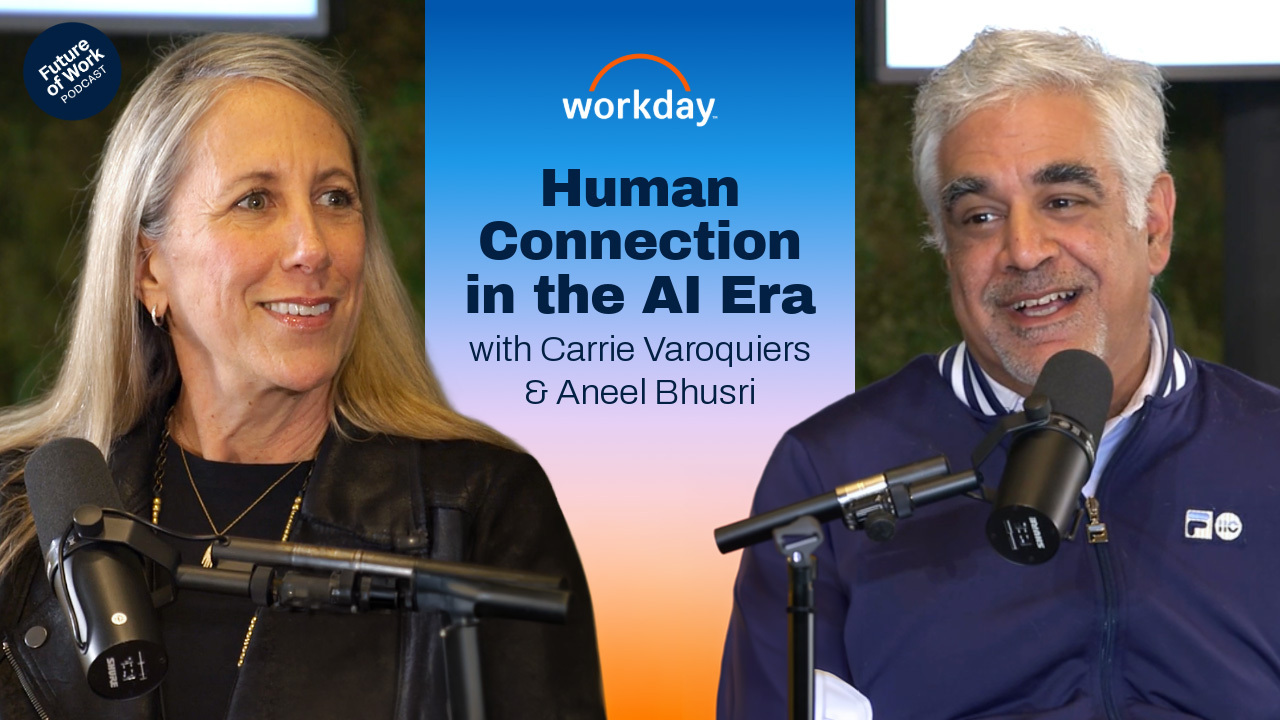
At the Human Algorithm Summit, Workday Chief Impact Officer Carrie Varoquiers sat down with Workday Co-Founder, CEO and Chair Aneel Bhusri to unpack what the data is telling us and what leaders need to do about it.
The biggest takeaway? The AI productivity boom is real—but the potential impact on human connection requires a serious closer look.
Report
Right now, the data seems to be pulling workers in two completely opposite directions. An overwhelming 86% of employees say that AI is making them more productive, and nearly two-thirds feel that it has increased their confidence to succeed in future roles. A majority of workers report that their stress levels and burnout risks have dropped since they started using AI, which points to a massive victory for workplace well-being.
However, that’s not the whole picture. We’re seeing some serious cracks form in the foundation of how teams engage.
Instead of bringing us closer, technology seems to be acting as a shield. More than a third of employees (37%) now prefer brainstorming with an AI agent rather than a human colleague, simply because they’re afraid of being judged. Workplace relationships are becoming strictly transactional, with a third of workers saying they rarely, if ever, have a conversation that isn’t strictly about a task.
We’re also avoiding the messy, necessary parts of human collaboration: nearly 30% of people would rather let an AI tool draft a response to a workplace conflict than just pick up the phone and talk it out. And for the youngest generation in the workforce, the isolation is real—21% of Gen Z respondents report feeling noticeably lonelier since AI tools were introduced.
"AI is delivering in really incredible ways," Varoquiers noted. "But there are also some major warning signs that are emerging, and we need to address them before they begin to impact our employees and the bottom line."

More than a third of employees (37%) now prefer brainstorming with an AI rather than a human colleague.
For Bhusri, tackling this issue begins by going back to one of the core principles Workday was founded on: employees are the foundation of every great company.
"When I think about all the great companies—past, present, future—they're all based on having a great employee culture," he said, citing research from Great Places to Work, which found companies with a strong employee culture consistently outperform the market. "It's not just the right thing to do. It's also good business."
His logic is simple, and worth repeating in the age of AI: You cannot have happy customers without happy employees.
"We've always had this belief you're in business to serve your customers,” he said. “But how many companies do you know that have unhappy employees and happy customers? The two just don't go together."
One of the most striking findings in the index is that workers are drawn to AI partly because it feels socially frictionless—it doesn't judge, interrupt, or disagree the way a colleague might. That's a feature. But it can also become a bug.
Bhusri brought up a classic Steve Jobs analogy that perfectly captures this tension. Jobs used to talk about how rough, jagged rocks only become smooth and polished by being tumbled together. Great ideas, Bhusri reminded the audience, work the exact same way—they require friction.
"People come together. Everybody's got a rough part of [an idea]. But over time, that idea gets polished by that human interaction. And that's where the best ideas emerge from… The best ideas do not come from talking to a prompt. They come from pushing each other to make better decisions."
The implication for leaders is nuanced. Not all friction is bad. Removing pointless friction—painful processes, low-value tasks, redundant communication—is exactly what AI should be doing. But human friction—the constructive, respectful push and pull between teammates—is where breakthroughs are born. Leaders need to protect it.
"The best ideas do not come from talking to a prompt. They come from pushing each other to make better decisions."
Aneel Bhusri
Co-Founder, CEO and Chair, Workday
If AI threatens connection in one direction, it democratizes knowledge in another.
"[AI] is unleashing all this knowledge," Bhusri said. When teams gather to debate a problem today, everyone arrives more informed than they would have just a few years ago. That raises the floor of every conversation.
But knowledge isn't judgment; judgment is earned through experience, context, and care for the people involved.
"If we look at AI in the right ways—where it's this leveler that gets everybody to the same level of knowledge—then we apply our human judgment and creativity to create something special,” he adds. “That's the best outcome for AI: it makes us all better."
For managers, the practical guidance is to be explicit with teams about where AI input is welcome and where a human voice is non-negotiable. For quick research, summarizing, code scaffolding, structured analysis, AI is often a great starting point. But the interpersonal aspects of work—performance feedback, conflict resolution, mentorship, culture-shaping decisions—still belong to humans.
Managers should be explicit with teams about where AI input is welcome and where a human voice is non-negotiable.
For executives weighing the cost-benefit of culture investments, Bhusri offered a clear-eyed business case.
"Without a sense of community, [work] is transactional. [Employees] will go to the next job where they can get something better on their resume or a little bit more money,” Bhusri said.
Bhusri argues that’s why fun is a core value at Workday—not a perk. From the early days of company-wideHalloween celebrations to the more than 100 unique employee-led work clubs spanning everything from boardgames to pickleball, the company’s culture is engineered to help people know each other as humans first.
"People that are tired and lonely and isolated and not having fun—they don't bring their best selves to work. It's that simple."
So how should leaders build AI into the workplace in a way that deepens connection rather than diluting it?
Bhusri's framework is honest about what we don't yet know—and clear about what we do:
The Human Connection Workplace Index is a baseline, not a verdict. It doesn't yet prove causality between AI use and loneliness.
But the directional message is already loud and clear: AI is making us more productive, more confident, and less burned out—and at the same time, it may be quietly making it easier to avoid each other. The leaders who win the next decade will be the ones who use AI to make more room for human connection, not less.
As Varoquiers put it in closing: "I use AI every day with joy and amazement. It's an incredible tool. But it can't replace the conversation that you and I just had."
That's the work ahead.
Report