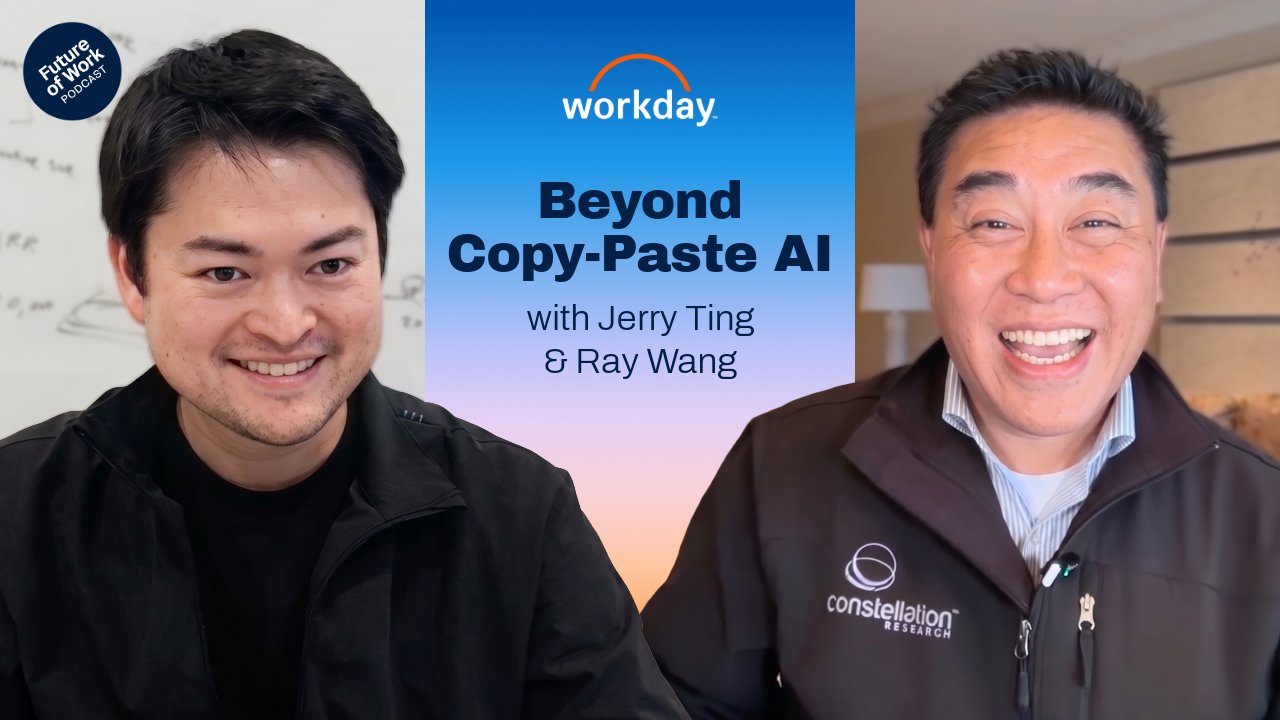
The Copy-Paste Economy Is Draining Your Workforce
On the Future of Work podcast, Constellation Research’s Ray Wang unpacks how disconnected tech swamps teams and drains budgets—and how to fix it.
Sydney Scott
Editorial Strategist, AI
Workday
On the Future of Work podcast, Constellation Research’s Ray Wang unpacks how disconnected tech swamps teams and drains budgets—and how to fix it.
Sydney Scott
Editorial Strategist, AI
Workday
Audio also available on Apple Podcasts and Spotify.
A staggering 97% of enterprise workers feel optimistic about AI. Yet thousands of employees lose eight hours every week simply copying and pasting data between separate applications.
Jerry Ting, co-founder of Evisort, spoke with Constellation Research founder, chairman, and principal analyst Ray Wang to examine this rising workplace friction on a recent episode of the Future of Work podcast. Their conversation highlights a costly enterprise reality uncovered by our latest research, The Copy/Paste Economy: How Task-Based AI Is Failing The Enterprise.
Disconnected AI tools create digital chaos, strain employee bandwidth, and burn cash without delivering real productivity gains. Instead of completing high-value tasks, workers waste critical hours making software talk to software.
Wang sums it up simply: “AI without productivity is just more cost.”
“AI without productivity is just more cost.”
Ray Wang
Founder, Constellation Research
Report
Years ago, executives asked staff to research market trends and waited two weeks for answers. Today, automated agents bring back responses in seconds.
That speed sounds like a win—until you consider what happens next. Employees are now expected to process and act on results instantly, but they're still working in the same siloed, disconnected tools as before. The tools got faster; the workflows didn't. So instead of saving time, teams are buried under a constant stream of outputs they don't have the systems in place to handle.
Wang compares this to a runaway "reply all" email thread—an avalanche of notifications and tasks with no way to keep up.
“That's what all workers are feeling at the moment. They're now doing ten times the amount of what they were doing before and wondering why they're so tired and unable to get any work done," Wang explains. "If you don't do the capacity planning or the orchestration and the work coordination, you are going to be miserable.”
When companies try to solve workplace friction by adding specialized software, the digital chaos deepens. Eager to capitalize on the AI hype, leaders push tech teams to acquire numerous niche tools for hyper-specific tasks. The rush leaves organizations drowning in dozens of separate apps that fail to talk to one another.
"Because of the excitement around AI, there’s ten startups doing every single part of the workflow," explains Ting.
Often, these apps only capture the basics, not the depth required by core business systems. Front-office tools usually collect simple, high-level information. Core operations like HR and finance, however, demand extreme precision—factoring in country-by-country regulations, regional tax laws, and intricate benefit structures.
"If you don't do the capacity planning or the orchestration and the work coordination, you are going to be miserable.”
Ray Wang
Founder, Constellation Research
Without that matching level of detail, things get messy quickly. Wang explains: "When you don't have the matching granularity, the data and metadata come back and it’s not the same. That's why you're doing a lot more work."
Employees end up trapped in the middle. Shifting data across disconnected applications burns cash, creates security vulnerabilities, and strips away vital business context.
"Platforms always win. Suites always win," Wang points out. "It's because of the cost of integration, the cost of data movement, and the knowledge that you might lose in the AI. That's the important piece."
Unless a process offers a true competitive edge, routine back-office work belongs on a single, unified enterprise platform. Managing custom internal code or stitching together broken software integrations only distracts companies from serving their core customers.
Companies pay the price for this constant data shuffling across disconnected apps. Every manual task drains employee bandwidth and erodes software ROI—a problem organizations can solve with a unified, outcome-driven data strategy.
Instead of adopting AI for its own sake, leaders must map out how work actually flows and build backward from clear business goals. Without concrete operational outcomes, software adoption numbers are just empty vanity metrics.
To measure real business impact, Wang uses a framework called the Return on Transformational Impact. It evaluates technology spending across seven distinct levels, starting with the clearest wins: risk mitigation and hard cost reduction.
"There's regulatory compliance," Wang explains, "and those are easy to measure. It's about mitigating a risk. That's very important."
Beyond risk control, hard savings show up as tangible bottom-line results—like reducing call center volume or eliminating expensive payroll errors. The most valuable technology investments go even further, driving top-line revenue growth, shortening accounts receivable cycles, and reshaping entire business models.
Capturing that true strategic value requires a fundamental leadership shift. Reflecting insights gathered at a recent conference featuring C-suite leaders, Wang noted: "Every CEO is now the chief AI officer, good and bad. They are now involved in every part of that decision."
Leaders cannot delegate AI strategy to technical teams alone; they must test these tools directly, uncover where workflows fail, and actively guide the cultural change from the top

“Every CEO is now the chief AI officer. They are now involved in every part of that decision.”
Ray Wang
Founder, Constellation Research
Setting teams up for success starts with taking a fresh look at how companies evaluate new software. Before signing another contract, leaders need one simple test to separate true productivity boosters from extra manual work.
It all comes down to a single question: How often will people actually use this, and where does it take heavy lifting off human shoulders?
"We tell clients to focus on highly repetitive tasks, lots of volume, places where there's a lot of coordination nodes of interaction," Wang explains.
The real test of AI value is simple: it should take work off people's plates, not add another thing to track. Software that passes doesn't just move faster—it picks up where human bandwidth runs out.
Getting there starts with one step: map how your business actually operates before you shop for more tools. No amount of new software fixes a broken process or an undocumented workaround.
The payoff is a unified platform that replaces the fragmented app stack that started this problem in the first place—handing teams back hours of focus every week and turning routine operations into a genuine competitive edge.
Report