Audio also available on Apple Podcasts, Spotify and Youtube.
Recent Gallup research reveals a massive trust gap across corporate America. A staggering 79% of workers believe AI will reduce the number of jobs over the next ten years. Much of this friction stems from fear that training a model means training a direct replacement. Yet corporate leaders keep rushing toward basic cost cuts, treating automation like a quick way to shrink payroll.
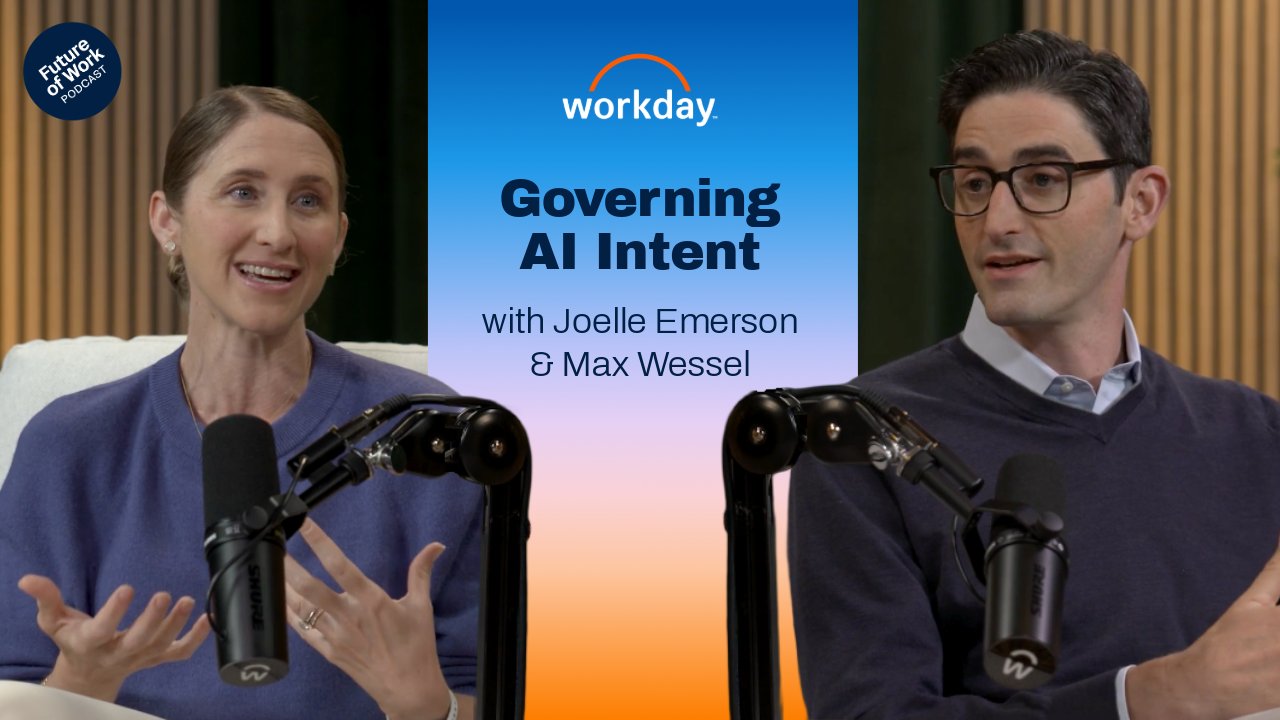
That cheap cost-cutting mindset burns out staff and stalls real company growth. Speaking on the Future of Work podcast, Paradigm Co-founder and CEO Joelle Emerson sat down with Max Wessel, SVP of product at Workday, to challenge this narrow view. They argue that successful adoption requires clear governance of intent—setting explicit goals that focus on human leverage rather than headcount reduction.
When executive intent shifts from trimming staff to expanding what teams can achieve, workplace panic turns into productive growth. Software gives staff real power to deliver goals that were previously impossible. Managing this transition requires leaders to stop treating automation as a simple budget ax and start governing how software aligns with human purpose.
“How unambitious to say that the best thing we can do with this new technology, this revolutionary technology, is cut budgets.”
Joelle Emerson
CEO and Co-Founder, Paradigm
Report
For years, corporate leaders viewed automation through a narrow lens. They sought quick savings on routine tasks. Emerson noted that this cost-first view creates heavy friction across teams. Software should remove dull tasks, spreadsheet chores, and manual tracking so employees can focus on creative work and direct collaboration.
"If you're approaching AI as an efficiency play, that is one of the most unambitious and unmotivating ways to think about what this technology can do for your organization," Emerson said.
Instead of using technology to do more, companies use software as an excuse for corporate downsizing. The intent behind software deployment dictates whether workers view new tools as partners or threats.
"A lot of tech companies are doing this kind of massive downsizing and blaming it on AI. How unambitious to say that the best thing we can do with this new technology, this revolutionary technology, is cut budgets," Emerson said.
When leadership uses software solely to chop budgets, worker trust breaks down. Ambitious firms take another path. Instead of trimming staff to keep output flat, growing companies keep teams intact to multiply their output.
"I think leaders can tell a story of AI as giving humans leverage. We can do things that were previously not possible at our headcount to deliver for our customers," Emerson said. "Efficiency is going to be a byproduct of all of that, of course. But it's not about cutting people."

Governing intent requires systems to understand internal company reality. A basic LLM reads public web facts, but lacks internal business context. A generic model knows nothing about company culture, local leadership norms, or unwritten rules.
"Most of that context is lost. It goes poof because it's held in the head of one individual or it's discussed in a team meeting," Wessel noted. "Part of the job of setting up AI is asking the right questions to organize context for reuse."
Emerson highlighted three key context layers that turn software into a real partner:
Organizational Rules: Deep facts about company norms, unwritten rules, and executive goals.
Applied Judgment: Field knowledge showing how general rules apply to real work situations.
Private Benchmarks: Custom internal metrics, such as Paradigm's Talent Practices Inventory, missing from the public web.
Feeding private layers into an automated agent creates an accurate picture. It helps tools spot hidden workplace trends before big problems start. When models understand this deep internal context, they align naturally with executive intent.
"Part of the job of setting up AI is asking the right questions to organize context for reuse."
Max Wessel
SVP, Product, Workday
To show how this transforms work, Emerson shared how a global retailer tackled high field turnover. In the past, finding the cause required a six-month consulting project full of manager interviews, focus groups, and exit file reviews.
Paradigm's platform, Surface, solved the issue in minutes. The tool combined HCM records, store sales numbers, and performance metrics from a single prompt.
The analysis showed turnover hit first-year top performers in key districts. The causes were job ambiguity during hiring and a lack of manager training. Beyond finding the cause, Surface drafted a targeted retention plan and manager toolkit. Humans checked the logic and ran the training.
"We want humans driving the change. We want humans looking at that output, making sure it makes sense to them. We want humans to be able to solve problems as quickly as possible rather than spending their time in spreadsheets," Emerson said.
This shift turns systems into proactive guides. Automated tools warn leaders about turnover risks early. HR teams move from pulling data to guiding business strategy.
A big debate brews over software design. Some executives believe massive horizontal base models will handle every business task. Emerson disagrees, betting heavily on purpose-built vertical software. Focused engineering teams work daily to solve specific domain problems in HR or law.
Vertical agents come pre-equipped with domain frameworks and skills. While general models struggle with complex workforce analytics, purpose-built tools fit real operational workflows without extra work. They embed specific domain intent directly into the software itself.
Building custom software tools from scratch comes with real costs. While internal hackathons bring great ideas, live production software demands ongoing data security, bug fixes, edge-case testing, and updates. External vendors handle that heavy work at scale, letting internal teams focus on core goals.
“AI can take on the drudgery...removing all of the things that take us away from each other so that we can work together.”
Joelle Emerson
CEO and Co-Founder, Paradigm
The barrier to using smart software is lower than ever. Non-technical generalists no longer need deep coding skills to test software concepts. Quick progress in modern tools lets department leaders build and adjust simple working prototypes over a single weekend.
This shift gives non-technical leaders direct leverage. Base model builders release constant learning guides, making tools easy to learn. Managers can test concepts fast, get real-time feedback, and refine workflows on the fly to match team goals.
When autonomous agents handle routine data tasks, work becomes more human. Teams spend less time filling out spreadsheets and more time talking face to face.
"I think so much of what we are doing now that AI can take on for us is the drudgery. It's the stuff that people don't like doing,” Emerson said. “It's removing all of the things that take us away from each other so that we can work together. We can come together and collaborate around these insights that an agent found for us and figure out how to take action on them."
Governing with intent means setting clear goals and guardrails for automated tools. When leaders shift intent from cutting costs to growing human power, worker fear turns into active support. Organizations that master this balance will build healthier workforces that outpace the market.
Report