AI Model Governance for Business Leaders
Enterprise leaders are working to harness AI’s potential while protecting people, customers, and brand. AI model governance enables both.
Sydney Scott
Editorial Strategist, AI
Workday
Enterprise leaders are working to harness AI’s potential while protecting people, customers, and brand. AI model governance enables both.
Sydney Scott
Editorial Strategist, AI
Workday
Enterprise AI now powers most core business operations, embedding autonomous digital teammates directly into the modern workforce. Staying ahead of this transformation challenges even the most forward-thinking tech leaders. But, one critical operational hurdle stands out above the rest: AI model governance.
McKinsey’s 2026 research on AI trust found that barely one-third of enterprises have built mature AI governance models. Meanwhile, agentic AI systems are already running high-stakes operations across HR and finance, driving decisions that carry real operational risk.
The risks are no longer confined to experimentation. Undetected drift and hidden bias quickly generate unexplainable decisions, leaving executives flat-footed during regulatory audits and board reviews. For business leaders, the focus is no longer on whether to adopt AI, but how to do so with discipline, accountability, and control.
Barely one-third of enterprises have built mature AI governance models.
Report
AI model governance is the set of policies, roles, processes, and controls that guide how AI models are built, used, and managed across the organization. It lives at the intersection of technology, model risk management, and business growth strategies.
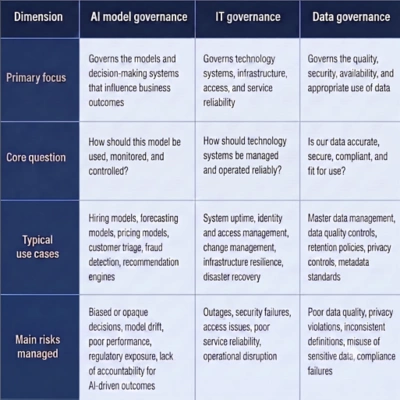
It’s important to note that AI model governance isn’t just another name for IT governance. IT governance focuses on systems, infrastructure, access, and service reliability. AI model governance is narrower and more consequential: it governs the models that shape decisions in real time and directly influence outcomes at an unprecedented speed and scale.
It’s also not the same as data governance. Data governance ensures data is high quality, secure, and used appropriately. AI model governance builds on that foundation and asks a different set of questions: What are we allowed to do with this data? Which real world use cases are acceptable? How will we test models for bias, robustness, and performance? Who is accountable for outcomes, and who can override a model’s recommendation?
In practice, effective AI model governance usually comes down to a few core elements:
Ownership and accountability: Clear executive sponsorship and designated owners, so the business knows who is responsible for performance, oversight, and escalation when something goes wrong.
Policies and standards: Documented rules for how AI can be used, including expectations for testing, approvals, human oversight, and principles like fairness, transparency, privacy, and security.
Risk-based controls: Classification of models by impact in a risk management framework, with stricter controls where decisions affect areas like hiring, credit, or compliance.
Lifecycle monitoring: Ongoing testing, drift monitoring, retraining criteria, and clear thresholds for when a model should be reviewed, updated, or taken offline.
Transparency and auditability: Visibility into how a model works, why it produced a given output, and what records exist to answer questions about it with a clear audit trail.
That structure transforms AI and machine learning models into defensible operational assets. A structured approach brings total clarity to complex model outputs, allowing leadership to scale adoption with absolute confidence.
When AI model governance is weak or ad hoc, risk doesn’t just grow—it compounds as AI models accelerate and scale. From a strategic and financial perspective, poorly governed models drive bad decisions systematically. Compliance and regulatory risks are also intensifying. Jurisdictions around the world are introducing or tightening their AI regulations, with particular scrutiny on AI models related to credit, healthcare, and other sensitive domains.
The EU’s AI Act, for example, classifies systems used in employment, creditworthiness, and certain medical contexts as high-risk. In the U.S., the proposed Algorithmic Accountability Act of 2025 would require impact assessments for AI and other automated decision systems used in housing, employment, credit, education, and healthcare.
In addition to regulatory compliance demands, reputational and ethical risks can be costly when governance gaps go unchecked:
A customer service triage model might disproportionately deprioritize certain types of complaint, leading to slower resolution for particular groups of customers.
A financial forecasting model may lean too heavily on pre-disruption patterns, missing structural changes in demand and recommending flawed investments.
Once poorly governed models are embedded in core decisions, small failures can quickly become enterprise problems—showing up as operational drag, compliance exposure, and reputational damage all at once.

Nearly 90% of employees say AI increases their confidence when they trust the underlying system and data.
While risk reduction is one of the clearest reasons to invest in AI model governance, it is not the only one. Done well, governance also makes AI programs more usable, scalable, and valuable across the business. Workday research found that 87% of employees gain confidence using AI tools once they trust the underlying data.
At an organizational level, trusted AI models:
Help teams scale AI into core decisions. When leaders trust that AI models are being governed appropriately, they are more willing to use them for core use cases like workforce planning, forecasting, and financial decision-making.
Reduce friction and speed execution. Clear standards, approval pathways, and oversight processes keep teams from reinventing the rules for every initiative, helping move AI from concept to deployment faster.
Improve cross-functional alignment. Governance creates a shared operating model for business leaders, data scientists, engineers, HR, legal, and risk teams, reducing the odds that important stakeholders are left out until late in the process.
Strengthen trust with customers, employees, and partners. Organizations that can show they use AI responsibly—with clear guardrails, oversight, and accountability—are better positioned to build credibility and protect stakeholder trust as AI adoption grows.
The result is not just lower risk, but stronger execution. Good governance helps organizations use AI with more consistency, more confidence, and more speed, turning it from a promising capability into a system the business can actually rely on.
AI model governance can’t be delegated solely to technical teams. Business leaders play a central role in shaping the intent, boundaries, and impact of AI development and implementation at the enterprise level.
Leaders must first set the risk appetite. Where is the organization comfortable using AI in a largely automated way, and where must human review be mandatory? Are there categories of decisions that will never be fully automated? Answering these questions is a leadership responsibility.Working effectively with specialists is another critical role. Leaders should expect regular communication with:
Data and AI teams to understand model capabilities, limitations, and dependencies.
Risk, legal, and compliance to stay ahead of regulatory trends and ensure alignment with existing frameworks.
HR and change management, to manage the human impact of AI—role changes, training needs, and communication with employees.
Finally, leaders should ask a consistent set of governance questions for every significant AI initiative, such as:
What decision is this model influencing, and what would be the impact of getting it wrong?
How have we tested for bias and robustness, and what did we find?
When and how can humans override the model’s recommendations?
How will we monitor model performance and intervene if things go off track?
What would we say publicly if this AI-driven decision were challenged?
When these questions become routine, AI model governance stops being theoretical and becomes part of the organization’s leadership discipline.
The core AI challenge for leaders is harnessing its potential while protecting people, customers, and brand; AI model governance is how you do both.
AI is evolving quickly, but the essential challenge for leaders stays the same. Leaders must harness its power while protecting people, customers, and brand. Effective model governance practices make that balance possible.
Regulations will continue to change. New AI techniques will emerge. But organizations that invest early in robust AI model governance will be better positioned to adapt, innovate, and earn trust. IIn a world where AI increasingly shapes how businesses run, strong governance provides the foundation needed to scale with certainty.
A remarkable 82% of organizations are already using AI agents. But is your team ready? Read our report to learn how 3,000 global leaders are maximizing human potential with AI.
Report