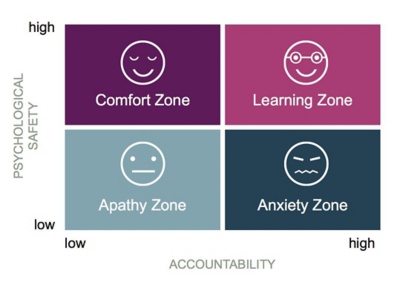
What Are the 4 Stages of Psychological Safety?
According to the organizational anthropologist Timothy R. Clark, there are four stages of psychological safety: inclusion, learner, contributor, and challenger. This proposed model builds a baseline of trust across a company, gradually creating a safe workplace where employees feel able to challenge the ideas of others.
As with any framework, these stages shouldn’t be viewed as rigid. Rather than applying them as a fixed sequence, it’s important to acknowledge that different teams may move between stages differently. That flexibility in approach, in turn, encourages further inclusion. The framework progresses as follows:
1. Inclusion Safety
The first stage of psychological safety, inclusion safety, focuses on fostering a sense of belonging regardless of factors like gender, race, religion, and age. Creating an environment where everyone feels included and people’s differences are celebrated is foundational to building trust. If employees are afraid of being discriminated against because of certain aspects of their identity, they won’t perform at their best. A strong diversity and inclusion initiative should be the first step in building psychological safety.
2. Learner Safety
Providing employees with the space to make mistakes and learn from them is a key part of promoting an environment of psychological safety. In order to learn, individuals must be able to ask questions, give and receive feedback, and get things wrong without the threat of negative consequences. By enabling employees to ask questions freely without negative repercussions, you empower them to innovate and undergo personal growth.
3. Contributor Safety
When an individual feels they can learn without fear of negative judgment, they may be more inclined to participate in dialogue at the workplace. Greater autonomy is created, along with an increase in employee engagement. Typically, contributor safety occurs when an individual rises to the occasion in their role, is an active team member, and performs at a certain level. While a lot of this is on the employee to participate and perform well, their people leader should also support their autonomy.
4. Challenger Safety
The final stage of psychological safety is challenger safety. Once employees have been given the freedom to learn from their mistakes and contribute to discussions openly, they can then challenge each other’s ideas. By encouraging people to question the status quo, in a respectful way, you enable a culture of constructive feedback. In turn, you embolden employees to innovate, generate new ideas, and push your organization forever forward.