Human Resources
The Peace Treaty: Workday’s Fix for the AI-Recruiter Split
Workday saved 24,000 hours by trading "queue-clearing" for precision hiring and talent orchestration.

Sara Braun
Editorial Strategist, HR
Workday

Workday saved 24,000 hours by trading "queue-clearing" for precision hiring and talent orchestration.
Sara Braun
Editorial Strategist, HR
Workday
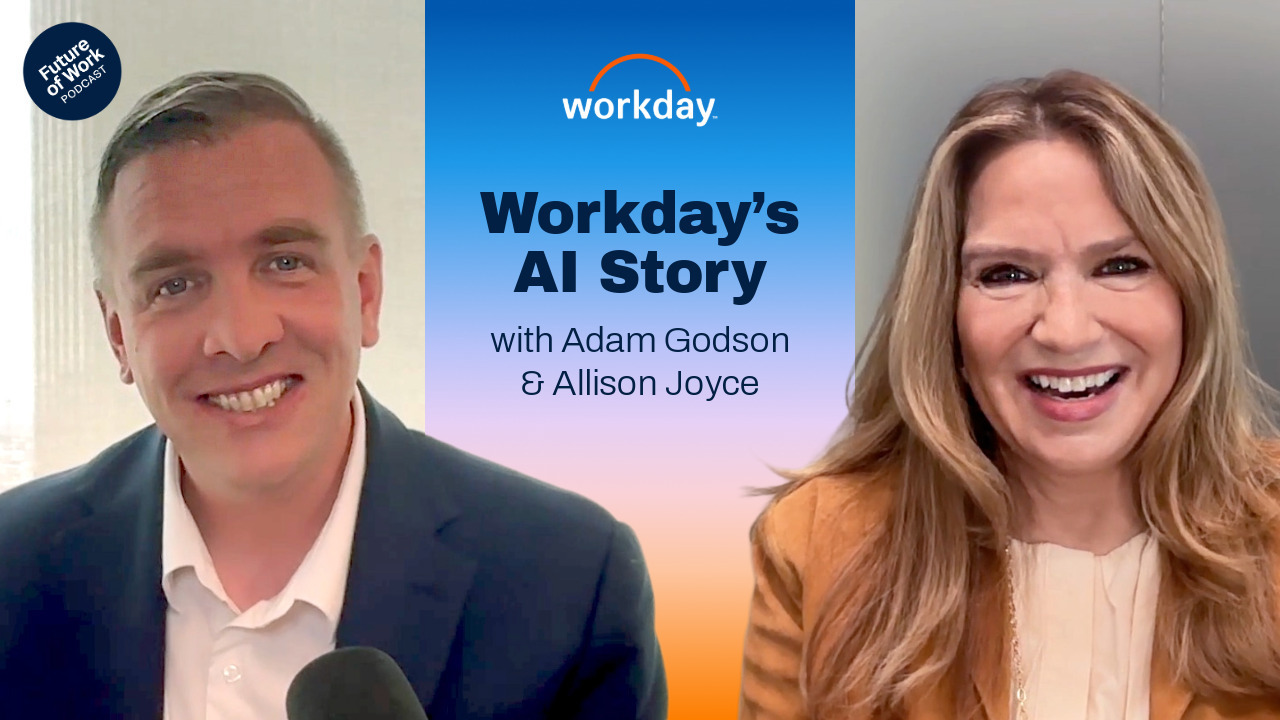
Audio also available on Apple Podcasts and Spotify.
The recruitment industry has spent the past few years balancing on a tightrope. There’s an inherent tension centered on the imperative to satisfy executive mandates—demands that frequently push for the deep integration of AI and automation into core operational processes—while also managing apprehension around the rapidly evolving technology.
So the challenge lies in merging the efficiency gains promised by AI with the essential, human-centric focus required for successful talent acquisition. Sounds easy enough, right?
In a recent conversation on the Future of Work podcast between Workday’s Allison Joyce, vice president of global talent acquisition, and Adam Godson, general manager of talent acquisition , these two HR leaders gave us a behind-the-curtain peek at their own AI transformation. They shared the friction of changing long-held habits, and the mindset shift required to move from reactive administration to true talent orchestration.
Report
The Invisible Burden of Recruitment
24,000 hours. That’s the number that Godson said “stopped us all in our tracks.” That’s the estimated time Workday recruiters spent a year screening candidates who didn’t meet basic qualifications.
“On a typical Tuesday, a year or two ago, our recruiters were spending most of their time evaluating candidates [with] no sort of rhyme or reason,” said Joyce. “There was no system supporting what was coming in and any ability to pre-screen the candidates against the job qualifications.”
Recruiters were also responsible for scheduling (and re-scheduling!) interviews with candidates: it typically took between two and four days to finalize an interview time via back-and-forth emails. While innovations in technology allowed candidates to apply more quickly and in higher volume, recruiters on the other side weren’t properly equipped to meet the moment.
And it’s not just time that is wasted with inefficient processes: SHRM’s 2025 data places the average cost-per-hire at $4,700, though many employers have said that the total cost to hire a new employee can be “three to four times the position’s salary.”
Workday recruiters spent 24,000 hours per year screening candidates who didn’t meet basic qualifications.
Recruiters, whose jobs revolve around the evaluation of candidates based on both tangible and intangible human aspects, were initially (and understandably) resistant to adopt new tools and processes.
Joyce acknowledged that AI integration didn’t happen overnight—it was an incremental process in which recruiters began to utilize the tools step-by-step, whether that be first using Workday Paradox Candidate Experience Agent to schedule an interview or evaluating a HiredScore AI grade for a candidate.
“It took time to pilot globally in small groups around the world,” Joyce said during the conversation with Godson. “But once we got through that process, our adoption rate was really fast.” After less than a year, the Workday team began to see major transformations in their day-to-day processes, accumulating to that magic number of 24,000 hours saved.
Workday integrated three different AI tools to replace manual processes and streamline hiring.
1. HiredScore AI: Shifts reviewing priority from “first
in” to “qualification-fit”
2. Paradox Candidate Experience Agent: Interview
schedule automation
3. BrightHire: Automates interview note-taking and
documentation
HiredScore helped to solve the “black hole” problem where resumes often went unnoticed. The technology allowed Workday to shift from a first-come, first-served model to qualification-fit prioritization.
This strategic use of AI cut resume screening time for recruiters by 57%. By automating the evaluation of low-match candidates, the tool empowered recruiters to move away from administrative "queue-clearing" and instead focus on high-value engagement with top-tier talent.
Strategic use of AI cut resume screening time for recruiters by 57%.
AI has redefined the recruitment landscape at Workday, increasing recruiter capacity by 40% through tools like HiredScore AI, Paradox Candidate Experience Agent, and BrightHire. This shift has allowed teams to move past manual screening and into strategic advisory roles.
With 75% of prioritized resumes now ranking as "A" or "B" matches, recruiters can confidently trade hours of resume scanning for high-touch candidate assessment. As Joyce noted, "That reinvestment of time has been really valuable both for the recruiters and our candidates," enabling a stronger focus on building elite talent pipelines.
A major reason that AI’s implementation has been so successful at Workday is because it was woven into the fabric of hiring, and not positioned as a mere side tool. Technologies like HiredScore AI became embedded in the core recruiting workflow, making it easier for recruiters to begin incorporating in their day-to-day.
The idea of precision hiring—a flip from a reactive “queue-clearing” mindset to proactive talent discovery—has been a game changer for Workday recruiting. Over time, team members have learned how to interpret and use AI-driven insights, such as HiredScore AI’s candidate grading and prioritization logic, and used it to stay focused on the key to effective recruiting: competitive candidates and making well-informed hiring decisions.
Recruiters began looking beyond the “first-in, first out” approach to applicants by sourcing internal and recent candidates to identify the best candidates to move forward in the recruitment process.
With less administrative tasks to eat up their days, recruiters were supported in developing higher-value skills as talent advisors, including using data to guide hiring manager conversations and candidate engagement.
With less time spent on administrative tasks, recruiters were supported in developing higher-value skills as talent advisors.
Ultimately, Workday’s journey proves that AI isn’t here to replace the recruiter, but to return them to the human-centric work they actually signed up for. By embedding these tools directly into their "natural habitat," Workday found a way to successfully broker a peace treaty between high-tech efficiency and high-touch talent acquisition.
The results speak for themselves: a 57% drop in time spent reviewing resumes, a 40% increase in recruiter capacity, and interview scheduling that now takes hours instead of days.
When AI handles the data, humans are finally free to handle the strategy. With those 24,000 hours back, recruiters were able to develop their own skills and fine-tune their precision hiring strategy.
Report

The rapid advancement of AI has raised huge questions about its impact on jobs. Despite that, 83% of workers agree that AI will enhance human creativity rather than limit it. Learn more about the AI skills revolution in this new global Workday study.