The 6 Hidden Advantages of ERP Software
ERP systems have long been drivers of productivity. Today, they’re also critical levers for strategic decision-making and growth.
Sara Braun
Editorial Strategist, HR
Workday
ERP systems have long been drivers of productivity. Today, they’re also critical levers for strategic decision-making and growth.
Sara Braun
Editorial Strategist, HR
Workday
Every organization runs on systems. But the best organizations run on strategy. Without the right plan in place to make the most of your eEnterprise resource planning (ERP), it might as well be gathering dust.
Here's a sobering reality check: Gartner projects that 70% of ERP implementations will fail to meet their original goals by 2027. Not because the technology falls short, but because the thinking behind it does. Too many organizations treat going live as the finish line, when it's just the starting point.
The gap between implementing an ERP solution and getting the most out of it is real, but it's also closable. These are the hidden advantages of ERP—key benefits that emerge only when you stop asking "Is our ERP working?" and start asking "Is our ERP working for us?".
Seventy percent of ERP implementations will fail to meet their original goals by 2027.
Guide
These are the six benefits of ERP systems that your business should be leveraging today:
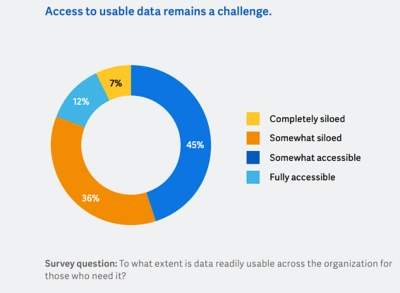
Data silos remain a persistent ghost in the machine. As a result, many enterprises struggle with fragmentation: Workday research shows that 42% of finance and tech leaders report their data is still somewhat or completely siloed—a major barrier to making decisions with full context. Only 12% say their data is fully accessible.
A unified ERP system tears down the walls between HR, finance, and operations—replacing fragmented data and educated guesses with a single, trusted picture of reality. Suddenly, leaders aren't just reacting to what happened last quarter; they can see exactly how one decision ripples across the entire business before it's even made.
That kind of transparency doesn't just keep people accountable—it opens the door to capabilities like scenario modeling and AI-powered predictive analytics that simply aren't possible when your data is scattered across a dozen disconnected tools.
Teams often frame collaboration as a "people" or "culture" challenge, when it’s actually a structural one rooted in the tech stack. When teams operate in disparate systems—relying on conflicting data and assumptions—friction is inevitable. But once data is unified within an ERP, teams plan and act within the same playbook.
Collaboration stops being a manual effort requiring endless meetings and starts occurring naturally as part of the daily workflow. A unified cloud ERP system also allows leaders to see where processes are stalling, enabling them to refine workflows and apply best practices across the entire organization.
In practice, the impact of stronger collaboration can be massive. For example, a global supply chain software company found its needs evolving after it was acquired, as it transitioned from a medium-sized business to part of a large, global enterprise. Teams expanded, projects risked becoming siloed, and the need for cross-company collaboration increased.
By incorporating change control requests through an ERP system and following up with bi-weekly meetings across teams to address them, the company was able to ensure that key changes in one area did not adversely affect any of the company’s other departments or global jurisdictions. By putting the right structure in place, positive results followed.

Teams often frame collaboration as a "people" or "culture" challenge, when it’s actually a structural one rooted in the tech stack.
The talent crisis isn't coming—it's already here. High-potential voluntary turnover climbed across 75% of industries surveyed by Workday this year, and employee expectations show no signs of slowing down. Yet for many organizations, the biggest threat isn't the talent they're losing—it's the talent they're sitting on without even knowing it.
Critical roles go unfilled while skilled employees in other departments go unnoticed. It's a costly disconnect, and it's largely avoidable.
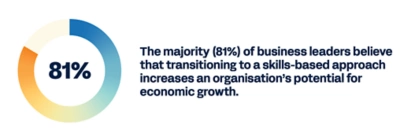
A unified ERP changes that equation by building a living skills inventory across the entire organization—one that connects individual worker profiles directly to operational needs. The result is a shift from reactive headcount management to a proactive, skills-based strategy that keeps the right people focused on the right priorities, even as market conditions shift. It's no coincidence that 8 in 10 business leaders say skills-based approaches drive higher economic value and growth.
The payoff goes beyond increasing efficiency and cost savings. When employees can see clear, meaningful career paths within their organization, they're far less likely to look elsewhere. An internal talent marketplace highlights your focus on employees, giving people a reason to stay, grow, and invest in a company that’s investing in them.
Enterprise risk management grows significantly more complex as companies scale. And too often, compliance teams become trapped in reactive mode, auditing data after the fact rather than preventing errors at the source.
This kind of fragmentation is what gives executives nightmares. According to the Workday CFO/CIO Indicator Study, only 42% of CFOs are confident in the integrity and usability of their data. This leaves 58% of finance leaders operating with active doubt—a risk that intensifies in complex regulatory environments.
Modern ERP systems address this by embedding controls directly into business processes. Instead of a separate audit layer, the ERP provides automated guardrails that stay aligned with shifting global regulations. By automating check-box compliance, the ERP acts as a proactive risk partner, allowing leadership to scale rapidly without the drag of operational gaps or regulatory oversight.
Fifty-eight percent of leaders doubt their data integrity, a risk that intensifies in complex regulatory environments.
Growth is supposed to be the goal. But for many organizations, it comes with a hidden cost.
Expanding into a new market or absorbing an acquired entity shouldn't grind operations to a halt—yet for companies running on outdated infrastructure, that's exactly what happens. Systems that were never built for scale become the bottleneck, and what should be a moment of momentum turns into months of painful rewiring.
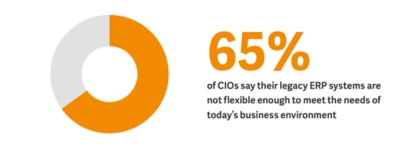
It's no surprise that 65% of CIOs say legacy ERPs simply aren't flexible enough to meet the demands of today's business environment. And that's before you factor in potential market volatility and disruptions. The organizations that weather them aren't necessarily the biggest or best-resourced—they're the most adaptable.
A modern, cloud-based ERP is built for exactly that kind of world. Rather than forcing teams to start from scratch with every expansion, it provides an elastic foundation, one where pre-configured templates can stand up new locations within an existing system, and where strategies can be stress-tested and pivoted in days, not months.
Ask most people where customer experience lives in an organization, and they'll point to the front office. But the best customer service isn’t just delivered at the front—it’s built from the back.
Every interaction a customer has with your brand is shaped, in part, by what's happening behind the scenes. When frontline employees have instant access to real-time data—inventory levels, project management timelines, billing history—they don't just answer questions faster, they answer them right.
Even if a customer never interacts with the ERP itself, they feel its presence through the reliability of the service they receive. In that sense, investing in your back office isn't solely an operational decision—it's also a major factor in driving improved customer satisfaction.
Every interaction a customer has with your brand is shaped by what's happening behind the scenes.
For leaders looking to move beyond basic implementation metrics, the focus must shift from the simple utilization to strategic integration.
To unlock the full potential value of your ERP investment, consider these enterprise-level directives:
The true advantage of an ERP is in how it’s pointed at your biggest goals. When ERP and business strategy move in lockstep, something shifts. Teams stop reacting and start leading, decisions get made faster, with greater confidence, and new opportunities get pursued before the window closes.
Guide