The Hidden Data That Fuels Your People and Finance Strategy
Discover how rich workforce data and AI innovation are transforming payroll from a transaction into a strategic business advantage.
Emily Faracca
Multimedia Content Writer
Workday
Discover how rich workforce data and AI innovation are transforming payroll from a transaction into a strategic business advantage.
Emily Faracca
Multimedia Content Writer
Workday
Audio also available on Apple Podcasts and Spotify.
Ask most leaders what payroll does, and you’ll probably hear some version of: “It cuts the checks.” For many, payroll is an afterthought—they only think about payroll when something goes wrong.
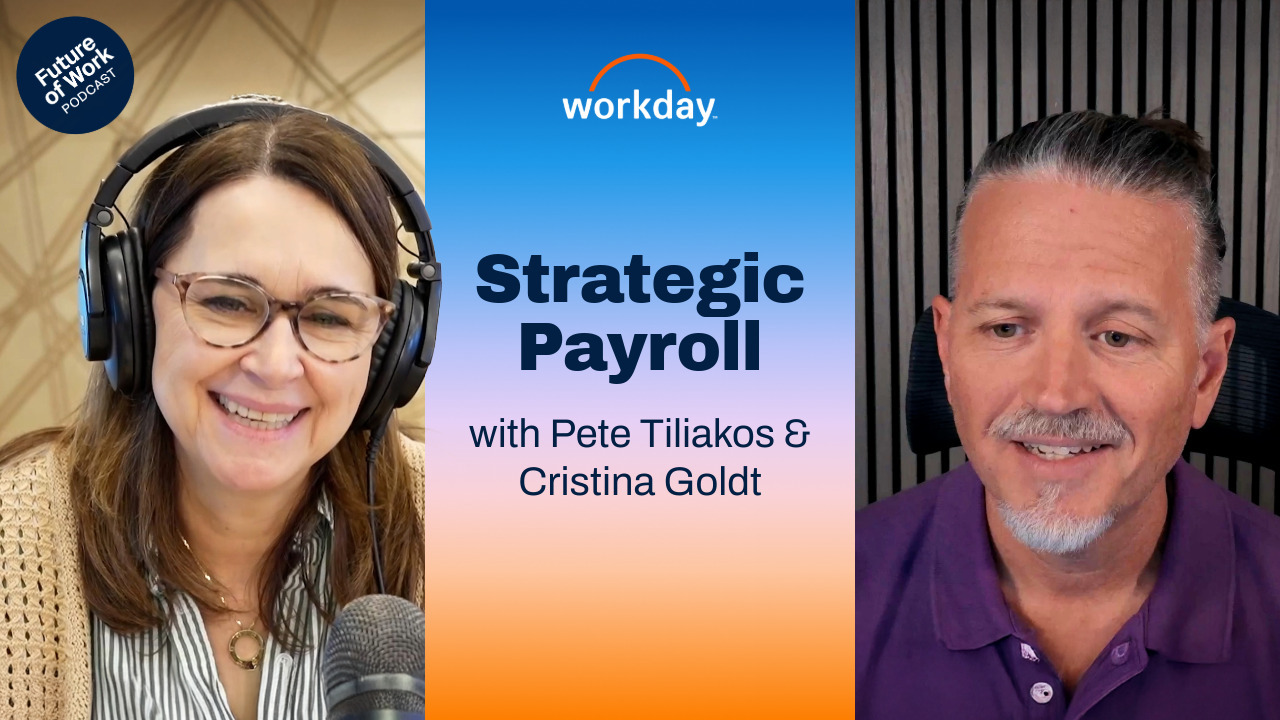
But beneath that surface view, there’s an entire world of compliance, complexity, and strategic opportunity. This is precisely where HR tech analyst Pete A. Tiliakos wanted to shine a light during an in-depth conversation on the Future of Work podcast with Cristina Goldt, general manager of workforce management and payroll at Workday.
Together, they ventured into that hidden world and explored the potential of payroll as a central influencer of strategy.
Report
For most organizations, payroll is treated like car insurance: something you don’t really want to think about, but you have to have.
“We’ve sort of left payroll in the corner, right down in the basement, just cutting checks,” Tiliakos acknowledges. It was managed for headcount and cost, not impact.
The problem with this approach is that payroll is not a small, back-office process. It’s the largest hit to the P&L in most organizations, and “one of the riskiest processes in the organization,” according to Tiliakos. When it fails, it does more than frustrate employees. Payroll lapses can derail momentum, damage trust, and put the business at risk.
Tiliakos’ recent research finds that 51% of payroll operations are unprepared to support the strategic direction of their business. It’s a bright red flashing light for leaders who want to move fast, scale globally, or navigate big moments like mergers, acquisitions, and market entries. If payroll isn’t ready, the company isn’t.
“You've got half of organizations right now that are operating unfit—unstable, from a foundational perspective—to navigate what they're trying to take on,” Tiliakos explains.
“You've got half of organizations right now that are operating unfit—unstable, from a foundational perspective—to navigate what they're trying to take on.”
—Pete A. Tiliakos, HR Tech Analyst and Strategic Advisor
The same function that’s been underappreciated for years is also one of the best sources of truth in your business. This is a massive untapped opportunity across the landscape.
“[Payroll is] probably the most overlooked and yet most accurate, richest data sets in the organization,” Tiliakos says. “Where do we call when something changes? We call payroll.”
Every pay cycle reflects what’s really happening: hiring, turnover, hours, overtime, compensation structures, location changes, role changes, and so on.
When payroll is modern and integrated with HR, finance, IT, and other systems, that data becomes an engine for insight:
“Payroll really should be at the table,” Tiliakos says, whether it’s a “big merger and acquisition or a wide-scale org redesign, or going into that new country to open a new manufacturing site.” Payroll can offer insight on how the action flows through to people, costs, and compliance in a way few others do.
That’s one reason Goldt calls payroll “the epicenter of workforce data,” adding that it’s quickly becoming either “a strategic enabler or a barrier to success.”
If payroll has historically been overlooked, it’s also been under-equipped. “For so long, payroll has really been starving for innovation,” Tiliakos says. Manual audits, spreadsheets, and time-consuming reconciliations were the norm.
The last decade has changed that, with automation, cloud platforms, and now AI transforming what’s possible. According to Goldt, this shift is reshaping how organizations view the function’s potential.
“We see with our customers...payroll is definitely a driver in these transformation decisions,” Goldt explains. “People are recognizing the strategic importance of payroll...but also knowing that as they think about their transformations for all their people systems, that payroll really is foundational to getting that done.”
AI in particular has a fascinating role for a function that is so immersed in data. Modern systems can surface preventative cues to flag anomalies and predict issues before they happen, helping payroll leaders confidently focus on strategy and deeper impact.
“I think what you're seeing is a much more always-on experience that is doing the heavy lifting for payroll leaders—augmenting them, making them smarter, making them more impactful in their actions. But more importantly, giving them the time to do what they should have always been doing. And that is being business advisors,” echoed Tiliakos.
“People are recognizing the strategic importance of payroll...but also knowing that as they think about their transformations for all their people systems, that payroll really is foundational to getting that done.”
—Cristina Goldt, GM, Workforce Management & Pay, Workday
As payroll paves new roads, the profile of the payroll professional is evolving too. The future is deeply data-driven, highly tech-enabled, and tightly connected to the rest of the business.
Tiliakos points to a World Economic Forum analysis of key future skills—adaptability, leadership, tech proficiency, innovation—and notes: “That just screams of a payroll leader.” He’s seeing more data scientists in payroll teams, tighter alignment with compensation and total rewards, and what he describes as an emerging “pay experience.”
But technology alone won’t get payroll to where it needs to be. It takes new partnerships and a louder voice. A real seat at the table.
“What I find is that the really mature organizations are finding a deeper engagement between the executive team and the payroll team,” he says. His advice to payroll leaders is direct and empowering: “If you can’t get invited to the table, build your own table and invite them.”
It can be an eye-opening experience for business leaders who are still mired in outdated perceptions of what payroll is and what it’s capable of becoming.
Tiliakos doesn’t mince words about where we are now: “This is your time. This is the golden age of payroll. You’ve never had more attention, innovation, and opportunity.”
Yes, compliance is more complex. And yes, the talent crunch is real. But the combination of modern technology, richer data, and growing executive awareness has created a unique window for payroll to claim its rightful role as a strategic leader in the future of work.
“Don’t stand on the beach and get hit by the wave,” he urges. “Get your surfboard and start riding that thing…the role is going to change. All of our roles are going to change. So, it’s time to lean in, be the adaptable, skilled experts that you are and use that technology to your advantage.”
For organizations, that means investing in modern payroll platforms, integrating payroll with the broader data ecosystem, and giving payroll leaders a real voice in strategic decisions.
For payroll professionals, it means seeing yourselves the way the business of the future needs you: as innovators, advisors, and essential partners.
As Goldt says, “This is payroll’s moment.”
Turn payroll into a powerful strategic asset. Too many organizations are constrained by siloed, manual payroll operations. This report outlines how an integrated platform delivers real-time data, mitigates risk, and drives a measurable 33% increase in strategy-impacting ROI.
Report