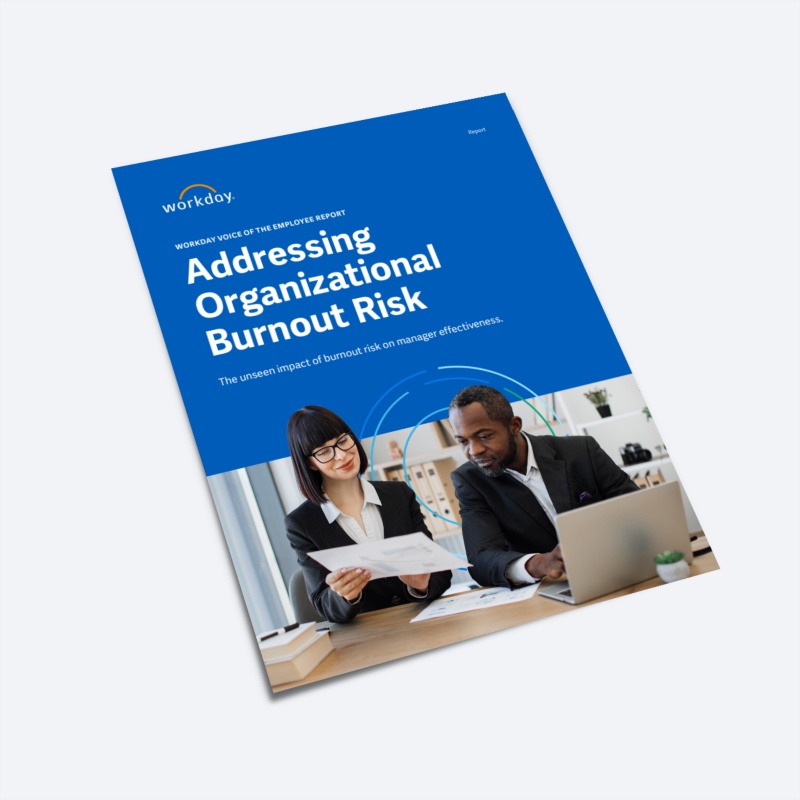
Beyond Wellness: Why Burnout Needs More Than Bandaids
Burnout is systemic misalignment, not weakness; leaders must redesign work, accountability, and culture so human sustainability becomes core.
Liz Pavese
Workplace Psychologist
Workday
Burnout is systemic misalignment, not weakness; leaders must redesign work, accountability, and culture so human sustainability becomes core.
Liz Pavese
Workplace Psychologist
Workday
Burnout isn’t a heavy week. It isn’t just a rough quarter. And it certainly isn’t a sign that people lack resilience.
For high-capacity individuals—from top contributors to middle managers and senior executives—burnout is too often framed as the inevitable cost of ambition. The implicit message is that if employees are playing at this level, they’re bound to be exhausted.
That story is not only incorrect; it’s organizationally expensive.
Burnout is a systemic erosion of the human spirit inside a company. It’s what happens when capable, values-driven people are repeatedly placed in environments that undermine their agency, integrity, and sense of contribution. Rising attrition, disengagement, "quiet quitting," and a shrinking bench of ready leaders are the direct downstream effects of that erosion.
If a company’s response has been to add another wellness benefit, it’s time to widen the lens. Quick-fix solutions like “wellness days” and gym memberships—while useful to a degree—will backfire without structural changes to work design and leadership practices.
Let’s move beyond the buzzword and clear up some common misconceptions about burnout and what actually works to prevent it.
Report
The World Health Organization classifies burnout as an occupational phenomenon driven by unmitigated chronic workplace stress—not as a personal failing or a clinical diagnosis.
It shows up along three dimensions:
Emotional exhaustion: That bone-deep depletion that sleep and weekends don’t fix. Even small tasks feel heavy, and the idea of one more initiative or meeting feels impossible to absorb.
Cynicism and distancing from work: Where engagement once lived, a protective layer of detachment takes its place. People begin to disconnect from the mission, the team, or the customers they serve.
Reduced professional efficacy: Highly capable people feel like they are underperforming, constantly behind, or no longer good at work they used to do with confidence.
Burnout is not:
A lack of grit or mental toughness
Proof that someone can’t handle the workload
Simply a function of too many hours
You can work 60 hours a week and feel energized, or 35 and slowly unravel. The differentiator isn’t volume; it is alignment. When there is a sustained mismatch between a person and the way their work is designed and led, burnout becomes a rational human response.
As an executive, the question is not, “Why can’t our employees cope?” It’s “What are we asking them to cope with?”
When there is a sustained mismatch between a person and the way their work is designed and led, burnout becomes a rational human response.
Research from Christina Maslach, a social psychologist and pioneer in the study of burnout, highlights six core mismatches between an individual and their job that predict burnout risk. Most organizations unintentionally optimize for several of them.
6. Values: The Most Damaging Mismatch of AllThis is where erosion of self becomes most acute. When there is a sustained gap between what an organization says it values (wellbeing, integrity, inclusion, customer service) and what it actually rewards, people experience moral friction. They feel they must contort their own values to succeed. Over time, that’s not just stress, it’s identity-level damage.
Most corporate responses to burnout are individual-level: wellness stipends, meditation apps, resilience workshops, maybe an annual wellbeing week.
These can help people cope within the system. They do not change the system.
Worse, when leaders don’t address structural issues, individual solutions can backfire:
The organization “checks the box” on wellbeing, while the six mismatches continue as unchecked.
Employees internalize the message that if they’re still struggling, it’s because they’re not doing self-care correctly.
Leaders see temporary bumps in survey scores and assume they’ve solved the problem.
The evidence is clear: individual interventions yield modest, short-lived benefits. Sustainable reduction in burnout requires organizational interventions—in how we structure, lead, and reward work.
Wellness programs can support recovery. Only work design and leadership practices can reduce exposure.
When leaders don’t address structural issues, individual solutions can backfire.
Today, companies have access to real-time signals: attrition trends, engagement and pulse data, manager-level patterns, even predictive indicators of burnout risk by role or business unit.
The capability gap is no longer data. It’s willingness.
Will you look at which leaders consistently sit over pockets of exhaustion or disengagement—and intervene?
Will you compare your stated values with the behaviors you actually incent and tolerate?
Will you allow “high performance” to remain defined by unsustainable heroics, or will you update the definition?
You cannot manage what you refuse to see.
For C-level leaders, particularly CHROs, the mandate is shifting from sponsoring isolated wellness programs to architecting systemic resilience.
Here’s where to begin.
Treat burnout as a diagnostic of system health. Ask:
Diagnose by team, by leader, by segment—not just in aggregate. Make it normal to ask, “What about this environment makes burnout a reasonable response?”
The people closest to the work know where the friction is. Invite them into structured redesign:
What work is genuinely creating value, and what’s legacy noise?
Where are approvals, meetings, or tools creating unnecessary drag?
How might responsibilities or interfaces be rebalanced?
Crucially, act visibly on what you hear. This not only improves workflow; it restores a sense of agency—a core buffer against burnout, and key to motivation.
Psychosocial safety—how safe it feels to speak up, set boundaries, admit mistakes—is now a performance variable, not a “nice-to-have.”
Integrate it into how you:
Select, develop, and evaluate leaders
Review team health and risk
Make promotion and succession decisions
Reward leaders who deliver results and build sustainable, humane conditions. Address leaders whose teams are chronically in distress, even if their numbers look good in the short term.
The most effective strategies operate at two levels:
Structural: clear prioritization and deprioritization, realistic resourcing, disciplined meeting cultures, transparent decision-making, fair and visible recognition.
Individual: access to mental health support, training in energy and attention management, and explicit permission to use these resources without penalty.
A simple litmus test: if a values-aligned, high-performing employee did everything right—used every wellness resource, had strong personal habits, communicated their limits—would the way work is currently designed still grind them down?
If the honest answer is yes, you don’t have a wellness problem. You have a systems problem.

For C-level leaders, the mandate is shifting: from sponsoring isolated wellness programs to architecting systemic resilience.
The erosion of self inside your organization is not inevitable. It is a function of the choices leaders make about how work is structured, how power is used, and what truly gets rewarded.
When wellness programs sit on top of misaligned systems, they will always be playing defense. The real strategic shift is to treat human sustainability as a core design constraint for how your business operates, rather than an afterthought.
Organizations that are able to make that shift become the real champions. They are able to build cultures where performance and wellbeing are not in competition, but mutually reinforcing and where burnout becomes the exception, not the norm.
Report