Key Stages of Business Growth
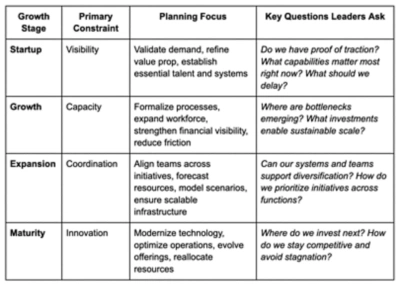
Knowing your organization’s growth stage is an important first step when building a business growth plan. Models like McKinsey's Growth Horizons and the Churchill and Lewis Growth Stages have stood the test of time and shown how businesses encounter predictable challenges as they expand or scale.
Leaders make better decisions when they plan within this proven context. When you know what your current growth stage requires, you can allocate resources more strategically, avoid common missteps, and build a plan that supports long-term performance.
Stage 1: Startup
The startup stage is defined by limited visibility. Leaders are working to confirm demand, refine their value proposition, and build enough operational structure to support early traction.
Growth planning at this stage is exploratory: Teams are focused on understanding customer needs, developing predictable revenue, and identifying hires and systems that will enable initial scale. Decisions at this stage are centered around learning fast and gaining clearer insight about how the offering needs to evolve.
Stage 2: Growth
In the growth stage, the constraint shifts from visibility to capacity. Demand is rising, but internal systems often lag behind, and planning becomes more operationally rigorous. Organizations have to formalize internal processes, expand their workforce, strengthen financial insight, and invest in technology to reduce friction as they scale.
Leaders in this stage use business growth planning to determine which functions require the most investment, and how to maintain high quality and customer experience as scale accelerates.
Stage 3: Expansion
Once an organization has stable and scalable operations, the next challenge is coordination. Expansion often involves entering new markets, launching new products or services, or diversifying revenue streams—all of which increase complexity.
A business growth plan must account for interdependencies across teams, long-range resource forecasting, scenario planning, and cross-functional alignment.
Leaders in this stage focus on ensuring the organization can scale coherently; that the right people, systems, and capital resources are in place to support initiatives moving in parallel.
Stage 4: Maturity
At the maturity stage, the constraint becomes innovation and competitive advantage. Systems are established, customer bases are broad, and the business now operates with deeper resources, but sustaining growth requires continual reinvention.
Mature organizations use business growth planning to do things like modernize technology, evolve offerings, optimize internal operations, and reallocate resources to the highest-value opportunities. Emphasis shifts from building overall scale to maintaining competitive relevance over time.