CIOs and CLOs Shape Workforce Adoption of AI
Uncovering AI's value requires an essential and unified CIO-CLO dual mandate that fuses the technology foundation with the human engine of adoption.
Chris Ernst
Chief Learning Officer
Workday
Uncovering AI's value requires an essential and unified CIO-CLO dual mandate that fuses the technology foundation with the human engine of adoption.
Chris Ernst
Chief Learning Officer
Workday
The rise of AI is the largest, fastest, and most pervasive workforce transformation I’ve witnessed in my career. For chief learning officers (CLOs), this is a critical inflection point.
Conversations around AI in the past year have evolved at a similar fast pace. First, we talked about skills that humans will need to meet the moment, then we moved on to AI implementation. Now, we’re tasked with proving AI’s value, moving it from a philosophical understanding to tangible impact.
We’re tackling the tough AI challenges, deploying new tools, and testing for impact; while all very important, adoption is king when talking about generating value. Without it, your AI investments are dormant.
When starting our own journey to increase AI adoption at Workday, my team and I knew we didn’t have all of the answers. Personally, I quickly discovered that a critical, often overlooked partnership to drive adoption is between the chief information officer (CIO) and the CLO.
What began as a straightforward technology roadmap from the team of our CIO, Rani Johnson, quickly morphed into a “locked arms” cross-functional strategy. This partnership became the necessary forcing function—and dual mandate—to move AI from an ambitious pilot to scalable, enterprise-wide human capability at Workday.
Today, our monthly AI adoption sits at 85%—45% above the starting point when this partnership was formed. Through this work, we quickly identified an adoption framework that can forge this powerful executive partnership that extends to our people, business, and the value, of AI.
Report
72% of CIOs recently cited data as the biggest challenge for AI, and a majority identify a struggle with unifying data platforms that are scattered across legacy systems.
What separates AI from past technology advancements is that it’s constantly learning based on what we feed it. We don’t have to wait for a monthly software update because we can give AI new instructions or data inferences any time. The downside to this is that AI is gullible and can sometimes trick itself with data hallucinations, leading to incorrect answers or results.
“The CIO/CLO partnership became the forcing function we needed to ensure we didn't just deploy AI, we enabled our employees to adopt it confidently.”
—Rani Johnson, CIO, Workday
If AI is learning from biased, outdated, or incorrect data, the outputs will be equally unreliable. This signals a large reliance on our existing data and its quality for AI to be a true catalyst for innovation.
Lucky for us at Workday, Rani and her team were already hard at work on an AI roadmap long before the learning organization was formally involved. That established foundation was indispensable and acted as a springboard for our newly formed partnership
But data integrity is only half of the battle. Modern CIOs are going far beyond deployment by establishing responsible AI (RAI) governance as a fail-safe for risk and an adoption accelerator.
Without explicit permission on how and when to use AI, employees can get gridlocked into adoption paralysis, where their fear of using AI incorrectly overpowers their appetite to play with the tool and learn.
The CIO’s role is to remove this fear by managing the immense risk and complexity, while the CLO crafts the human engine of adoption on top of it. Only by unifying these two mandates can you move from ambitious pilots to enterprise-wide AI strategy.
Once we established the technology foundation and RAI governance, the focus shifted entirely to maximizing AI usage and its value.
Industry-wide, we see that too many AI initiatives stall in the pilot phase, with only 11% of CIOs reporting fully implemented AI across their enterprise. This pilot-to-production void is where billions of dollars in potential value evaporate.
Rani made sure we lost no momentum, and she explained it well in a recent conversation, saying “The foundation for AI success is two-fold: technology and people. Our focus on data integrity, governance, and security created the trusted infrastructure, but that’s only half the story. The CIO/CLO partnership became the forcing function we needed to ensure we didn't just deploy AI, we enabled our employees to adopt it confidently."
This is precisely where the CIO-CLO dual mandate proves its worth, moving the needle from technology access to enterprise-scale behavioral adoption.
As an organizational psychologist, I’ve spent my career studying how humans and organizations adapt to change. With AI like other large-scale transformations, the biggest barrier to adoption is the fear of uncertainty. Fear of using the tool incorrectly, fear of data hallucinations, and the underlying fear of role displacement.
This uncertainty generates adoption paralysis, causing employees to retreat to the safety of old, proven processes—thereby guaranteeing limited value on your AI investment.
To overcome this, the CLO, supported by the CIO's governance structure, must build a learning environment of psychological safety. Teams with high psychological safety run significantly more experiments and in the AI era, experiments equal learning velocity, which translates directly to adoption and value realization.
Our internal EverydayAI program is a testament to this, with 85% of our employees adopting at least one AI tool within the first six months of the program launching. AI adopters were 13% more likely to see a clear career path and 15% more likely to feel aligned to company strategy.
Garrett Gatlin, director of enterprise enablement at Workday, recently touched on the approach that led to success, “Our goal with EverydayAI was to demystify AI and make it accessible and practical for everyone. We didn't just want to roll out tools; we wanted to build confidence and spark curiosity."
To continue demystifying AI for our workforce, we moved away from top-down mandates and focused on internal crowdsourcing, creating peer-to-peer sharing channels where employees demoed their own low-risk, successful use cases. This organic, peer-driven adoption proved far more impactful than any formal training module.
When employees feel safe to learn and use the tool, they stay, they grow, and they drive value—that’s the real business value.

“Our goal with EverydayAI was to demystify AI and make it accessible and practical for everyone. We didn't just want to roll out tools; we wanted to build confidence and spark curiosity."
—Garrett Gatlin, Director of Enterprise Enablement, Workday
The CLO’s role is to ensure that the time freed up by AI automation is reinvested into higher-value, smarter work performed by highly engaged employees. As a guiding north star, there are three pillars to lean on when realizing AI’s value:
1. Give permission to test: Leaders must actively and continuously communicate that new AI tools are not a pass/fail assessment of competence. We need to normalize and champion experimentation. Our most effective move was shifting the language from AI training to internal crowdsourcing. By having peers share small, successful use cases, we made AI adoption a source of professional pride and a path to recognition.
2. Humanizing AI usage: By making AI exciting for employees and spotlighting their own use cases, employees benefitted from increased collaboration with their peers.
3. Link adoption to talent mobility: The clearest value generation signal to the HR audience is talent retention and growth. When the CLO’s learning programs show employees how AI use directly unlocks their career path, the barrier to adoption dissolves.
In the AI era, experiments equal learning velocity, which translates directly to adoption and business value.
This is the moment for every CLO to lead from the intersection of technology and human potential. You must champion the CIO-CLO partnership as a strategic necessity, demonstrating the very cross-functional agility that we’re asking our workforces to develop.
The modern CLO must be fluent in data governance, security, and the technical roadmap. Likewise, the CIO cannot view their job as finished once they deploy the technology. They must partner to drive the cultural and learning engine that ensures adoption.
By unifying the technical foundation with a culture of safe, fast experimentation, leaders can help their organization not only adopt AI but also the innovation potential along with it, ensuring every dollar invested delivers maximum return.
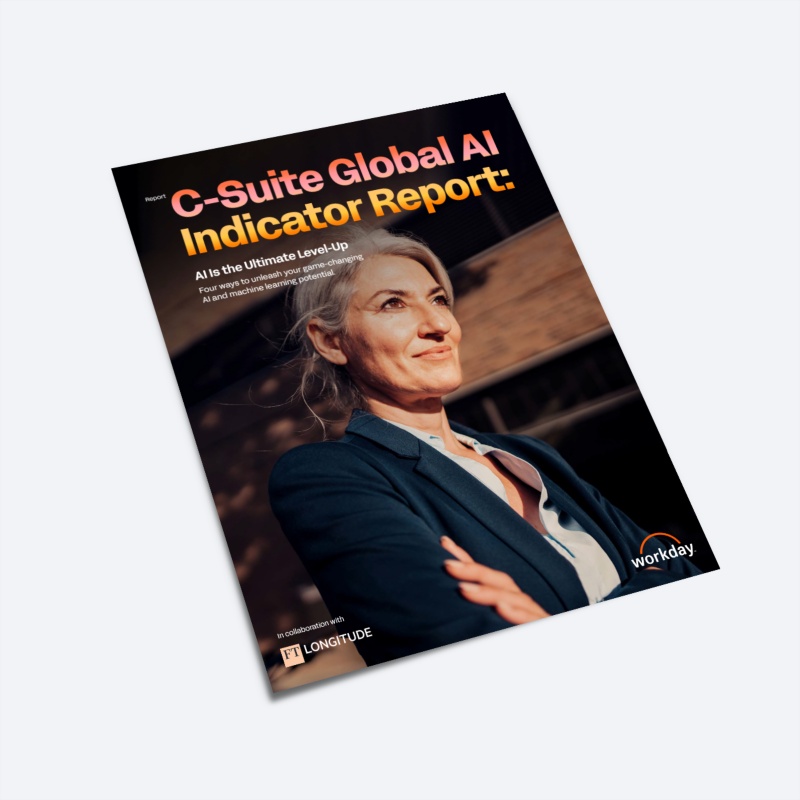
Ninety-eight percent of CEOs foresee an immediate business benefit from implementing AI. Download this report to discover the potential positive impact on your company, with insights from 2,355 global leaders.
Report