Why Capital Investment Planning Is Key to Sustainable Growth
With disciplined planning, capital investments become a long-term growth engine in dynamic markets across industries
Blaise Radley
Editorial Strategist
Workday
With disciplined planning, capital investments become a long-term growth engine in dynamic markets across industries
Blaise Radley
Editorial Strategist
Workday
McKinsey & Company research shows that companies that actively direct capital toward their highest-value opportunities consistently outperform peers that rely on tactical budgeting. The same research links dynamic capital allocation with stronger capital efficiency over time.
Among companies that adjusted at least 30% of capital across regions or business units over a multi-year period, dynamic allocation appeared far more often among high performers than laggards. Capital investments may require complex judgment and sustained attention, but the organizations willing to apply structure by planning see materially different growth outcomes.
Companies that direct capital toward their highest-value opportunities consistently outperform peers.
Report
Capital investment planning is the process of evaluating and prioritizing long-term capital commitments and ensuring they align with long-term goals. By balancing limited funds against priorities, such as international growth and increased headcount, businesses can focus on investments that drive future growth.
Each investment decision draws on financial analysis, execution capacity, and strategic direction at the same time. The capital planning process surfaces those dependencies before allocating resources. It involves:
When tackling common issues like cash flow and supply chain disruptions, it’s important to not lose sight of the big picture. Capital investment planning is a growing priority for businesses across industries looking to expand into markets where capital decisions shape competitive position, while also mitigating risks.
PwC notes that 80% of investors expect companies to increase investment in capital expenditures over the next three years, signaling rising expectations for disciplined capital planning and deployment. By aligning capital planning with strategic goals, businesses are best positioned to seize opportunities, improve efficiency, and track performance in real-time.
Capital investments commit significant company resources for extended periods of time. They demand funding, leadership attention, operating capacity, and follow-through long after approval. But when guided by disciplined capital investment planning, that commitment becomes a growth engine.
Well-planned investments expand core capabilities, reinforce strategic priorities, and create durable platforms for execution. Over time, those effects compound. These are the top 5 areas where capital investments translate long-term commitment into sustained growth:
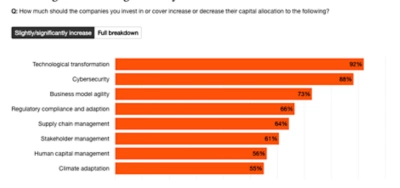
Capital investments play a central role in modernizing the systems that support finance, operations, and decision-making across the enterprise. PwC reports that 92% of investors expect companies to increase capital allocated to this area as technology transformation plays a central role in long-term competitiveness and execution capacity.
Capital today is flowing into comprehensive ERP software, connected data and analytics environments, automation across core processes, and emerging AI-enabled decision support tools. When coordinated through capital investment planning, they form an integrated foundation that supports insight and scale.
When capital investments are supported by smart planning, it becomes a growth engine for the business.
Capital investments enable holistic financial planning because they establish clear, multi-year financial commitments. Once approved, they define when cash is deployed and how returns are expected to materialize over time.
That clarity gives finance teams reliable insight for forecasting, scenario modeling, and capital tradeoff decisions across planning cycles. In a time when finance leaders are increasingly expected to be strategic figureheads and partners across the enterprise, capital allocation is one of the most consequential levers that leaders use to proactively guide short-term and long-term growth.
Market expansion often requires upfront investment in infrastructure, technology, supply chains, and local operating capacity. These investments define how quickly an organization can expand into new regions, support demand, manage risks, and maintain service levels as scale increases.
Nearly 40% of CEOs report that their companies have begun competing in new sectors over the last five years and 34% say geographic expansion is an important growth strategy, indicating that expansion and reinvention are active strategic priorities for many leaders.
Capital investment planning provides a structured way to sequence expansion investments, assess readiness, and align capital commitments with realistic timelines. That discipline supports sustained entry into new markets while also preserving operational stability as the organization grows.
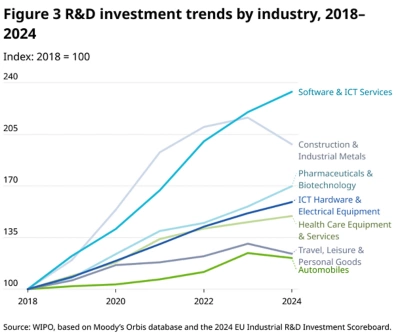
Corporate R&D spending reached a record $1.3 trillion in 2024, even as overall growth slowed to about 3%, signaling continued commitment to innovation despite headwinds. This is especially true in industries like software and IT, pharmaceuticals, biotech, healthcare, and electrical equipment, which have all shown rising R&D investment trends for more than five consecutive years.
Capital allocations focused on innovation give organizations capacity to develop, test, and scale new ideas with intent. They support sustained R&D, faster product development cycles, and controlled experimentation that, over time, create repeatable pathways for bringing new offerings to market and responding quickly to shifts in demand.
As business growth initiatives multiply, organizations face increasing pressure to choose among competing investment opportunities. Capital investment planning introduces rigor into those decisions by evaluating capital projects based on strategic relevance and long-term value contribution.
Organizations with clear capital prioritization practices are better positioned to focus resources on initiatives that generate durable returns rather than dispersing capital across marginal projects. By creating a framework for comparison and review, capital investment planning helps leadership concentrate effort and funding where it can drive the greatest impact over time.
Without clear planning, capital investment decisions can be shaped more by past commitments than future opportunities.
Capital investment planning ultimately comes down to how intentional an organization is about its future. Every major investment locks in priorities, capacity, and direction for years at a time. Without a clear planning discipline, those decisions tend to accumulate reactively, shaped more by past commitments than by where the business actually needs to go next.
The organizations that get this right treat capital as a living strategy. They revisit assumptions, compare opportunities honestly, and stay willing to redirect funding as conditions change. That flexibility doesn’t come from moving fast for the sake of speed. It comes from having a clear decision framework and visibility into how capital choices affect the business.
Getting started doesn’t require reinventing finance or launching a massive transformation. It starts with aligning leaders around how capital decisions are made, what “value” really means for the organization, and how often those decisions should be revisited. From there, capital investment planning becomes less about controlling spend and more about creating room to grow deliberately, even as markets, technology, and priorities continue to shift.
Finance leaders are facing increased expectations from both internal and external stakeholders. Download this report to uncover the top five reasons CFOs are moving to Workday to optimize their finance operations.

Report