Human-AI Collaboration: 4 Key Trends
To succeed with AI adoption, leaders must build an AI-ready culture and a workforce prepared to embrace it with confidence.
Sydney Scott
Editorial Strategist, AI
Workday
To succeed with AI adoption, leaders must build an AI-ready culture and a workforce prepared to embrace it with confidence.
Sydney Scott
Editorial Strategist, AI
Workday
Enterprise AI is now the operating standard. Eighty-eight percent of organizations use AI in at least one function, and leaders reported nearly unanimously to Workday that it’s delivering real benefits.
As standard AI automation gives way to generative AI, AI agents, and full-scale agentic systems, organizations have shifted their thinking from AI as a technology tool to AI as a core part of the operating model. Human-AI collaboration is key to that shift.
To prepare for a future where humans and AI work side by side, leaders need to do more than implement new technology. They must manage the organizational change that comes with it—reshaping workflows and workforce design.
Eighty-eight percent of businesses use AI, and leaders unanimously agree it delivers benefits to the enterprise.
Report
Workday research shows people are comfortable with AI as a collaborator, especially when it supports human-led tasks and workflows. In particular, what’s driving boosted adoption is the belief that agents will ease workloads and boost productivity.
But, things change when AI takes on a role of authority or operates without clear visibility. With adoption continually on the rise, transparency and accountability now determine whether AI earns trust at scale. These are the 4 trends shaping human-AI collaboration:
One of the primary narratives driving AI resistance is the potential replacement of human employees at work. But Workday research consistently shows that as AI advances, it's doing the opposite of replacing humans—it's enhancing their ability to deliver value in their roles.
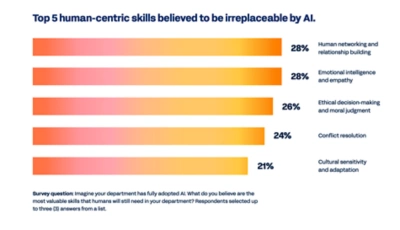
As AI handles routine and automatable work, it highlights the irreplaceability of human capabilities. Leaders rated skills like moral judgement, emotional intelligence, and relationship-building as some of the top skills AI will never replicate in the future.
At the same time, employees using AI report greater focus on areas like strategic thinking, creative work, and complex problem-solving. The real win for leaders is using AI to clear away the busywork so people can actually think. Real value lies in focusing less on technical chores and more on human insight.
Agentic AI emerged in 2025 as the next phase of intelligent AI automation, notable for its ability to autonomously handle workflow execution. With the right frameworks in place, agents can handle routine decision-making, task routing, and reasoning on their own.
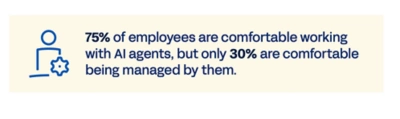
The shift toward agent adoption is widely accepted when expectations are clear—75% of respondents to a recent Workday survey say they feel comfortable working alongside agents. Here are four industries and sectors where agents are already delivering value:
AI agents in HR are responding to routine employee questions and routing requests that require human review.
AI agents in finance are generating forecast scenarios and identifying anomalies in spend or revenue for review.
AI agents in healthcare are prioritizing patient outreach, flagging high-risk cases from clinical data, and escalating care gaps for clinician review.
AI agents in education are recommending personalized learning content and identifying learners who need intervention.
Across domains, teams benefit from the speed, consistency, and data coverage agents offer while pairing their execution power with human ownership when a complex decision or exception is needed. By letting agents handle the heavy lifting and initial reasoning, humans move from being doers to orchestrators. This new model allows humans and agents to effectively solve problems together.
As AI and agents are embraced in the enterprise, the data shows that clear human authority remains important. In fact, only 30% of respondents to Workday's survey feel comfortable with AI agents in management roles.
Comfort drops further when agents handle high-stakes financial decisions or operate without transparency. More significantly, fewer than half view agents as full members of the workforce. Without a human in the loop, employee trust in AI implementation plummets.
Clear boundaries aren't just a safety net. They are the only way to make AI actually work. The goal for leaders isn't to see how much control they can give away, but to prove that humans still hold the wheel. Trust doesn't come from what the AI can do—it comes from knowing exactly where its power ends.
AI technology adoption alone—even when executed well—cannot deliver real outcomes or drive long-term success at the organizational level. Strong human-AI collaboration is key in order to truly integrate AI and realize value from it.
Successful AI-supported business environments share common traits:
Clear expectations for AI use: Employees understand how AI will be used and where human judgement remains responsible for decisions.
Training that builds confidence and fluency: Teams receive practical guidance on how to work with AI tools and integrate them into their daily tasks and workflows.
Governance employees can understand: Oversight, data use, and decision logic are transparent enough for employees to trust AI systems.
Shared responsibility across HR, IT, finance, and leadership: Cross-functional ownership ensures AI adoption accounts for workforce impact, technical integrity, financial risk, and ethical considerations.
An AI-ready culture aligns technology with human judgement, values, and growth potential. Leaders who invest in real change management and are transparent around their goals for AI adoption, will enable the AI-human teams of the future.
Successful human and AI collaboration hinges on intentional leadership.
Successful human and AI collaboration hinges on intentional leadership. AI can expand quickly, but trust, clarity, and accountability don't appear without intentional effort. Leaders shape them through the way accountability is managed and AI tools are handled in practice.
Organizations seeing sustained value today treat AI as part of their workforce system rather than a standalone capability. AI supports analysis, coordination, and execution. People retain judgment, context, and responsibility for outcomes.
That balance is reinforced when leaders reference AI recommendations, explain decisions, and remain visibly accountable:
Set expectations for AI in decisions: Clarify which decisions use AI input and where human judgment remains responsible.
Assign clear ownership for AI-supported outcomes: Ensure accountability sits with a named leader or team, even when AI contributes analysis or recommendations.
Make AI input visible in decision-making: Encourage leaders to reference AI insights openly so its role is understood rather than assumed.
Build leadership capability alongside AI tools: Equip managers to evaluate AI recommendations, apply context, and explain outcomes.
Approach AI adoption as workforce design: Align HR, IT, finance, and business leaders on how AI reshapes roles, expectations, and accountability.
Preparing a workforce for AI collaboration requires decisiveness. Leaders who define roles clearly, model accountable decision-making, and reinforce expectations through daily actions create the conditions for confident adoption. Over time, that clarity enables collaboration to scale alongside AI capability without eroding trust.
A remarkable 82% of organizations are already using AI agents. But is your team ready? Read our latest report to learn how businesses are maximizing human potential with AI.

Report