How to Build a Corporate Financial Plan: 7 Key Steps
Building a corporate financial plan is an exercise in sequencing decisions. Finance teams must establish a reliable financial starting point, translate strategy into clear priorities, and create mechanisms for adjusting those priorities as conditions change. The seven steps below outline how to do that in practice.1. Establish a financial baseline leaders can trust
Start by assembling a shared view of current performance across the income statement, balance sheet, and cash flow. Pull the most recent data available and incorporate known in-flight activity such as committed spend, planned hires, signed deals, and upcoming capital expenditures. Review this baseline directly with leadership and confirm it reflects how the business is operating today.
As part of this planning process, identify constraints that shape decision-making. Liquidity levels, capital availability, and fixed cost commitments define the outer bounds of what the business can pursue. Bring those constraints into the open to give planning conversations a clear starting point.
2. Anchor financial priorities to strategic intent
Translate strategy into explicit financial priorities before forecasts or budgets take form. Work with leadership to decide which outcomes carry the most weight and how tradeoffs should be evaluated. Growth, margin, cash, and resilience all pull in different directions, so clarity here matters.
Capture priorities in plain language and use them as a reference point throughout planning. When priorities are visible, financial decisions align more consistently with strategic intent.
3. Use forecasts to test assumptions
Build financial forecasts around business drivers like volume, pricing, headcount, and capacity. Use multiple operating conditions to observe how the business behaves as assumptions change. Adjust one variable at a time to identify which factors have the greatest impact on outcomes.
Use this analysis to assess exposure and flexibility. At this stage, forecasting supports learning and refinement by showing where plans remain stable and where they need recalibration.
4. Allocate resources dynamically
Use the financial priorities you established earlier to guide where funding goes. Start by mapping current spend and investment against those priorities, then identify areas where resources are misaligned or underutilized. Shift funding toward initiatives that directly support strategic objectives and away from activities that no longer deliver sufficient return or relevance.
Build regular checkpoints into the planning cycle to revisit these allocations. As performance data, forecasts, and assumptions change, reassess whether resources are still flowing to the right places. Set clear decision rights and thresholds for reallocating spend so adjustments happen consistently and predictably. This approach allows the organization to respond to changing conditions while maintaining financial discipline and control.
5. Stress-test plans
Once plans are defined, it's essential to evaluate how well the plan holds up under different conditions. Stress-testing forces you to examine the business plan beyond a single expected outcome and prepares leaders to respond when reality diverges from assumptions.
The objective is to surface risk early and clarify what action looks like before pressure mounts. Build a focused set of scenarios that reflect a realistic range of operating conditions, such as:
- Base-case scenario: Assumptions play out largely as expected, providing a reference point for performance and funding levels
- Downside scenario: Revenue softens, costs increase, or investments take longer to generate returns, revealing pressure points in cash flow and liquidity
- Upside scenario: Demand accelerates or margins improve, testing whether the organization has the capacity and capital to support faster growth
- Break-point scenario: One or two key assumptions shift far enough to materially change financial stability, highlighting where risk escalates quickly
For each scenario, examine impact on revenue, cost structure, cash flow timing, and liquidity. Pay close attention to second-order effects, particularly where small changes in assumptions create outsized financial consequences.
Use these insights to define clear action thresholds. Establish in advance when leadership should adjust timing, scale investment up or down, pause initiatives, or reallocate capital.
6. Operationalize the plan across the business
The goal at this stage is to translate financial priorities and assumptions into guidance leaders across the organization can apply consistently. Needing to reinterpret the plan each time a decision comes up causes unnecessary bottlenecks.
Start by linking the plan directly to the decisions teams make every day, including:
- Hiring and workforce planning: Align headcount targets, hiring timing, and role prioritization with financial assumptions and capacity limits
- Investment approvals: Use the plan’s priorities and scenarios to evaluate new initiatives, capital requests, and expansion efforts
- Operating decisions: Tie spend, vendor commitments, and program scope to the assumptions and constraints embedded in the plan
Make these connections explicit so teams understand how their choices affect financial outcomes and where flexibility exists.
Reinforce the plan through regular leadership forums. Review performance, assumptions, and upcoming decisions using the same financial frame each time. When leaders reference the plan as part of normal operating discussions, it becomes a shared point of orientation.
7. Treat planning as a continuous feedback loop
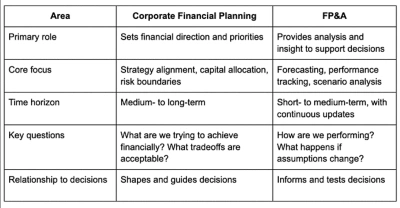
Use the assumptions behind the plan as the reference point for ongoing review during financial reporting. Track performance as new data comes in, and pay attention to where results begin to diverge. FP&A plays a central role here by surfacing early signals—changes in demand, cost behavior, hiring pace, or cash timing—that indicate conditions are shifting.
Finally, bring those signals back into planning conversations and use them to update strategy as needed. When planning operates this way, adjustments happen incrementally and deliberately, rather than all at once under pressure. An ongoing feedback loop keeps financial planning tightly connected to business realities.