The Cost of Inaction: Why Stagnant AI Savings Are a Competitive Risk
Learn why CFOs may want to consider moving beyond pilots to rethink cost structures and avoid margin compression.
Bruno J. Navarro
Senior Editorial Strategist, Finance
Workday
Learn why CFOs may want to consider moving beyond pilots to rethink cost structures and avoid margin compression.
Bruno J. Navarro
Senior Editorial Strategist, Finance
Workday
For CFOs who’ve successfully implemented AI within the finance function, the conversation around the technology has shifted. After initial gains from the technology, some organizations are seeing their results hit a plateau.
Across industries, finance leaders are seeing a troubling pattern: Some early AI pilots delivered promising efficiency gains, but cost structures look largely unchanged months later. Meanwhile, competitors are quietly converting AI into durable margin expansion.
This gap represents a growing competitive risk.
Report
In the last few years, AI adoption moved rapidly from experimentation to expectation. Automation in finance operations, customer support, supply chain planning, and analytics are no longer novel. Boards increasingly assume AI-driven productivity gains are embedded in forecasts, an assumption that creates pressure.
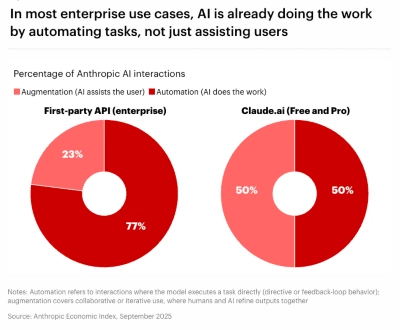
In fact, Anthropic reports that 77% of its enterprise API usage is linked to automating tasks. That share is expected to rise along with the rise of AI adoption and prompting skill levels.
When an organization’s AI initiatives stall at incremental improvements—5% efficiency here, a faster report there—while peers are restructuring cost bases around AI-enabled workflows, the result is widening margin divergence. (Our research found that approximately 37% of the time reportedly saved by AI is lost to fixing outputs.)
Stagnant AI savings don’t show up immediately as a red flag. They surface gradually:
Individually, these issues look manageable. Collectively, they signal competitive erosion.
Stagnant AI savings don’t show up immediately as a red flag.
In this environment, the true cost of inaction becomes the opportunity cost of not compounding gains over time.
Organizations that treat AI as a one-time efficiency project tend to see diminishing returns. Those that treat it as a continuous operating lever unlock second- and third-order effects such as expanding task automation to launch process redesign or connecting reporting speed to an acceleration in decision-making.
When AI savings stagnate, it can mean the organization automated around existing processes instead of rethinking them. The risk is faster inefficiency. As the author of a study, which examined cultural stagnation, wrote about the lack of novelty in AI, “Without it, systems optimize for familiarity because familiarity is what they have learned best.”
From a CFO’s perspective, this creates three material risks:
1. Margin compression relative to peers: If competitors are using AI to permanently lower unit costs, maintaining margins requires constant price pressure or cost-cutting elsewhere. Over time, this limits strategic flexibility and investment capacity.
2. Capital misallocation: AI tools that don’t scale savings still consume budget—licenses, integrations, consultants, internal teams. Without measurable ROI expansion, AI becomes a cost center disguised as innovation.
3. Forecasting blind spots: AI has the potential to materially improve forecasting accuracy and scenario planning. Failing to operationalize these capabilities can mean an organization remains exposed to volatility that peers can anticipate and manage.

When AI savings stagnate, it can mean the organization automated around existing processes instead of rethinking them.
In many organizations, stagnant AI savings are an operating model problem. Common causes include:
For CFOs, the key insight is this: AI does not generate savings simply by existing. It generates savings when it changes how work is done—and how decisions are made.
To garner sustained savings, organizations can evaluate AI with the same rigor as any other capital investment. That means shifting the conversation from asking, “What can this tool do?” to, “What cost structure does this enable?”
In its report on where generative AI in finance is successful, Bain & Company writes, “Early adopters who link gen AI to a modernization agenda will see benefits increase over time as their data, governance, and automation foundations strengthen.”
High-performing finance organizations ask sharper questions that examine what processes should no longer exist once AI is deployed, where AI can replace judgment with probability, and how staffing models might change over a 24–36 month horizon.
This reframing moves AI from experimentation to financial strategy.
Breaking out of stagnant AI savings requires sharper governance and financial discipline. Key actions include:
Most importantly, CFOs will want a clear answer to one question: How does this initiative permanently change our cost structure or risk profile?
If the answer is unclear, the savings likely won’t scale.
Choosing not to push beyond early AI gains is still a decision, one that competitors may happily exploit.
As AI-driven efficiency becomes standard, the absence of sustained savings signals operational inertia. Over time, that inertia shows up in margins, valuation, and strategic options.
For CFOs, the mandate is clear: Treat stagnant AI savings as a competitive risk that demands financial leadership. Because in the next phase of AI adoption, standing still is the most expensive option of all.
Report