The 2026 FP&A Blueprint for High-Velocity Finance
Our top five predictions for FP&A show how AI, scenario modeling, and unified planning are reshaping enterprise finance.
Julie M. Gonzalez
Senior Vice President, Financial Planning & Analysis
Workday
Our top five predictions for FP&A show how AI, scenario modeling, and unified planning are reshaping enterprise finance.
Julie M. Gonzalez
Senior Vice President, Financial Planning & Analysis
Workday
Welcome to 2026! As we dive into a fresh fiscal year, the landscape for financial planning and analysis (FP&A) will soon shift from “digital transformation” as a buzzword to “high-velocity finance” as a reality.
If 2025 was the year of AI awareness and experimentation, 2026 is the year where AI becomes part of the operating rhythm. This shift marks a move from isolated pilots to AI becoming embedded in everyday planning and decision-making workflows. The role of the FP&A professional is no longer about simply gathering or analyzing data, it’s about driving financial value and impacting business outcomes.
Here are our top five predictions for FP&A in 2026.
Report
In 2026, we anticipate the mainstreaming of agentic AI for planning.
Unlike simple bots, these AI agents act as digital analysts. They don't just follow a script; they can reason through multi-step problems. Imagine hiring a teammate on demand. Give it a goal, and it plans, takes action, and learns—no coffee breaks needed.
Instead of an analyst spending three days on a variance report, an AI agent drafts the first version of commentary—flagging that a revenue miss in Europe was driven by lower product volume for a given channel—leaving the human analyst to provide the strategic "so what?" Or, the AI agent auto-generates multiple business scenarios with driver-based variations, empowering FP&A teams to quickly explore alternative futures. Even creating “board-ready” commentary tailored to different audiences.
For years, we’ve talked about the death of the annual budget. In 2026, market volatility—driven by rapidly changing business conditions, geopolitical shifts, and rapid-response supply chains—has finally made static budgets obsolete and impractical for high-performing organizations. In place, we will see heightened focus on eliminating decision latency. Leading organizations already operate with 12- or 18-month rolling forecasts, updated when they need to course-correct or when business conditions evolve. At the same time, planning models are becoming more market-aware, incorporating external drivers like inflation indices, interest rates, and others, to adjust forecasts in real time—fueling more precise, AI-powered predictive forecasts.
In 2026, FP&A isn't just about predicting the future—it's about ensuring the company can survive any version of it. If the 2020s have taught us anything, it’s that the “base case” is usually wrong by February.
As a result, we believe that most FP&A teams will officially move away from the three-scenario model (best, base, worst) toward on-demand scenario simulation. Analysts will spend far less time updating actuals and more time acting as strategic pilots—running their own ongoing simulations, monitoring critical business triggers to proactively make changes based on likely scenarios, and stress-testing decisions as new information emerges.
We believe that most FP&A teams will officially move away from the three-scenario model (best, base, worst) toward on-demand scenario simulation.
In 2026, “unified planning and analysis” will be the standard. FP&A will end being a siloed department with standalone systems but rather a central nervous system orchestrating data flows across the entire organization.
Modern planning solutions will become more ubiquitous, where cross-functional data will be seamlessly integrated. When HR changes a headcount plan, or sales adjusts a pipeline stage in the CRM, or other operational data is updated, the impact on cash flow is reflected instantly in the planning model. The big shift is from “tool sprawl” to platform thinking or an intelligent decision-engine.
As planning becomes more connected across the business, FP&A’s role continues to evolve. FP&A professionals are increasingly embedded within operational units, acting as internal consultants who use data to solve supply chain or marketing ROI challenges before they hit the P&L.
As planning becomes more connected across the business, FP&A’s role continues to evolve.
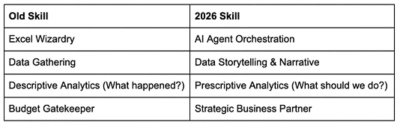
To thrive in an era of high-velocity finance, FP&A professionals will need to expand their skill sets in several key ways:
The bottom line: AI’s arrival for FP&A teams does not mean hands-off finance. It means higher impact, shifting from reactive to proactive, from simply planning a business to truly steering a business. Success in this transition requires a departure from legacy mindsets. If teams remain anchored to yesterday’s best practices, they will fail to capitalize on the true capabilities of modern, AI-powered technology.
The FP&A leaders who succeed in 2026 won’t be the ones who build the most complex models, but the ones who best interpret what the models and signals mean for the future of the business—the ones who challenge assumptions and help the business move faster with confidence. Rather than reporting on the past, they are engineering the future. The transition from cost-center to profit-driver happens when teams stop managing data and start managing outcomes.
See how leading finance teams are rethinking how planning, forecasting, and scenario modeling work together so they can move faster with confidence. Bring high-velocity finance to life with Workday Adaptive Planning. To learn more, visit workday.com/planning and book a live demo or free trial today.

Report