Scaling AI: From Pilot to Human-Centric Value
Discover how two AI-native founders move beyond the hype to deliver measurable ROI through people-centric, problem-first innovation.
Emily Faracca
Multimedia Content Writer
Workday
Discover how two AI-native founders move beyond the hype to deliver measurable ROI through people-centric, problem-first innovation.
Emily Faracca
Multimedia Content Writer
Workday
Audio also available on Apple Podcasts and Spotify.
AI is the most exciting frontier for business innovation right now. But the technology itself isn’t driving transformation. Rather, it’s the people, teams, and organizations that are continually discovering new ways to unlock the potential of AI, turning its capabilities into measurable value and game-changing outcomes.
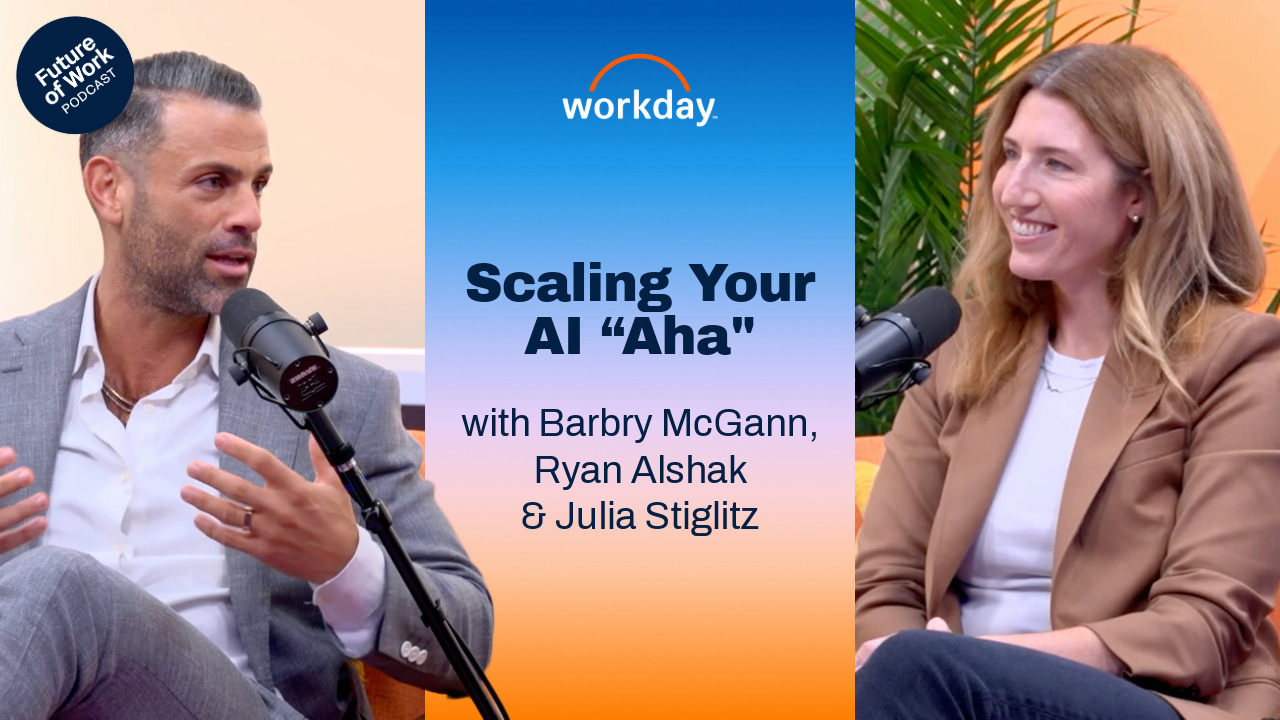
This was the guiding principle behind a conversation with Barbry McGann, managing director and senior vice president of Workday Ventures, and two founders building AI-native companies inside the Workday ecosystem: Julia Stiglitz, CEO of Uplimit, and Ryan Alshak, CEO of Laurel.
Together, they unpacked what it really takes to move from AI pilots to enterprise-wide adoption, and why a people-first mindset is the difference between experimentation and enduring value.
Report
We all know that AI is brimming with possibilities to explore. The sheer number of them could cause a business leader’s eyes to grow big—or glaze over. Finding your focus is critical, and should be guided by identifying where genuine pain points can be alleviated.
“AI is so exciting, the demos are so cool,” Stiglitz notes. “It can be easy to be enamored by the technology, but unless the technology is solving an actual real problem for the organization, it won’t get adopted across the board.”
That dynamic shows up repeatedly across enterprises. AI pilots launch with enthusiasm, but stall because success metrics were never clearly defined. Without alignment on what should actually change—whether that’s time saved, costs reduced, or outcomes improved—initiatives remain stuck in proof-of-concept mode.
There’s a difference between AI adoption and AI value. Alshak shared an example from a Laurel customer that had rolled out Microsoft Copilot broadly across the organization. When usage data was analyzed, the top use cases were Teams chat, drafting emails in Outlook, and—tellingly—asking Copilot what Copilot could do.
This highlights a growing disconnect in the enterprise: metrics that look good on a dashboard don't always translate to the bottom line.
As Alshak puts it, “Right now, adoption is the most used metric as a proxy for success for AI tooling. But just because you’re using a tool doesn’t mean you’re actually getting value.”
In many organizations, adoption metrics have become a narrow barometer of success. But elevating AI demands more rigorous measurement. As Alshak emphasizes, enterprises need telemetry and instrumentation that connect AI investments to results leaders actually care about—namely, time and money saved.
For Laurel, that means quantifying how much time professionals save and how much revenue companies generate as a result. For customers, it gets to the heart of justifying these investments: Is this AI making work better?
Right now, adoption is the most used metric as a proxy for success for AI tooling. But just because you’re using a tool doesn’t mean you’re actually getting value.
- Ryan Alshak, CEO, Laurel
When moving AI from pilot to enterprise scale, executive sponsorship is essential. So is frontline belief. This is where demos can fall short.
Stiglitz stresses that successful pilots are designed to create an “aha moment” for users. An immediate, hands-on experience of value can change how people think about their work.
“If you want to drive adoption across a lot of end users, they need to have that aha moment from actually experiencing the value of that technology,” she says. “It can’t be watching a video about something.”
Stiglitz has deep professional roots in the education space, having worked with Teach for America and Coursera before co-founding Uplimit, an AI-powered learning platform. This gives her a deeply informed perspective on how to make new knowledge and habits stick.
For Uplimit, Stiglitz says impact and ROI are primarily measured across two dimensions: efficiency and learner outcomes. Are the business and the employees both clearly benefiting? Their customers are proving out both. Databricks, for example, has used AI to dramatically reduce instructor time while scaling cohorts from dozens of learners to thousands.
When people see that AI helps them learn faster, apply skills more effectively, and grow in their roles, adoption follows naturally.
“If you want to drive adoption across a lot of end users, they need to have that aha moment from actually experiencing the value of that technology.”
- Julia Stiglitz, CEO, Uplimit
Recognizing the need to engage both corporate and personal interests, Alshak looks at AI adoption through a B2B2C lens. Enterprises may purchase AI tools at the organizational level, but individual employees ultimately decide whether those tools become part of daily workflows.
Thus, a messaging paradox: what motivates executives doesn’t always motivate end users. “Show me the incentive, I’ll show you the behavior,” as Alshak puts it.
For leadership teams, the narrative might be revenue growth, margin improvement, or operational efficiency. Meanwhile, employees are looking for fewer tedious tasks, less administrative burden, and more time spent on meaningful work.
Tailoring your message to the right audience and connecting the outcomes holds the key to resonating with all parties.
We’ve seen that AI can outperform humans in certain forms of analysis and pattern recognition, but many fundamental aspects of work remain uniquely human: building relationships, exercising judgement, and strengthening trust.
Alshak anchors his approach in this viewpoint. “I’m a human optimist,” he says. The AI and data revolution helps him gain clearer insight into how the human element can be understood and optimized.
“Why am I so excited about our Workday partnership? We've actually never quantified how much time people are spending on HR, on performance management,” he observes. “Are we happy with that number? Do we want them doing more, less? You cannot manage what you don't measure.”
Stiglitz, meanwhile, is most excited about the role AI can play in making opportunities to learn and grow more accessible. “There’s still a scarcity in terms of people having access to really quality learning experiences,” she says. “What AI unlocks is that you can make it not scarce anymore.”
By putting people first and weaving that perspective into the business conversation, Laurel and Uplimit—along with numerous other rising stars in the Workday Ventures community—are channeling AI excitement into groundbreaking innovation.
Report