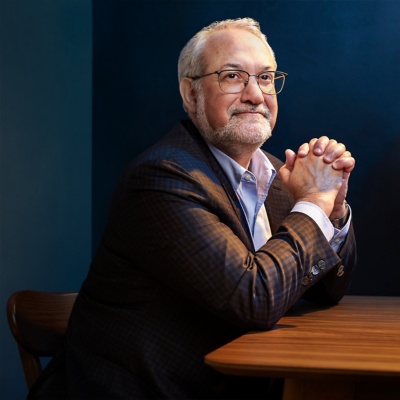
Motti Finkelstein: Intel’s Business-First CIO
Learn how Intel’s IT leader uses focus, automation, and disciplined use of AI to transform complexity into clarity at enterprise scale.
Julie Colwell
Principal Strategist
Workday
Learn how Intel’s IT leader uses focus, automation, and disciplined use of AI to transform complexity into clarity at enterprise scale.
Julie Colwell
Principal Strategist
Workday
When Motti Finkelstein joined Intel as its IT leader in 2022, he didn't walk into a stable environment, he walked into a tumultuous one. The semiconductor giant was embarking on its ambitious IDM 2.0 strategy—a massive, multi-billion-dollar bet to rescale its manufacturing, expand its foundry services, and navigate profound global supply chain complexity.
In such a high-stakes environment, the role of IT becomes pivotal. For Finkelstein, a seasoned technology executive with a diverse background spanning the Israeli Air Force, the City of New York, and global finance at Citi and Bank of Montreal, the goal was clear. IT could not just be a service provider, it had to be a foundational business partner.
His leadership philosophy is built on a business owner’s mindset, a principle that has allowed his IT department to restructure operations and deliver more than $1.5 billion in business impact through faster time-to-market and improved cash flows.
Report
Finkelstein’s business-first philosophy was not developed at Intel, it was proven there. His career has been a masterclass in navigating and optimizing complex, high-stakes environments.
It began in the Israeli Air Force Computer Unit, a role he landed partly because of his native English knowledge and ability to comprehend the dense technical manuals. He describes the job as being a jack-of-all-trades. “I had to understand everything—the outcomes for the business, how to move logistics, how to repair things. And most especially, the overall goal. What were the KPIs that mattered.”
“I had to understand everything—the outcomes for the business, how to move logistics, how to repair things. And most especially, the overall goal.”
This calm, collected, and relentlessly logical approach was forged decades earlier. As a junior officer in the Air Force, Finkelstein was put on rotation in the help desk. "You were the new guy? You took the calls," he recalled. "And that's how you learned. You had to go find out the answer and solve it. It was training under fire.”
Later, he faced a massive system upgrade that failed catastrophically at 2:00am. With only a four-hour downtime window, panic set in.
"My boss at the time said something fascinating to me," Finkelstein said. "He said, 'Let's go have a cup of coffee.’”
The lesson: "You need to sit back. Think in a calm, cool, and collected way. Because if you're going to be all frazzled, you're not going to be able to solve the problem.”
(The bug, it turned out, was that the new CPU was too fast and had more cores, causing processes to start before dependencies were ready. Finkelstein and his boss found a fix well before the “green zone” window ended.)

After the military, he worked for the City of New York, leading a massive project to consolidate all city agency data centers into a single new department. This was followed by a 22-year tenure at Citi, where he held nearly a dozen different roles and rose to senior technology leadership. It was at Citi where he learned to manage the complexities of a global IT organization operating in ~108 different countries.
From there, he was a senior advisor at McKinsey and CTO for Capital Markets at the Bank of Montreal. This diverse path, from military logistics to public sector consolidation and global finance, prepared him for the challenge he was about to accept at Intel.
One of Finkelstein's first moves at Intel was to challenge the very definition of transformation. When he arrived, he found a system where projects were tagged as "digital" so they received extra funding. He saw this not as a driver of innovation, but as a financial exercise that distracted from the real goal.
"The most important thing was to prioritize outcomes.”
"Everything we were doing had a digital component. It was an irrelevant designation," Finkelstein said. "The most important thing was to prioritize outcomes.” He promptly eliminated the project tagging.
This move was a direct cure for a common corporate ailment. He found Intel's incredible talent was spread thin, trying to appease everyone and do everything for everyone. By removing the arbitrary labels, he forced a new, more difficult conversation focused on a single question: what actually matters?
This focus allowed Intel to shift from many projects to ensuring the top three to five projects for every business unit were delivered much faster, all based on defined business needs.
Finkelstein's business-first approach was on full display as he took charge of IT's role in the IDM 2.0 Acceleration Office. During an early conversation with Intel's CFO, Dave Zinsner, he said, “We’re not just doing an IT product migration, we’re doing a complete business transformation. We can have the product installed and ready to use in no time, but it won’t make it usable without the business changes.
The point, he explained, was that IT is not about installing software. True transformation is about fundamentally changing business processes, streamlining data, and making operations fit for today. And crucially, he argued, IT cannot and should not make those decisions for the business, but needs to be the business trusted advisor and partner.
Instead, we ensured that global process owners from the business itself lead the charge. IT's role was to be the expert partner to enable it. The result was a massive business transformation enabled by IT, built on partnership, not ticket-taking.
Finkelstein in conjunction with the AI management review committee that existed at the time jointly applied the same rigorous, outcome-based logic to the generative AI boom. While many organizations are experimenting broadly, the strategy is characteristically focused. His guiding principle is to follow the money.
"What does the company spend the most money on that AI can help?
"What does the company spend the most money on that AI can help? And how do we optimize and reduce those costs?" he asks. "We also wanted to know how AI can increase our time to market and revenue generation.”
This framework led Intel to focus its initial AI investments on four key areas: manufacturing, pre-silicon, post-silicon, and software development. The company established a GenAI blueprint and a centralized platform they called Intel Forge to standardize governance and security. But the business units are still responsible to prove its ongoing value.
"It's not cheap," Finkelstein says. "AI is not free, so the effort has to show value. Which can be seen by productivity, velocity, and savings.”
"Be curious. Understand your company's goals, understand what motivates your peers, and above all, be their partner.”
This governed approach is already paying dividends. As of mid-2025, Intel's internal GenAI platform had already saved roughly 1 million work-hours and generated an estimated $400 million in business value.
His advice for the next generation of CIOs is simple, and it's the code he lives by, "Be curious. Understand your company's goals, understand what motivates your peers, and above all, be their partner.”
A remarkable 82% of organizations are already using AI agents. But is your team ready? Read our latest report to learn how businesses are maximizing human potential with AI, featuring insights from nearly 3,000 global leaders.
Report