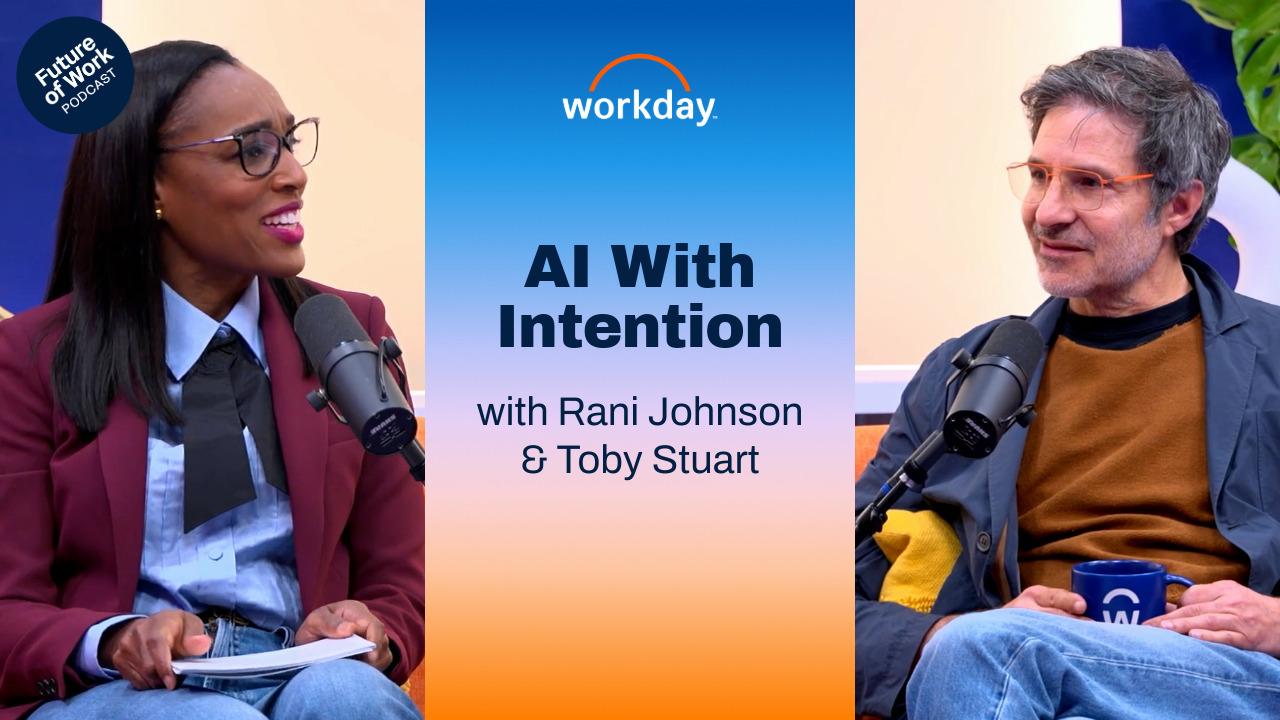
The Hidden Cost of Clarity in the Age of AI
As AI reshapes every corner of the enterprise, Toby Stuart explains how CIOs can guide their organizations with clarity, intention, and bold optimism.
Emily Faracca
Multimedia Content Writer
Workday
As AI reshapes every corner of the enterprise, Toby Stuart explains how CIOs can guide their organizations with clarity, intention, and bold optimism.
Emily Faracca
Multimedia Content Writer
Workday
Audio also available on Apple Podcasts and Spotify.
There’s a myth in the air that AI success demands instant ROI and overnight transformation. Not so fast.
Workday CIO Rani Johnson had the chance to sit down with someone who has been helping organizations navigate one of the biggest technological shifts of our time: Toby Stuart, chair of Workday’s AI Advisory Board and helzel professor, UC Berkeley-Haas.
In their conversation, Stuart offered clarity, confidence, and a bit of joy about what it means to lead in the age of AI. Here are some of the themes that stood out.
Guide
In some ways, the AI adoption era can feel like a race we are all compelled to participate in. Resisting that notion, Stuart encourages business leaders to take a beat. With everything moving so quickly, it can be advantageous to stay patient and attentive to new breakthroughs.
“We absolutely see some incredible deployments of AI so far,” he says. “But I think a lot of companies should take a step back, take a breath, look at what's happening and decide when the moment is.”
It may be that the most valuable solution for your needs is still on the way. Stuart references Workday’s recent enhancements to the AI Agents suite as an example of how AI technology continues to evolve and solve different problems. “But those didn’t exist last week, at least not on the market.”
The organizations that win, Stuart believes, will be the ones that adopt AI intentionally, aligning timing and investment with real business value.
One of the most energizing ideas from the conversation: AI will soon reshape what every function does, owns, and leads. This creates opportunities for organizations to radically reimagine how various roles can impact growth and success. We’re entering an age of blurring boundaries and new collaborations.
Technology leaders will be pivotal in spearheading this transformation. Stuart underscores the importance of clarity in setting a vision, carving out jurisdictions, and managing expectations.
“If I'm a CIO today,” he says, “I want to be super clear about articulating roles, responsibilities, accountability, and metrics so that I'm not on the hook for things that aren't reasonable and that I'm not resourced for.”
While having a patient and opportunistic mindset is valuable, CIOs need to stay proactive and in control. Don’t let AI happen to your organization; help shape how it happens. Although the timeline and specific implementations of AI are variable, there’s no avoiding its permeation.
“AI to me is not a thing, it's everything. It will impact every aspect of organizations.”
—Toby Stuart, chair, Workday AI Advisory Board
You might have heard the buzz lately around an MIT survey claiming that AI investments don’t generate ROI. Stuart notes the irony that this small-scale, unrigorous study received significant attention compared to a much larger Google Cloud study that found the opposite.
But also, he says, fixating on ROI at this moment in time is a bit misguided from a strategic standpoint. On the one hand, there is value in measuring ROI via small-scale deployments in narrow, well-defined pilots—via techniques like A/B tests and controlled experiments. On the other hand, an urge to obsess over immediate return on investment can cause organizations to overlook big-picture opportunities and fall behind.
Johnson emphasized that this pressure to move fast while proving immediate ROI can create unrealistic and burdensome expectations for IT leaders.
“I think we should remove ROI from the conversation because it’s now apparent to everybody… This is the way the world is migrating. Your job is to build, and prepare the company and the product it makes for the future. That's an AI future.”
—Toby Stuart, chair, Workday AI Advisory Board
While he’s optimistic about what the future of AI holds, Stuart doesn’t beat around the bush: it’s not all going to be roses and daisies.
“This is going to be a year of miracles,” he says. “And it's also going to be a year of minor fiascos.”
Heeding this refreshingly honest take, leaders should make sure they are prepared for whatever may come. That means:
Progress doesn’t come from waiting for perfection. It comes from building the muscle and developing skills to thrive.
As the conversation wrapped, Stuart left CIOs with a powerful call to action:
“It’s insane to try to bite off the whole thing…but it’s also crazy at this point not to start articulating roles. I like the CIO’s office leading in that articulation and thinking very carefully about measurement and metrics.”
This is the time for CIOs to help their organizations navigate the unknown, define the playbook, and bring teams together around a shared path forward.
Top leaders of tomorrow will be forged and distinguished through this experience—through curiosity, courage, and willingness to rethink how work gets done. Conversations like this one remind us that AI isn’t just a tool, but a catalyst for reinvention.
Guide