AI Agents vs. Agentic AI: The Key Differences
Most organizations are already experimenting with AI agents. Understanding how they operate under agentic AI systems is essential to maximize returns.
Sydney Scott
Editorial Strategist, AI
Workday
Most organizations are already experimenting with AI agents. Understanding how they operate under agentic AI systems is essential to maximize returns.
Sydney Scott
Editorial Strategist, AI
Workday
AI is ubiquitous in modern business—a necessity to achieve the level of speed, scale, and data intelligence required to be competitive. Today, 82% of companies report they're also experimenting with or using AI agents to further automate workflows at their organization.
What’s less obvious is that AI agents don’t operate on their own. They rely on agentic AI to interpret high-level objectives and orchestrate the steps needed to achieve an outcome. In short: Agentic AI is the thinker, defining the plan; AI agents are the doers, executing tasks within the plan.
Many organizations use both without clearly understanding the distinction. But clarifying the roles of AI agents vs. agentic AI is important to help leaders design smarter automation strategies and understand how work should be delegated across multiple systems.
Eighty-two percent of companies are using AI agents, but they often don't know their distinction from higher-level agentic AI.
Report
Agentic AI refers to AI systems that interpret high-level goals, reason through the steps required to achieve an outcome, and determine the best plan for execution. Agentic AI operates a level above task-based agents and generative models, functioning as a strategic layer of intelligence that can understand what needs to happen and why.
In enterprise contexts, agentic AI can orchestrate multi-step workflows and coordinate multiple AI agents with minimal oversight. It can adjust decisions as new information becomes available and bring the contextual reasoning and autonomy needed for complex processes without relying on human judgement.
Agentic AI systems are built on large language models (LLMs) trained on vast amounts of text and data. This training enables LLMs to understand and generate human-like responses, while further interpreting intent and meaning. Those interpretations then enable the strategic thought and complex decision-making that empowers agentic AI to reach its goals.
Key attributes of agentic AI include:
For example: When employees submit a payroll discrepancy, an agentic AI system could review the employee's pay history, compare it to time data, identify the source of the discrepancy, and route follow-up tasks to agents, including notifying the employee of the resolution. Since agentic AI adapts in real-time, this can all be done without requiring human input—unless a true exception occurs.
AI agents are task-oriented software systems that carry out specific, predefined actions within a workflow. Where agentic AI determines the plan, AI agents are responsible for completing the steps that move a process forward.
AI agents follow rules and instructions. They excel in environments where tasks are repeatable, high‑volume, and require precision. They don’t make strategic decisions but they can perform their assigned functions reliably and at scale.
Key attributes of AI agents include:
In practice, AI agents show up across day‑to‑day operations in highly targeted ways. An AI agent in HR might respond to routine employee inquiries, guiding staff to the right answers without requiring human support. AI agents in finance might pull real-time vendor or budget data from systems of record, validate it against approval thresholds, and pass the correct figures into downstream workflows.
Agentic AI is the "thinker," understanding goals and orchestrating plans to reach the right outcome. AI agents are the "doers," carrying out the execution steps.
Although agentic AI and AI agents most often work together, they play fundamentally different roles in how work is planned, executed, and adjusted. Agentic AI determines the direction of a workflow and adapts it as conditions evolve, while AI agents excel at carrying out the specific tasks that move the process forward.
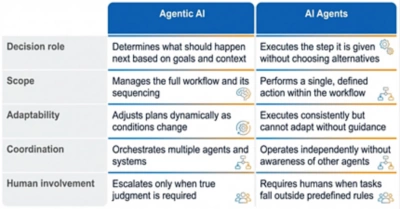
Understanding how their responsibilities diverge makes it easier to design automation that is resilient, efficient, and aligned with business goals. Here are five key differences between AI agents and agentic AI.
Agentic AI evaluates the state of a workflow and determines what should happen next. It weighs constraints, interprets changes, and adjusts its plan to keep the process aligned with the intended outcome.
AI agents do not decide between alternatives. They act only when given an instruction, follow that instruction exactly, and pause when a decision or deviation requires judgment beyond their scope.
Agentic AI manages the broader workflow, including the sequence of steps, their dependencies, and how they should adapt over time. It maintains awareness of how individual actions fit together.
AI agents operate within a narrower portion of that workflow. They perform a specific task such as gathering data, updating a record, or routing information, but they do not manage the sequence or understand the larger context.
Agentic AI responds dynamically as new information enters a process, enabling it to learn and adapt. If an exception appears or conditions shift, it reevaluates the path forward and redirects the workflow accordingly.
AI agents function best in predictable environments. As long as tasks match the rules they were designed for, execution is consistent. However, when something falls outside of those rules, they wait for an updated direction.
Agentic AI coordinates how various agents and systems contribute to a workflow. It manages timing, dependencies, and information flows so the overall process progresses smoothly.
AI agents do not coordinate with one another on their own. They complete their individual steps when assigned and return control to the orchestrating system.
Agentic AI reduces the amount of human oversight required by managing decisions, resolving routine issues, and escalating only when judgment is necessary.
AI agents require human involvement when a situation falls outside their parameters or when a process cannot proceed without additional direction. Their reliability lies mainly in execution, not supervision.

Agentic AI and AI agents each contribute distinct value to data and business process automation strategies. Agentic AI provides the intelligence required to guide strategic work and coordinate activity across systems. AI agents deliver the focused execution that turns those decisions into measurable progress.
When organizations design workflows that reflect these complementary roles, they can create a more resilient and scalable foundation for intelligent automation. A strong agent-based system also lays a building block for future capabilities, enabling enterprises to evolve their automation strategies with confidence as their needs grow and technologies advance.
A remarkable 82% of organizations are already using AI agents. But is your team ready? Read our latest report to learn how businesses are maximizing human potential with AI, featuring insights from nearly 3,000 global leaders.
Report