Artificial Intelligence
The Workslop Crisis: Are Your Colleagues Trading Quality for AI Speed?
The most effective defense against AI slop is a team with a pilot mindset.

Sydney Scott
Editorial Strategist, AI
Workday

The most effective defense against AI slop is a team with a pilot mindset.
Sydney Scott
Editorial Strategist, AI
Workday
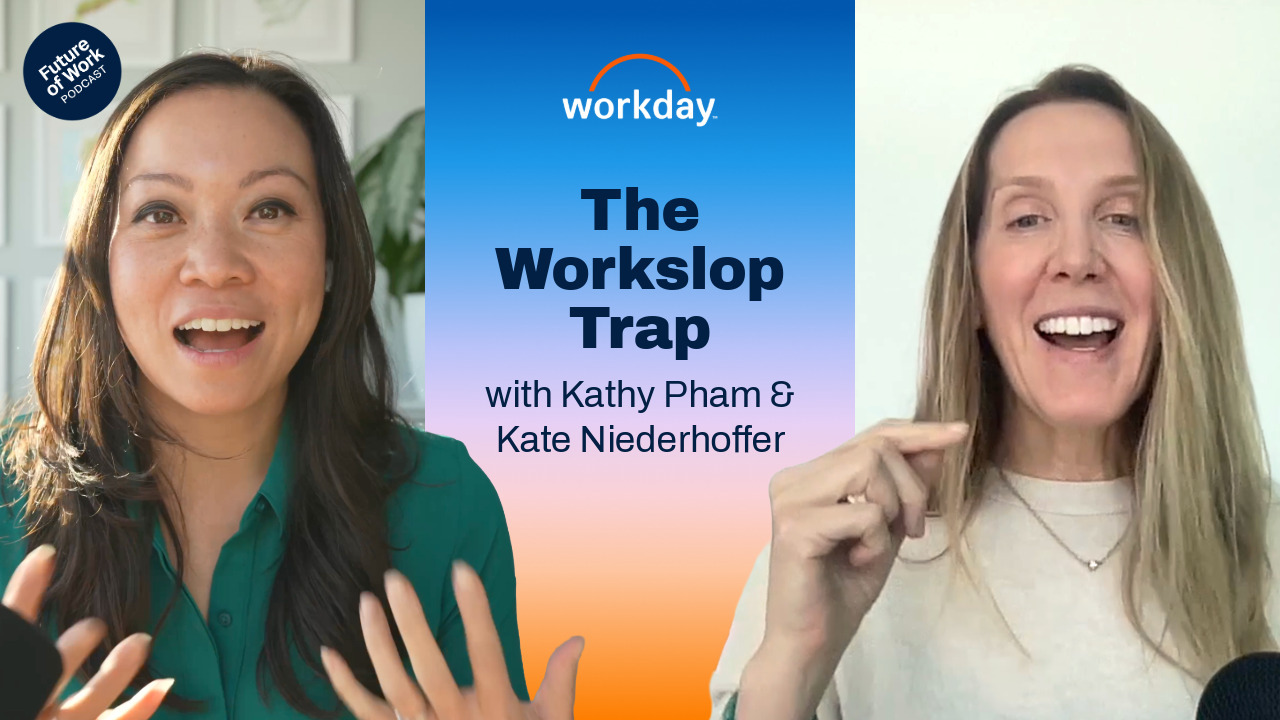
Audio also available on Apple Podcasts and Spotify.
In many ways, AI is the ultimate co-pilot. It frees us from tedious, time-consuming tasks and gives us the opportunity to focus on creative, strategic work. But only if we know how to use it.
There’s a crisis of quality unfolding. Many offices are drowning in workslop—AI content that looks professional but lacks the substance to actually move a project forward. It has created an "effort asymmetry," where work is cheap to produce but incredibly expensive for a human to verify. Researchers from BetterUp and Stanford found that around 40% of U.S. workers have experienced workslop and each instance takes around 2 hours for a colleague to rework, amounting to about a 9 million-dollar loss in productivity for a 10,000-person company.
It’s something Dr. Kate Niederhoffer, chief scientist and head of BetterUp Labs, and Kathy Pham, Workday’s VP of AI and open technology, recently explored on the Future of Work podcast.
Discussing the hidden cost of AI inefficiency, the pair presented a new idea for leaders: intentionally adding friction back into AI systems to force humans into the pilot's seat.
Report
Workday research found that for every 10 hours of productivity gained, we pay back about four hours in rework—correcting, clarifying, and refining AI output. This is why the people most excited about AI are often the ones feeling the most exhausted.
"The highest adopters, the highest enthusiasts of AI, were actually reporting the most burnout,” Pham explains. We have become excellent at volume, but in an AI-driven world, raw speed is just the baseline.
As Dr. Niederhoffer puts it, "It’s like you’re just doing whatever it takes to work with what other people give you because you want so badly for this tool to be a panacea.” To unlock real potential, we have to move from gross efficiency to net value.
The greatest irony of all is that for AI to work, we need to be better at being human.
— Dr. Kate Niederhoffer, Chief Scientist, BetterUp Labs
If chasing speed is what got us into this mess, reclaiming our sense of control is the only way out. This requires moving away from blanket AI mandates and instead instilling professional development for what Dr. Niederhoffer calls a "pilot mindset.”
She explains that this mindset is "a unique cocktail of [both] high optimism and high agency that leads to the most powerful usage, higher adoption, and higher discernment.
With this approach, you don't just sit in the back and let the AI fly the plane; you are constantly checking the dials, adjusting for changes, and making the final call on the landing.”
The benefits of a pilot mindset reach far beyond AI adoption and include increased productivity (+19%), goal attainment (+35%), innovation (+13%), and job performance (+16%). The incorporation of AI into workplaces makes the decidedly human parts of management more important than ever before. Those with pilot mindsets are more emotionally energized at work and the impact rubs off on their teams. In fact, those reporting into a manager with a pilot mindset are 2-3xs as likely to adopt the mindset themselves.
Forward-thinking companies are now building in agency checkpoints that act as a "Whoa, let's take a look at this" moment. These checkpoints force us to stop and ensure the AI is actually being used in a beneficial way. It’s the difference between just running fast and actually making progress. When we let AI handle the whole journey without these checkpoints, we stop being pilots and start being passengers—and you can’t lead a business from the passenger seat.
We have become excellent at volume, but in an AI-driven world, raw speed is just the baseline.
The C-Suite is at a crossroads. Keep chasing gross efficiency and watch their most enthusiastic AI adopters burnout? Or, embrace a new kind of leadership that prioritizes value and human judgement? Choosing that second path requires us to stop seeing AI as a way to replace human effort and start seeing it as a way to augment it.
The goal isn't to ban AI, but to create a culture where humans feel safe enough to experiment and take risks. By building intentional AI checkpoints into our workflows, we protect the space needed for transforming generic output into breakthrough work.
As Dr. Niederhoffer perfectly summarized on the podcast: "The greatest irony of all is that for AI to work, we need to be better at being human.” We are moving toward a future where the most valuable skill isn't knowing how to use the tool, but having the discernment to know when the tool needs a human touch.
Report

AI has been a gamechanger across nearly every industry and marketplace. But realizing the true value of AI requires buy-in between different stakeholders. In this AI Masterclass, learn how you can make the most of AI for finance, HR, and more.