Top 5 AI Agent Frameworks for 2026
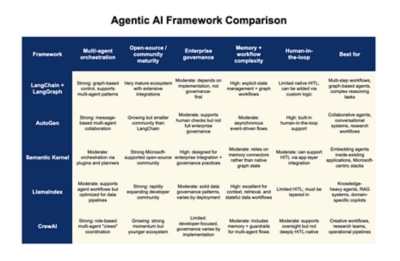
Organizations evaluating AI agent frameworks are looking for platforms that can support reliable agents and complex multi-step tasks without sacrificing on governance or flexibility. Leading frameworks take different approaches—some focus on graph-based control flow, others on data-centric retrieval, and some on multi-agent coordination or orchestration.
Understanding each framework’s design and the real-world examples of AI agents they power helps teams match their agent use cases to the right foundation and architecture. Here are five of the top AI agent frameworks available to businesses in 2026.
LangChain is an open-source framework for building AI applications with large language models, and LangGraph extends it with a graph-based runtime for long-running, stateful workflows and agents.
Key capabilities:
- Graph-based workflows: Models agent behavior as a graph, with nodes representing steps and edges representing transitions, including support for single-, multi-, and hierarchical-agent patterns
- Stateful execution: Provides shared state and persistence for long-running workflows and iterative agent loops
- Ecosystem integrations: Connects to a wide range of models, vector stores, tools, and data sources through the broader LangChain ecosystem
Best suited for: Teams that want fine-grained control over agent workflows, especially multi-step or multi-agent applications that benefit from explicit graph structure and state management.
AutoGen is an open-source programming framework from Microsoft for building agents and multi-agent applications, with a strong focus on conversational and collaborative interactions.
Key capabilities:
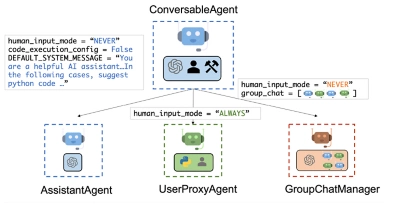
- Multi-agent collaboration: Enables multiple specialized agents to communicate via messages and cooperate on tasks
- Human-in-the-loop support: Allows agents to work autonomously or alongside human users, with configurable intervention points
- Asynchronous workflows: Supports event-driven, asynchronous interactions between agents to handle more complex workflows
Best suited for: Applications that center on conversational agents, collaborative problem-solving, or scenarios where humans and agents need to work together within the same workflow.
Semantic Kernel is Microsoft’s lightweight, open-source SDK for building AI agents and integrating large language models into .NET, Python, and Java applications.
Key capabilities:
- Plugin and skill model: Organizes capabilities into plugins and functions that agents can invoke, allowing structured tool use and orchestration
- Model-agnostic orchestration: Supports multiple model providers while offering a common abstraction layer for prompts, plans, and executions
- Enterprise alignment: Designed to act as middleware in production systems, integrating with existing application code and services
Best suited for: Engineering teams that want to embed agent capabilities directly into existing applications, especially in Microsoft-centric environments, while keeping a clear separation between orchestration logic and business code.
LlamaIndex is an open-source framework that began as a data layer for LLM applications and has evolved into a developer-focused framework for context-aware AI agents and workflows.
Key capabilities:
- Data-centric design: Provides tools for ingesting, indexing, and querying private or enterprise data so agents can ground their reasoning in relevant context
- RAG and agents: Offers retrieval-augmented generation pipelines and agent abstractions that can chain retrieval, reasoning, and action-taking
- Event-driven workflows: Supports stateful, event-driven workflows and custom agents that operate over structured and unstructured data
Best suited for: Knowledge-intensive applications—such as research assistants, internal copilots, and domain-specific agents—that must reliably interact with complex or proprietary data sources.
CrewAI is an open-source Python framework for building and orchestrating multi-agent "crews,” or groups of specialized agents that collaborate to complete tasks.
Key capabilities:
- Role-based agents and crews: Lets developers define agents with specific roles and skills, then organize them into coordinated crews for end-to-end workflows
- Built-in guardrails and memory: Includes mechanisms for memory management, knowledge, and guardrails to help keep multi-agent interactions on track
- Developer and UI tooling: Offers both a code-first experience and visual tools for designing, testing, and deploying multi-agent workflows
Best suited for: Teams that want to structure work as collaborative, role-based multi-agent processes—such as content pipelines, research workflows, or operational automations—without building their own orchestration layer from scratch.