A Prescription for Innovation
From AI tools to a Minecraft hospital, CIO Dr. Zafar Chaudry solves problems and keeps young patients connected at Seattle Children’s.
Julie Colwell
Principal Strategist
Workday
From AI tools to a Minecraft hospital, CIO Dr. Zafar Chaudry solves problems and keeps young patients connected at Seattle Children’s.
Julie Colwell
Principal Strategist
Workday
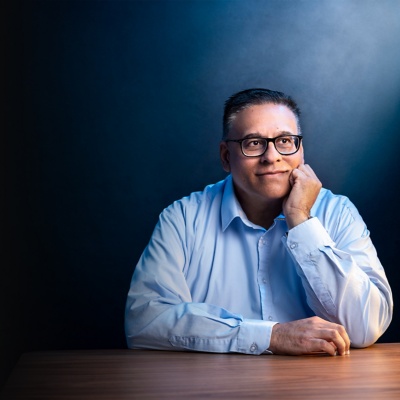
Dr. Zafar Chaudry, senior vice president, chief digital and AI officer at Seattle Children’s, has a simple rule for innovation: listen. As both a physician and a technologist, his first question for his staff is never about technology or even health. Instead, he asks, “What problem are you actually trying to solve?” This approach is reshaping the patient experience, empowering staff across the pediatric health system, and proving that the best technology is deeply human.
Dr. Chaudry’s own path to this role began in the early 1990s when, as a physician in the U.S., he volunteered for a tech project simply to get off the grueling night shift. That decision sparked a career that has taken him across the globe, with leadership roles at Cambridge University Hospitals and as a global research director for healthcare at Gartner. This international career has evolved into managing the technology for Seattle Children's, a pediatric healthcare organization with 47 sites across Washington, Alaska, Montana, and Idaho.
“What I've learned is that healthcare everywhere is treated basically the same. Same medications, different trade names. But what makes all the difference is philosophy and funding.”
Report
“The European model focuses on preventative medicine, keeping you out of the hospital. In the U.S., we treat the problem when the problem occurs, with very little emphasis on prevention.” Dr. Chaudry also contrasts the socially funded systems in Europe, with its lengthy waitlists, to the commercial insurance-based system in the U.S., which typically offers faster access. “What I've learned is that healthcare everywhere is treated basically the same. Same medications, different trade names. But what makes all the difference is philosophy and funding.”
This focus on prevention is core to Dr. Chaudry's worldview. He points to fast food and the prevalence of ultra-processed foods as drivers of poor health in the U.S. “It's always better to provide prevention versus cure,” he says. He laments the economic realities facing many families. “They’ll opt for a buy one, get one free offer on macaroni and cheese, which is powdered junk. Healthy food like eggs and produce are astronomically expensive. We are filling our kids up with cheap garbage.”
He sees this as a systemic issue where social determinants, like food and nutrition access, make kids sick before they ever see a doctor. It’s a problem technology alone can't fix, requiring a cultural shift he’s seen work elsewhere. “In Europe when you go to your primary care doctor, they're concerned about your height, weight, and diet. There are fewer processed foods. People are generally poorer, so they cook more.”
But technology can fix some problems, especially if it’s strategic and simplified. In the middle of the COVID-19 pandemic, Dr. Chaudry spearheaded one of the most complex projects a health system can undertake: consolidating the hospital’s disparate clinical and revenue-cycle systems from Cerner to the Epic platform. This was a fundamental migration of the hospital's core operational and financial backbone.
The project's complexity was magnified exponentially by the lockdown, which made traditional, in-person training impossible. His team had to pivot, designing and executing a virtual training program for approximately 13,000 people. The stakes were high, but the team achieved a 92% first-time pass rate on the proficiency exams. The new system went live, a massive logistical success that modernized the hospital's infrastructure during a global health crisis.
“He told us we should build a gaming platform so he and the other kids could play games in their rooms because that would keep them occupied.”
This focus on solving large-scale problems for his clinical users is matched by an equal dedication to solving problems for his youngest ones: the patients themselves.
During a conversation with a 12-year-old patient, Dr. Chaudry heard some blunt feedback: the hospital is boring, and the cable TV isn’t interactive enough for the patients. The boy had a better idea. “He told us we should build a gaming platform so he and the other kids could play games in their rooms because that would keep them occupied.”
His team listened. They partnered with Microsoft to build a digital twin of Seattle Children’s inside Minecraft, a world first for a hospital. The platform serves as a pre-admission tool, allowing new patients to virtually explore the hospital halls, find their room, and locate the playroom, all before they physically arrive.
For current patients, it’s a distraction and a vital social link. Patients can meet up and play together in Minecraft, even when they’re confined to bed. Dr. Chaudry tells the story of one young patient recovering from three major spinal surgeries who said that immersing himself in the game was critical to surviving the intense post-operative pain. “Gaming therapy is a real thing.”
This problem-solving approach also applies to his application portfolio. Dr. Chaudry's team manages 1,168 different systems. He constantly challenges his organization to simplify. “When you ask someone why they are using the system, usually, they can’t tell you. But when you ask if you can turn it off, the answer is always no.”
Dr. Chaudry’s goal is to solve more problems with fewer solutions, like the Pathway Assistant, an AI agent. For years, the hospital’s internationally recognized clinical pathways were buried in 4,000 pages of static PDFs. Now those are accessible through AI.
“You can ask the Pathway Assistant about a patient’s symptoms and it will look through all that data and give you options based on the brain power of the most experienced clinicians in our organization.”
The agent acts as a "phone a friend," pulling only from the hospital's vetted knowledge base. Fifty doctors spent hundreds of hours each helping to build and validate the tool.
“You can ask the Pathway Assistant about a patient’s symptoms and it will look through all that data and give you options based on the brain power of the most experienced clinicians in our organization.”
This data analysis has also helped Dr. Chaudry’s team identify an over-reliance on opioids for post-surgical pain. Instead of issuing mandates, they built a data analytics platform that allowed clinicians to see their own prescribing patterns.
Today, Seattle Children’s is nearly 100% opioid-free for outpatient surgeries and 50% opioid-free for inpatient surgeries. “We have to manage patient pain, but we’ve uncovered other strategies and options that are healthier for the young people we treat.”
“Great leadership starts with acknowledging that you don’t know everything. I try to surround myself with the best people and empower them to do their best.”
Dr. Chaudry’s philosophy is to hire experts and empower them to execute. “Great leadership starts with acknowledging that you don’t know everything,” he says. “I try to surround myself with the best people and empower them to do their best. If I hire the best guy in AI and then override everything he does, then I’m just a tyrant. And I’ll probably lose that talent.”
He likes to stay curious and humble. Outside of the hospital, Dr. Chaudry works on cars, a hobby he picked up from his father. Certified in repairing German cars, he spends his weekends fixing and driving them for the tangible satisfaction of solving a completely different kind of problem before returning to the complex challenges of healthcare on Monday morning.
Report