Censia’s CEO on How AI is Reshaping Leadership
Censia CEO and Co-founder Joanna Riley discusses the mindset shifts and strategies needed for leaders to successfully collaborate with AI.
Emily Faracca
Multimedia Content Writer
Workday
Censia CEO and Co-founder Joanna Riley discusses the mindset shifts and strategies needed for leaders to successfully collaborate with AI.
Emily Faracca
Multimedia Content Writer
Workday
People aren’t afraid of AI. They’re afraid of the uncertainty that AI presents. The world is experiencing a pace of change like never before and it’s only natural to feel a sense of anxiety about all the unknowns. Doomy-gloomy headlines don’t help.
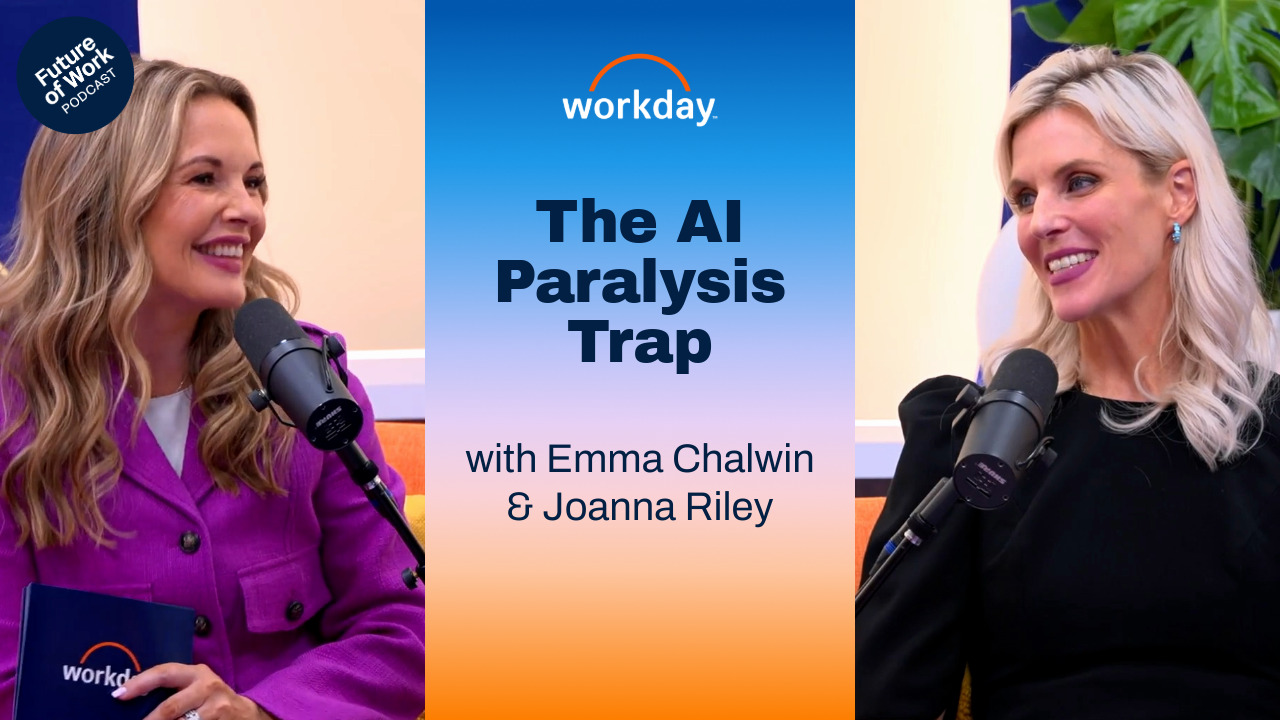
What we can’t do, as Censia CEO and Co-founder Joanna Riley told Workday CMO Emma Chalwin on the Future of Work podcast, is let fear push us into paralysis. Staying frozen while the world keeps moving is the biggest risk.
“If you wait until you have all of the answers and you're standing still, you're actually going backwards,” Riley asserts.
During their conversation, she laid out her point of view on leading teams through transformation, making time for meaningful work, and how to harness AI as a superpower.
Report
The big reason AI feels intimidating is that it’s so vast in its power and capabilities. Keeping pace with all the platforms and features and applications feels legitimately impossible.
“There's this fear of, I have to understand it all, and I have to be an expert before I can even start leaning in,” Riley says.
Her advice? Don’t sit idly and wait for others to figure it out first. Find your focus and take the lead by experimenting and encouraging your team to do so. Help people understand what the time saved by AI can make possible: work that replenishes the soul.
From her side, Chalwin views jobs through two lenses: salary work and soul work. Salary work is “the stuff that you have to get done to just kind of keep the lights on.” These tasks are important but draining, and not the source of much fulfillment.
“Soul work is when you get stuck into a project that brings you alive and you radiate completely,” Chalwin explains.
This is the raw fuel for high-performing teams. She suggests that when you get into a range where teams are focused on 70-80% soul work they become truly unstoppable. This is the potential that AI can unlock by handling manual and repetitive tasks or streamlining workflows.
“The stuff that humans would have to be doing themselves, that now can be really done by AI, allows us to be the most human we can be.”
—Joanna Riley, CEO and Co-founder of Censia
When employees get immersed in the soul work that truly energizes them, they can tap into a “zone of genius,” Riley adds, where their greatest strengths are accentuated and their greatest impact is felt.
From small businesses to enterprises, automation and AI agents have profound abilities to change the way we work for the better, and bring forth the best version of every team member.
“When I first started as a leader, I would try and guard my people from bad things,” Riley recalls. “You know, I would try and be a protector. I was like, I'm going to take the stuff and I'm going to repackage it. I'm going to tell you that I think it's going to be all okay.”
Looking back, she now realizes she wasn’t doing her teams any favors by shielding them from reality. These days Riley leans in the opposite direction: total transparency and “extreme vulnerability” in navigating ominous news or the unknown.
In this way, leaders can build trust and camaraderie while spurring innovation. “Instead of me trying to solve the problem and package it in front of the team, they were actually all in it with me,” she says.
That’s an important culture to build in the unfolding era of AI adoption. The most valuable resource we have while adapting to this strange new world is one another.
“My advice to leaders would be, the more that they can be vulnerable, the more they can be transparent, the more they can encourage their teams to be involved in the solution … the more trust, connection, growth, innovation that’s going to come.”
In discussing the future of AI and its impact on work, Riley envisions a world of flattening hierarchies where everyone is empowered to make a difference and break new ground. “We're going to see innovation coming out of everywhere.”
Specifically, she’s excited for the ability of automation to help organizations:
Innovate faster
Create new roles
Empower individuals at all levels
Benefit from an AI-native workforce entering the job market
It’s not about removing work, Riley says, but transforming work. A vital role for leadership at this moment is fostering imaginative experimentation. Think promotion, not permission. Provide resources and tools to grow at their own pace, but ensure no one is standing still.
That’s an imperative that goes beyond the business world.
“I believe humans that know AI are absolutely going to outpace and be able to replace humans that don't know AI,” Riley says. “So as a leader: how do we give people permission to explore and be innovative and try these technologies so that they can be better?”
By fostering a culture of transparency and giving people promotion, not permission, to explore these technologies, leaders can transform the anxiety of change into the excitement of possibility. The ultimate leadership superpower isn't the AI itself, but the human ability to harness it, connect with one another, and build a world where everyone is empowered to be the most human, and the most impactful, version of themselves.
Report