What Type of Performance Management System Is Best?
Strong performance management leads to higher employee engagement, productivity, and growth. Having the right system in place to support it is crucial.en.
Blaise Radley
Editorial Strategist
Workday
Strong performance management leads to higher employee engagement, productivity, and growth. Having the right system in place to support it is crucial.en.
Blaise Radley
Editorial Strategist
Workday
Workplace talent dynamics are trickier than ever, even for the most seasoned HR teams. Voluntary turnover among high performers is on the rise, according to Workday research, while skill demands and job roles are changing fast alongside AI advancements.
At the same time, employees have increasingly high expectations for engagement and experience. They want more from employers when it comes to feedback, values alignment, and ongoing development opportunities.
Performance management sits at the center of it all. With a strong process in place for it, leaders can engage employees while also holding them accountable, helping people grow while still setting clear expectations for performance.
The payoff of getting this right is significant—a McKinsey report found organizations that effectively focus on their people’s performance are 4.2x more likely to outperform their peers. But getting it right requires more than good intention. Human resources (HR) teams need tools that provide the level of visibility and insight needed to execute personalized performance management at scale.
Companies that focus on their people’s performance are 4.2x more likely to outperform their peers
Report
A performance management system is software that centralizes all of the components of employee performance management—goal setting, feedback, performance metrics and reviews—in one visible platform for managers and employees. It's a shared platform for capturing discussion around performance over time.
With a strong system in place, performance management becomes a collaborative and constructive practice vs. a once-per-year session that can feel more daunting for employees.
Some of the key features of modern performance management systems:
Goal creation and tracking: Interfaces for creating individual and team goals, updating progress, and viewing the status of key performances indicators (KPIs) in real time
Feedback capture: Built-in tools for managers and employees to give, request, and record feedback as work happens
Check-ins and one-on-ones: Dedicated spaces to schedule, guide, and document ongoing performance conversations
Performance review workflows: Configurable review cycles, evaluation forms, and approval flows to run performance reviews consistently
Performance history and records: A centralized record of goals, feedback, and reviews that managers and HR team members can reference over time
Performance management software also typically integrates with other key tools, like HRMs and payroll software, to deliver easier visibility into all factors that impact the employee experience.
At their most effective, performance management systems help organizations balance two things that are often in tension: keeping employees engaged and supported while also setting clear expectations and making fair decisions about pay, promotion, and development.
When that balance is off, performance management feels… performative. When it’s right, it becomes a tool for employee trust, loyalty, and growth.

There are several effective ways to manage performance. The best approach for any given company depends on factors like company size, regulatory requirements, and leadership philosophies.
Listed below are five of the most common ways teams approach performance management, all of which can be supported by modern platform tools:
Traditional performance management is built around structured review cycles, typically annual or semi-annual. Performance is formally evaluated at set points in time, often using ratings or standardized appraisal criteria.
Above all else, this approach prioritizes consistency and documentation. It creates a clear record of performance outcomes, which can be especially important in highly regulated or hierarchical companies where auditability and comparability matter. For organizations with stable roles and structures, they provide welcome predictability.
The tradeoff, in most instances, is timing. Feedback and performance discussions often happen long after the work itself, which can limit its usefulness for improvement in the moment. When expectations or priorities shift mid-cycle, traditional approaches sometimes struggle to keep pace.
2. Continuous performance management
Continuous performance management systems shift focus away from formal review moments and toward ongoing performance conversations. Rather than waiting for annual reviews, employees and their managers connect regularly through check-ins and real-time feedback.
This approach is designed to support coaching, course correction, and faster alignment. It works well in fast-moving work environments where priorities change frequently and employees benefit from timely input vs. retrospective evaluation.
The effectiveness of continuous performance management depends heavily on manager capability. Without clear expectations or follow-through, frequent check-ins can become inconsistent or superficial. When they're done well, however, continuous feedback creates stronger alignment and reduces surprises at review time.
3. Goal-based performance management
Goal-based performance management centers performance discussions on clear goals and measurable results. Managers and employees set defined objectives against organizational goals, track progress, and use those outcomes as the basis for performance appraisal.
Goal-based approaches connect individual work to organizational priorities, making performance expectations more concrete and transparent. Research shows there’s a payoff to doing so—when individual goals are aligned with organizational objectives and key results (OKRs), performance improves by up to 22%.
The risk of this approach is oversimplification. Not all work fits neatly into metrics, and performance discussions that focus too narrowly on results can overlook employee behaviors, collaboration, or positive impact that matters. Goal-based approaches work best when paired with regular feedback and context-setting conversations.
Performance improves up to 22% when employee goals and organizational needs are aligned.
360-degree feedback performance management systems expand input beyond manager-employee relationships. Employees receive performance feedback from their peers, cross-functional partners, and even direct reports for a more holistic evaluation.
360-degree performance management processes are most useful in collaborative environments where outcomes depend on teamwork and communication rather than just individual output. They can surface blind spots and reinforce shared accountability across teams.
Because they add complexity, 360-degree feedback-based systems are rarely used on their own. Most organizations pair them with other performance management approaches, using this aspect to inform employee development rather than drive formal evaluations.
Development-focused performance management puts employee growth at the center of performance conversations. Rather than prioritizing ratings or rankings, these systems focus on skills, lifelong learning, and future readiness.
Performance discussions often align directly to development plans, coaching, or new growth opportunities. This approach resonates well with employees who value career progression and continuous learning, particularly in roles where skills change quickly.
The challenge is balance. When development-focused systems aren’t clearly connected to performance expectations or advancement criteria, employees may struggle to understand how growth, performance, and rewards fit together. These systems work best when development and accountability are treated as complementary priorities.
Any good performance management strategy should recognize that no single model fits every organization—or even every role. The most effective approaches combine clarity, flexibility, and consistency, allowing leaders to adapt performance practices as work, skills, and expectations continue to evolve.
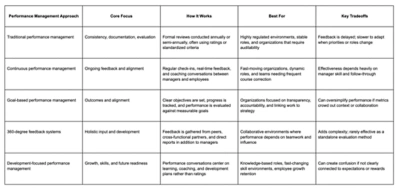
The below table offers a clear comparison of the benefits and tradeoffs of each method. From there, your organization can decide the best performance management system (or systems) they want to focus on for the next cycle.
However, what matters most is not which methodology an organization chooses, but whether its approach creates shared understanding. Employees need to know what’s expected of them, how their work connects to broader priorities, and how feedback will help them grow. Managers need timely insight, context, and structure to support meaningful conversations.
Modern performance management systems make this possible at scale. By bringing goals, feedback, and performance history into one place, they help organizations move beyond static or performative reviews and toward a methodology that improves employee performance and builds long-term trust.
Feeling the strain of rapid market changes on your talent strategy? Develop a plan to define goals, evaluate possible vendors, and unlock workforce potential with the right skills technology in this Workday Buyer's Guide.
Report