How to Calculate a Budget Variance Analysis (With Formulas)
Budget variance reveals when financial plans and results become misaligned, giving leaders an early signal to adjust before gaps compound.
Blaise Radley
Editorial Strategist
Workday
Budget variance reveals when financial plans and results become misaligned, giving leaders an early signal to adjust before gaps compound.
Blaise Radley
Editorial Strategist
Workday
In finance, hindsight isn't 20/20—it’s a ghost story. Finance leaders discover overages that have already happened, hiring mistakes teams have already made, and course corrections for a ship that has already hit the iceberg.
According to Gartner, only 13% of organizations detect performance issues before they impact financial results, and a staggering 81% remediate them too slowly to influence the company's financial health.
For most organizations, budget variance analyses function like post-mortems—numbers reviewed after the opportunity to act has passed. But modern finance tools make it possible to support more continuous planning using budget variance analysis as an early signal that market conditions are shifting or a plan is drifting off course.
Just 13% of organizations detect issues before they impact finances, and 81% resolve them too slowly to influence outcomes.
Report
Budget variance occurs when there’s a difference between a company’s financial plan and the actuals recorded in the budget sheet. At its simplest, it compares budgeted expectations to realized outcomes over a defined period.
But the real value of budget variance analysis lies less in the calculation itself and more in what the deviation reveals about the accuracy of financial forecasting models and the actions needed to remain aligned. In other words, variance isn’t inherently good or bad. Instead, the types of variance are divided into favorable or unfavorable.
A favorable variance may indicate disciplined cost control, or it could signal delayed hiring, postponed investments, or under-resourced teams that will feel pressure later. An unfavorable variance might reflect poor planning or weak execution, or it could be a result of intentional decisions, such as accelerating spend to capture a spike in demand.
Key insights gained from a budget variance analysis include:
For example: Coming in under the budgeted amount of operating expenses may initially look positive on paper. But if unfilled roles or deferred projects are driving the savings, the organization could be trading short-term efficiency for longer-term delivery risk.
Conversely, exceeding a quarterly expense budget may appear negative until it becomes clear that the overage came from pulling forward hiring to support stronger-than-expected demand. The goal in practice isn’t to eliminate variance, but to understand what it’s signaling early enough to respond.

The goal in practice isn’t to eliminate variance, but to understand what it’s signaling early enough to respond.

Budget variance analysis doesn’t need to be complex to be valuable. What matters is that you’re comparing against the right baseline, using the same method each period, and pushing past the math to understand why results moved. Knowing that revenues fell short is useless if you can’t break down the motivating factors.
These are the five steps you have to follow to calculate budget variance accurately:
Before running any calculations, confirm the budget you’re measuring against. Use the version formally approved for the period that reflects the assumptions in place at the time.
For example, imagine a SaaS team that entered the quarter expecting steady pipeline conversion and a planned expansion of the sales team. Based on those assumptions, the approved quarterly budget included:
Unless leadership approved a reforecast mid-quarter, that plan remains the baseline for variance analysis. If a reforecast occurred, the SaaS team should use that newer version.
Absolute variance shows the straightforward dollar difference between what you planned and what actually occurred.
Formula: Absolute variance = Actual - Budgeted
Now assume the quarter closed with:
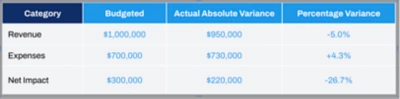
Revenue shows a -$50,000 variance, while expenses show a +$30,000 variance. At this stage, the intention isn’t to diagnose causes. You’re simply pinpointing where results diverged from plan.
Percentage variance adds scale to the calculation. It shows whether a dollar variance is minor noise or a material deviation relative to the original plan.
Formula: Percentage variance = (Actual - Budgeted) ÷ Budgeted
Using the same figures:
This makes it easier to compare impact across categories, especially when budget sheet line items vary significantly in size.
Resist the urge to lump everything together—factors like sales volume and labor costs should be analysed distinctly. Revenue and expense variances usually reflect very different dynamics.
In this example:
Analyzing them together would mask those key differences. Reviewing them separately keeps the signals clean.
This is where variance analysis becomes useful for planning, not just reporting. Ask whether the variance is:
For example, a $50,000 revenue miss caused by delayed contracts requires a different response than one caused by weakening pipeline quality. The same applies to expenses driven by one-time costs versus ongoing commitments.
Looking at the table, you can see:
This gap is where leadership should focus. It raises questions about whether revenue assumptions, budgeting processes, cost timing, or execution sequencing need to be adjusted going forward. Running this kind of analysis on a consistent cadence makes these patterns easier to spot early, before small variances accumulate into larger planning problems.
Up to 90% of descriptive variance analyses will be automated by 2027.
As planning becomes more continuous and more cross-functional, understanding budget variance is key to maintaining your company’s operating rhythm. Finance teams aren’t stepping in at isolated moments to explain results after the fact; they’re expected to help leaders adjust assumptions, capacity, and priorities while plans are still in motion.
That expectation coincides with a real shift in the work itself. With up to 90% of “what happened” and “why it happened” variance analysis projected to be automated by 2027, the mechanical explanation of variance is becoming table stakes. The value is now in how a budget variance is contextualized and used to guide decisions and next steps.
In practice, budget variance has to be reviewed continuously, alongside long-term strategy and financial performance. When finance teams see variance in areas like strategic hiring plans, spend commitments, and revenue assumptions are changing, they can use budget variance analyses as a shared planning and strategy tool to keep decisions aligned to business reality.
Report