Middle Managers Aren’t Failing. Their Jobs Are.
The manager role wasn't built for the AI era. It's time to redesign it around workflows, skills, human-agent collaboration, and trust.
Sara Braun
Editorial Strategist, HR
Workday
The manager role wasn't built for the AI era. It's time to redesign it around workflows, skills, human-agent collaboration, and trust.
Sara Braun
Editorial Strategist, HR
Workday
Ask any executive team where the pressure lands in a modern enterprise, and you’ll likely get the same response: the middle. Middle managers are asked to lead change, retain talent, coach careers, build trust, protect wellbeing, improve productivity, and increasingly introduce AI into every workflow. Many of them have watched their capacity shrink and formal authority erode over time.
In too many organizations, the gut reaction is to assume managers are the problem—they’re under-skilled, over-tenured, resistant to change. That framing is short-sighted and misses the point. The manager role itself, as most companies have defined it, has stopped working. AI is not going to fix that role—it’s going to expose it.
The right response isn’t another training or performance review. It’s time to redesign the job.
Report
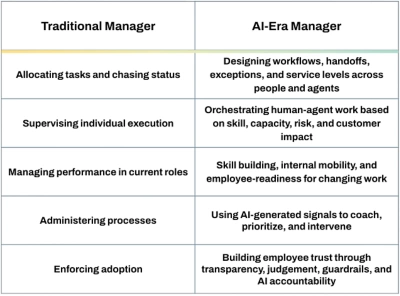
The traditional manager operating model was built to allocate tasks, chase status, supervise execution, and administer processes. Those activities made sense when work was linear and information was scarce.
That world is disappearing. Coordination, administration, analysis, and portions of operational execution are moving to AI and agents. Managers must now focus on high-impact work: designing human-AI workflows, deciding human roles, building future skills, and fostering organizational trust.
In other words, managers are being asked to move from running the work to architecting the work. Yet, most job descriptions, incentive systems, and manager development programs have not caught up.
The role of a manager has stopped working. AI is not going to fix that problem—it’s going to expose it.
AI has transformed the manager's job from task coordination to defining how work should flow: what is automated, what remains human-led, which handoffs require review, and how exceptions are handled. In a future where teams increasingly include both humans and agents, managers become the local designers of that system.
Valvoline offers a concrete example. By pairing three years of their historical data with AI, the company reduced the time managers spent generating weekly schedules by 87%—from more than two hours to roughly 15 minutes. While the time saved is important, it’s not what matters most. The real impact is what Valvoline managers did with the time they get back: focus on improving customer and employee experience.
As agents enter the workforce, managers will increasingly need to decide which work belongs to people, which to agents, and where human review is mandatory. That decision doesn't belong exclusively to IT or HR. It belongs to the person closest to the work.
Hiring offers a useful preview. Recruiting agents can automate or augment resume screening, provide next-best-action recommendations, and summarize interview feedback. Tighter hiring manager collaboration reduces communication lags and speeds up candidate advancement. In the redesigned model, the manager's job is not to manually process every step. It allows them to set selection standards, review recommendations, provide quality feedback, and remain accountable for hiring decisions.
The AI era raises the premium on managers who can diagnose capability needs, create developmental opportunities, and move talent toward emerging work. That premium shows up clearly in skills-based transformation stories.
Manufacturing company Dow mapped more than 3,500 skills to 95% of its workforce as part of a global skills framework. It reported a 50% increase in employee engagement and an 83% increase in career-planning confidence through Workday’s Career Hub and mentor matching. That kind of data gives managers a stronger foundation to identify skill gaps, connect individuals to learning and mentors, and develop future leaders.
When managers are freed up from managing tasks to cultivating skills, they stop being performance administrators and start being talent developers. That is exactly the type of shift the AI era rewards.
Skill mapping gives managers a stronger foundation to identify gaps, connect individuals to learning and mentors, and develop future leaders.
The more AI transforms work, the more managers need to make its use understandable, safe, and legitimate for their teams. Trust requires clear boundaries: what agents can do, the rules they operate under, when they act independently, when they act on a worker's behalf, and how their actions are audited.
The agent-management model distinguishes between ambient mode, where an agent acts under its own permissions, and delegate mode, where it acts on behalf of a human using that worker's permissions. Managers need enough fluency to explain these distinctions to their teams and make sure teams know who remains accountable.
At the enterprise level, governance frameworks emphasize agent identities, least-privilege access, traceability, continuous monitoring, and analysis of business impact. IT and HR likely own most of that infrastructure. But managers are increasingly becoming the local owners of adoption.
Recent Workday data revealed that demand for AI fluency—the everyday ability to use AI tools—declined across all sectors between September 2025 and April 2026. If companies aren't actively hiring for these skills, teams may not be equipped to use new technology.
Managers are suited to lead AI fluency—as long as companies actually prioritize this skill. With coordination and administrative work delegated to AI, managers can evaluate processes, determining whether agents are used appropriately in real workflows and if teams experience AI as support rather than surveillance or opaque control.

Managers are increasingly becoming the local owners of AI adoption.
If the job of a manager has changed, the systems around it must change too. Chris Ernst, Workday’s chief learning officer, stresses the importance of taking a big-picture approach to manager growth and development.
“What this time most requires is the ability for leaders to slow down to see the horizon, understand the vista, or climb to the apex,” he says. “Because it really is about creating the capacity to challenge our business models."
That means:
Middle managers are not failing the moment. The job they were handed was already failing before AI arrived. AI is just making the gap impossible to ignore.
The organizations that win the next decade will not be the ones that pile AI adoption onto an outdated job description. They will be the ones who redesign the manager role for the highest-value work: architecting how humans and agents do great work together.
Report