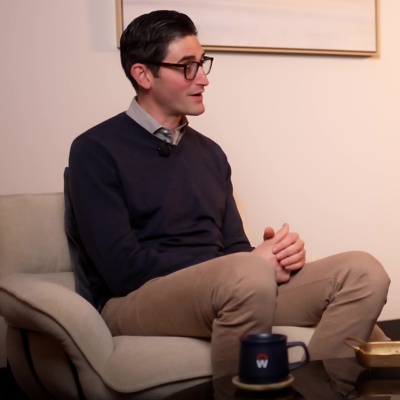
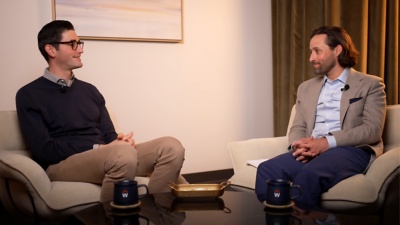
Max Wessel: The ground's shifting beneath our feet, and the pace of change requires us to think about organizational structures differently. If AI is coming in and taking new capabilities potentially every 3 or 6 months, I need to get my organization comfortable with dynamic organizational design.
Host: While many AI conversations focus on re-engineering enterprise systems, the real revolution happening in the second order affects how work gets architected, how teams adapt, and why the traditional job description is quickly becoming obsolete.
Welcome to the Future of Work podcast. In this episode, you'll hear from Jordan Ekers, VP of Commercial Strategy and Product Marketing at Achievers, and Max Wessel, SVP of Product at Workday. Together, they explore how enterprise leaders are preparing their workforces for the era of agentic AI. Let's hear from Jordan and Max.
Jordan Ekers: So, Max, appreciate the opportunity to share a conversation today. You have the privileged opportunity to be helping to guide the product strategy for one of the world's most admired HR software companies, and you're partnering with the world's most admired organization to support their people. And I know from a lot of the conversations we've had, it's been really focused around how do organizations really think about and how can they apply AI to optimize the human potential of their workforce.
And so, from your perspective, I'd be really curious to understand, what are you thinking about? What are the customers you speak to every day thinking about in terms of applying agentic AI?
Max Wessel: First, thanks for having me. I've been really excited to talk about some of these exact topics with Achievers’ customers, with your team, and with Workmates around the globe who have come in for the event.
So thanks for that. The question you asked is a pretty interesting one, right? Because most of the conversation around applying AI to transform the workforce, that conversation today has, for the most part, centered on process automation. How do I take a recruiting process and make it more efficient?
How do I take a deployment process and make it more efficient? How do I automate the steps from here to here? And I'd say most of my customer conversations fall there. And one of the things that I have been sort of challenging customers to think about and observing from the most forward-thinking organizations is they're addressing some of the second order effects of AI, the ground shifting beneath our feet.
And the pace of change, for instance, requires us to think about organizational structures differently. If AI is coming in and taking new capabilities potentially every 3 or 6 months, and the only gating factor we have in our organizations is how can we drive the change management in one process after another, I need to get my organization comfortable with dynamic organizational design.
How do I do that? How do I create the right rewards? How do I make sure I'm preserving a record and history of what any individual has accomplished in role? And so that really, for me, is the next thing that we need to think about.
And, as you know, Workday, we spend a lot of time thinking about how do we build systems that will enable that? How do we help people collect, rather, better information? How do we help people identify the things they need to skill up into? Because we can't if we don't have permanent organizational structures, we can't have permanent training programs for how you onboard into an organization.
And so all of that dynamic design needs to permeate our systems. And the cool thing is AI is going to help us do it. AI is going to help us move faster and be more dynamic. And it's going to give us this magical output that just happens to support our needs.
Jordan Ekers: Yeah, I love that. I think one of the discussions over the last two days has been around agile organizational design, and one of the conversations we had around is the job description going to continue to exist.
And part of the conversation that we had earlier was around helping organizations understand the work that's actually happening, the tasks that are being completed, and the skills that are required to effectively execute against those tasks. And I'd love to get your perspective. Or when you think about skills and task intelligence and how that helps organizations more dynamically deploy their labor based on the jobs to be done, that feels like that is a massive unlock, because you can now deploy people against the things that are most important.
So I'd love to learn a little bit more on how you guys are thinking about that.
Max Wessel: Well, if you think about the place where agents meet humans, it's in the task.
I'm a human. I happen to have a job profile. There's a job description. Whether or not it's accurate. You know, by the time I release my new job architecture, and cascade it out to the organization, it's probably already deteriorating in its relevance. I have been encapsulated in that environment, and then I have a set of skills that I've built over the course of my life that helped me do the job.
An agent has a set of capabilities, and it's been optimized to achieve, and it can sort of be evaluated in terms of the tasks you can set it out against. We at Workday are thinking about binding at the task level, that sort of ontology. So you can understand, here's Max. Here are the skills he has. Here are the tasks that he has to do for this job.
And by the way this agent has emerged. And it can do these tasks. So maybe you can reorient, give Max more responsibility or new responsibility or this part of the job description can change. I think task and skill and agent and job mapping is an enormous unlock. It's something we're working on a lot at Workday. We've actually introduced or are in the process of introducing into our object graphs, to the core, and data engine for all of Workday, a new task object.
And it's exactly for this purpose, because we're going to have more dynamic modeling, we're going to have more dynamic mapping, and we're going to need organizations that lean into that. The one thing I will say, though, about the second order effect here is we're going to need organizations that are comfortable understanding that tasks and jobs and the people and what they're doing are just going to need to change, right.
That doesn't mean there's going to be less work for people. One of my favorite examples is on the amount of graphic design I consume. I can now ask an AI agent to generate a perfect presentation for a given customer. I wouldn't have done that before. Now I do it for every customer conversation. And so we're also going to see while certain tasks are going to shift and they're going to move to agents, the volume of consumption, a lot of the work that humans are directing go up a lot.
Jordan Ekers: Yeah. And I think you made a comment there around change. And so there's the customer maturity and the organizational readiness to adapt to this model of being able to reimagine the way that they identified the task, the skills required to deploy their talent. Another element of that change is the pace at which we are all acquiring new skills in a way we've never had to before, and how that changes the fundamental learning experience.
When I look at the last five years and the skills I've had versus the skills I've acquired in the last 12 months, it's a dramatic acceleration. And so when you think about that dynamic model of deployment, when you think about the fact that we're learning more than we ever have before, how does that learning environment change over time to support the workforce to be successful?
Max Wessel: Well, we've talked about this a little bit, but AI allows you to put a Leonardo Da Vinci in everyone's pocket. You know, the reality is you have this incredible polymath that can do everything, and it has full understanding of your organization. And they can ingest all of your organization's policies, processes, tools, and it can advise you in the moment that you require advisement.
So instead of building learning and development programs towards the average, we can build the learning and development program towards you. And that's how we see this evolving as all of a sudden you are told that job is shifting. You've been given new tools. Those tools are amazing and magical. You don't know how to use them.
You can just ask the question. The AI should respond, it should support, and if you need it, it should be able to generate formal learning content or hands-on training just right there on the spot.
Jordan Ekers: Yep. And when you think about this mass experimentation that's happening across every organization you support, that we support, for me, at the center point still lies the people. And I'm curious when you think about the different ways that you've deployed AI across different workflows internally within Workday, whether that's talent acquisition, whether that's how you drive learning development, how are you starting to think about how you nudge and reinforce those behaviors across your 22,000 workmates?
Like how do you support them along this change transformation that's happening?
Max Wessel: Well, we've partnered a lot for that. So I'm grateful for the help that Achievers has offered. You know, part of it is recognition. It's showing great work that occurs. So with folks who've embraced sort of everyday AI for us in every role, we're really happy to highlight them and reward them and show that they're seen for the work that they accomplish and for the learning they do.
I personally try to highlight this and I send a weekly message to our entire product organization, and I'm regularly trying to call out things that I've seen that are new uses of AI to solve problems that we didn't think we could solve easily. And the reality is to show that the innovation can come from wherever.
You don't have to be an ML engineer with a PhD who's looked at this for the last 15 years. Everybody can get access, everybody can experiment. And with a polymath in your pocket, like everybody can learn it too. It's pretty unreal.
Jordan Ekers: Yeah. And I think when you look at the dynamics of this transformation, I think we've now empowered everyone to be creators, as you've mentioned, right down to an IC role.
And you're having this transformation happen both from the bottom up and the top down. Organizations are trying to grapple with what is the best way to think about this software, and how do I redesign workflows and how do I deploy it? Meanwhile, across every organization, you're having experimentation that's happening every day.
And so it'd be interesting as you think about some of what you shared earlier around how Workday has been applying agentic within the four walls of the business. How have you been learning from your employees and giving them that license to experiment, to drive that innovation?
Max Wessel: We shipped a tool a couple of months back to our product organization. To give you a sense, it was a tool that allowed our product team to rapidly prototype Sana applications just on the fly. Perfect fidelity, understands the movement system, all the design components. It's in line with the roadmap, so the tool itself knows what capabilities are coming. And you know, we made it.
We gave them more of the capability to experiment in the playground as a form of the carrot, not the stick. Right. It's not like you must learn this stuff, it’s go explore. And what we see is as we make it easier to go explore, people embrace it, and then we see what are the edges that they run into, what are the things we hadn't even thought about?
And so now we use that as our feedback loop. Oh, this part of the design system and this part of the application needs to evolve. And we do the same thing when we ship our own capabilities into our environment. Our IT organization and our HR organization are our best partners in helping us to to play around and see what's the edge of the application that needs to evolve. And so I think that's really the core of it is, you need to constantly be listening and you need to make it easy and accessible for folks to kick the tires and explore.
Jordan Ekers: Yeah. And when you think about that feedback loop and an earlier conversation we had around the customer maturity, like, we sit here at this point in time where we're evolving from that system of record to system of action and just kind of delivering an entirely different interface of how we interact with the workflows we need every day.
When you talk to customers across the portfolio. Like, where are you finding interest in starting? Where are you finding they land on the maturity of early adopters versus laggards? Like, how are we guiding customers towards kind of this better future and what do we need to do? What would be the blueprint of where to start and how to grow?
Max Wessel: I'm a huge believer in that Everett Rogers' diffusion of innovation process or Geoffrey Moore's Crossing the Chasm. Right. Like every technology wave unfolds with a similar pattern. And so, you know, we sort of see the population of customers represent the population of the world, like some of them are waiting. They want to see that there's vetted, validated ROI in the process that they understand before they change. And some customers are like, I'm going to test it, whatever it is, turn it on right now.
And actually, what we focus on is not figuring out how we convince somebody to be in a position that they're not otherwise dispositionally oriented towards. Right now, we're focused a lot on working with the visionaries in the early adopters to harden the system, to test it, to make sure that the ROI is there. And so we spend a lot of time meeting customers where they are.
If all you want to do is get sort of a generated text box within your existing Workday application, we're happy to turn that on for you. If you want to blow up your workflow entirely and test something out, we'll work with you on that as well. And the learning that we get is actually not with the customers who are willing to lean in. I mean, we get great feedback and we see a lot of what they're interested in, but it's the actual telemetry, which is really interesting.
For the first time, you know, we can see all of the context of this sort of interaction, right? You know, you can see what agents have we shipped that are going all the way through. You know, we have the agent traces. This is where the agent ran into a roadblock. This is what the agent was able to accomplish. And so the more people are using the agents, the more we can learn about how they need to be architected. And so we spend a lot of time with visionaries and early adopters for that reason, because we really just want them to kick the tires on the system as much as they can, so we can learn as much as we can.
Jordan Ekers: Yeah. And I think it's, um, to two items you shared earlier today around the perceived view that 70% of the administrative tasks can be solved for by AI. And when you think about the millions of employees across the world, the 75 million employees that you guys support through Workday, the amount of productivity that that can unlock by being able to solve for that administrative work, to unlock kind of that higher level of human potential.
When you're thinking about kind of redesigning work, and you can eliminate 70% of the things I do every day. The example of turning a slide into a customer branded slide, one click of a button, I do that as well. It's incredible. Where are you starting to have those discussions with customers around that next level of value for employees, as they can become more strategic as they become more critical thinkers?
Max Wessel: I think that is different in every customer conversation, and it always comes up. And, you know, I've said as we use with the slide creation example, you know, now there are more things that our design team is doing around standards, contacts, governance, how do we evolve our communication style, these types of things?
How are we thinking about information architecture? There are a lot of problems we haven't been able to fix just for capacity. And I say that in so much as there are a lot of things that we just, we naturally see folks shift into. The other thing is, you know, these cycles play out over a fairly long period of time.
I mean, even ten years it took us when the internet was popularized, ten years after it was really there. And then there was the.com boom. And now we're 30 years after the popularization of something that was really established 40 years ago and the economy is now seemingly dominated by these.
These institutions that grew up over what was a generation of time. Even if you compress that down to ten years for a rollout for AI, you know, we have ten years of growth for all of our organizations that we get to re-establish and redistribute work. And so that 70% number that I shared. Like often it strikes people as this terrifying thing. Oh like holy smokes. Like 70% of my work can be taken on by AI, but, at 4% growth over 15 years, you've doubled your organization size and capacity. And then 70% of automation actually doesn't seem like that huge of a number because you have to do it, you know, if you're doing it with the same or similar amounts of people.
Our population growth is certainly not that high. We're really allowing people to transition into this demand that is growing. And so I'm really excited that I've yet to, this conversation is happening, I have yet to see an organization that has struggled to figure out where they need to deploy capacity.
Jordan Ekers: Yeah, yeah. And I think it comes down to being really smart about the workflows, really understanding the tasks that are being completed, the skills that are required to successfully execute against those tasks. Finding ways to be able to elevate your people so you can remove the administrative burden. And when you think about the future of work, it will fundamentally change the way that we all contribute to the mission, vision, values of what we're trying to achieve, which feels like a really exciting time.
Max Wessel: And yes it is. And it's going to be I mean, we talk about this a lot, like there's going to be displacement and reskilling in that process where we're going to say, hey, the work, like this job description or this job family, it's going to have to change. But if as a society, we're investing more into tools like Sana Learn that allow you to reskill more dynamically. The tools that allow you to map your organization and predict change. It's going to be that much easier for us to manage through. I think that's the biggest fear I have around that 70% is more around the frictional change. And the biggest opportunity is that it's going to unlock so much more from all of our organizations.
Jordan Ekers: Yeah. And how you can inspire both organizations and their employees to lean in and embrace it. Absolutely. With curiosity, experiment, find ways of reimagining the way the world works.
Max Wessel: We spent a lot of time with our team talking about the fact that our backlog is many, many years long and so no amount of automation should scare them. It should just allow us to burn down the backlog faster.
Jordan Ekers: Yeah. Awesome. Well, I really appreciate the opportunity to share your conversation with you today. You guys are doing some really inspiring work, and it's a privilege to partner with you along that journey.
Max Wessel: I appreciate the opportunity as well.
Jordan Ekers: Awesome. Thanks so much.