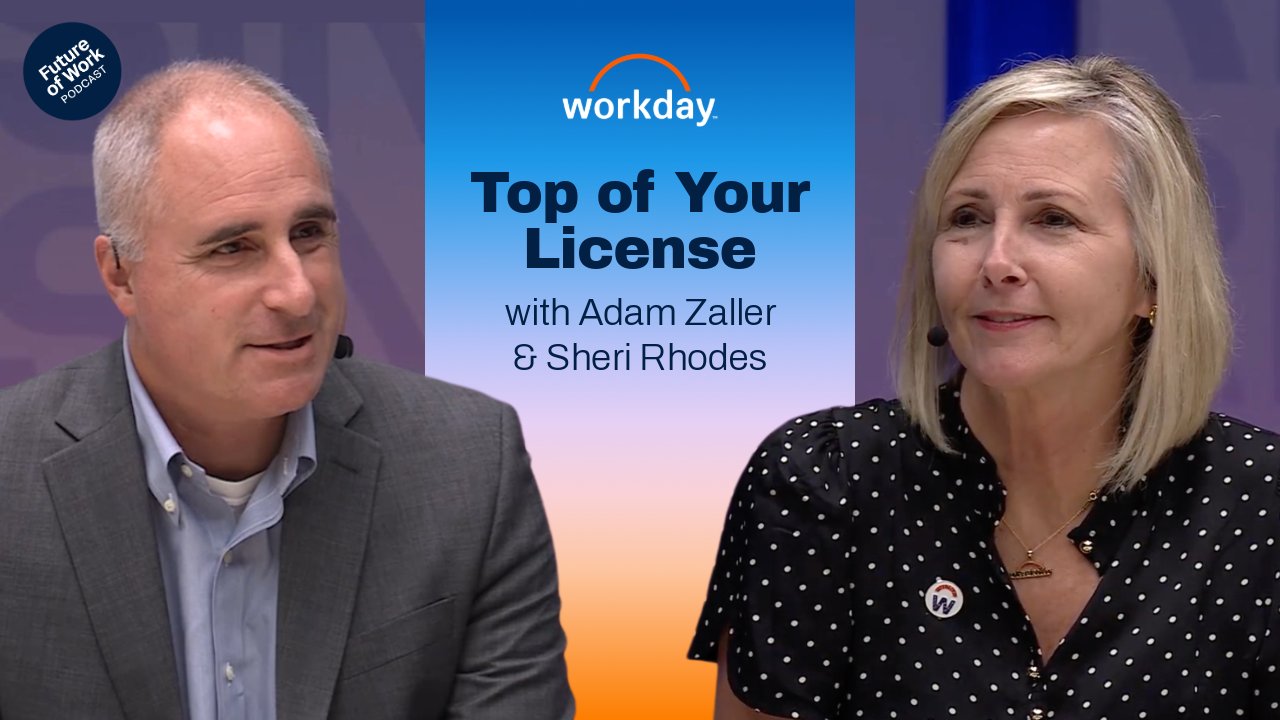
Audio also available on Apple Podcasts & Spotify.
Adam Zaller borrowed his favorite phrase from the pharmacy. Cardinal Health’s pharmacists talk about working at the top of your license. “Instead of just focusing on fulfilling scripts,” Zaller explains, “it’s about patients and taking care of patients.”
Zaller, vice president of global HR services at Cardinal Health, applies this maxim to his own role. In HR, he says, it’s “less about completing transactions and just input to output, and it’s more about being a consultant.” The services run from onboarding to offboarding, and the question he asks of himself is how can he make an employee’s experience better.
Report
When Zaller brought six global HR teams together into one organization, the combined group inherited a services catalog of 1,100 items. As the teams merged, they also built a shared culture, one that asked people to act as consultants, to listen, and to look for what Zaller calls “even better if” moments. “How can you take something and make it that much better?” he asks. The last piece on his list is the one he returns to most: find a way to “yes.”
“How can you take something and make it that much better?”
Those values guided the simplifying that followed. Today the catalog lists fewer than 330 services. “Since we’ve simplified,” Zaller says, the team has the ability to “really work on each one to make them the best.”
He wants AI held to the same standard. “I want to reinvent our processes and our services based on an outcomes approach,” he says. Payroll Agent is already improving payroll at Cardinal Health, and Self-Service Agent comes next. The team handles 50,000 HR transactions in the U.S. alone, and Zaller would like that number “whittled down by eighty, ninety percent,” with self-service reaching beyond the company’s 33,000 U.S. employees to all 52,000 of its people worldwide.
He wants, in his words, “to take HR out of a transactional red tape environment.”
Zaller’s team started with 15 possible AI use cases and narrowed them to five. To choose, they plotted each one on two axes: its strategic business value and how much AI could disrupt the work. “If we can get to a high-high,” he says, “then we’re going to really focus on that and tackle that.”
The exercise also showed that some of the outcomes they wanted were already within reach. “You want these 10 use cases, Workday already has it in its Self-Service Agent,” Zaller says. “We don’t need to recreate it in Developer Agent.”
Next, he wants to apply the same scrutiny to individual roles, using Workday’s Decision Intelligence agent to look “job by job, task by task, what really can be automated through AI, and what really needs the human in the loop because the human does need to be there.” His approach to that work is practical: “Keep it simple. Get your ‘aha!’ moments, and then dig a little deeper.”
“Job by job, task by task, what really can be automated through AI, and what really needs the human in the loop because the human does need to be there.”
Some of the hours Cardinal Health has won back came from a tool Zaller admits he tends to overlook. He calls Workday Extend “the unsung hero” and “the quiet submarine that I forget about.” When the team faces a big problem, someone usually asks whether they’ve thought about Extend, “and I’m like, ah, yeah, we should have thought about that!”
Succession planning is one example. Cardinal Health’s HR business partners rely on a succession planning tool the company built for itself, one Zaller describes as “embedded in Cardinal Health process” and “highly successful for us.” The catch was that building each succession planning deck took hours of manual work. An Extend app now does it in 30 seconds. “Our HR business partners are so happy about being able to have this new capability,” he says. The idea came out of an optimization call with Workday, when someone asked the familiar question: had they thought about Extend?
The same approach is reaching employee relations. A new corrective action form moves attendance cases into self-service, so the employee relations team can focus on its biggest cases. In the company’s distribution centers, an Extend app is helping training managers match frontline employees with the right training.

Asked how other leaders might follow Cardinal Health’s path, Zaller starts with a plan. HR leadership built a three-year roadmap for what HR services could look like from onboarding to offboarding, then set a few “big rocks” for each year. “And then we get out of the way,” he says.
That freedom comes with structure. “If you empower somebody and say, ‘Here are the guardrails,’ and you encourage them to innovate, encourage them to find something different, it’s amazing what employees will do,” he says. Taking transactional work off their plates gives them room for “critical thinking and problem solving and cross-functional collaboration,” and that’s where the surprises come from.
“If you empower somebody and say, ‘Here are the guardrails,’ and you encourage them to innovate … it’s amazing what employees will do.”
One of those surprises involved state unemployment. Someone on the team asked a question about how the work was done, and thinking differently about it saved thousands and thousands of hours. “You’re like, ‘Oh wow, I didn’t even know we could do that,’” Zaller says. “And it was just somebody asking about an old process that’s been that way forever.”
That question is what working at the top of your license looks like in HR.
Report