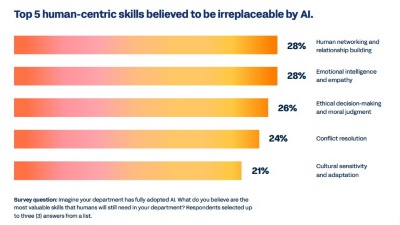
AI is amplifying the need for people who can lead, communicate, and make decisions in uncertain environments. Future-ready organizations are prioritizing:
Collaboration across functions, cultures, and geographies
Leadership in hybrid or remote work environments
The ability to work dynamically and oversee new technologies like AI agents in HR and other functions
The ability to build and maintain strong professional relationships
Proactive problem-solving and creativity
As automation drives efficiency and takes on the heavy lifting for routine tasks and processes, employees will have new opportunities to add value in ways only humans can. HR leaders must support their workforces through this transition, helping to foster and develop human-centric skills that may only have been needed at higher levels in the past.
Rethinking Roles and Career Paths
As roles become more fluid, HR teams are increasingly leaning into internal mobility and skill development. Workday research shows that over half of organizations are already transitioning to skills-based operating models, giving employees opportunities to move between teams, take on stretch assignments, and grow in non-linear ways.
Their efforts are paying off. Internal hires are 80% more likely to be rated as top performers than external counterparts because they're already familiar with their company's expectations, processes, and culture.
Flexible hiring strategies that embrace skills-first approaches and leverage internal mobility allow companies to better match talent to opportunity, while giving employees autonomy over their development. As a result, career development is no longer a linear path but a dynamic journey shaped by personalized and learning-rich employee experiences.
Embracing Human and AI Collaboration
Forward-looking enterprises are adopting AI not to replace but to enhance their existing workforces, designing workflows where humans and AI collaborate. To get this right, HR must approach AI as a culture shift. It requires trust, training, and thoughtful design of human-machine partnerships. When done well, AI gives people more time to think, create, and lead.
Workday research found that 75% of professionals believe that with humans and AI working side by side, human creativity will be amplified and organizations will achieve new forms of economic value.
The most successful companies will be those that prepare their people to work alongside intelligent systems by demonstrating the benefits AI can bring to teams and individuals, training employees to use AI tools to their fullest potential, and actively supporting higher-level creative and strategic contributions as people's roles change and evolve.