The New Rules of Business Start With AI
AI is a story about management, not technology. Here’s what that means for leadership, hiring, and how work gets designed.
Sara Braun
Editorial Strategist, HR
Workday
AI is a story about management, not technology. Here’s what that means for leadership, hiring, and how work gets designed.
Sara Braun
Editorial Strategist, HR
Workday
Audio also available on Apple Podcasts and Spotify.
The time has come to stop looking at AI as just a tech upgrade. The real disruption isn't happening in your codebase, it’s happening to management itself.
For decades, the corporate playbook valued the gatekeepers: the people who hoarded information, controlled data, and ran the analysis. But now that AI has democratized all three, that old playbook is officially obsolete.
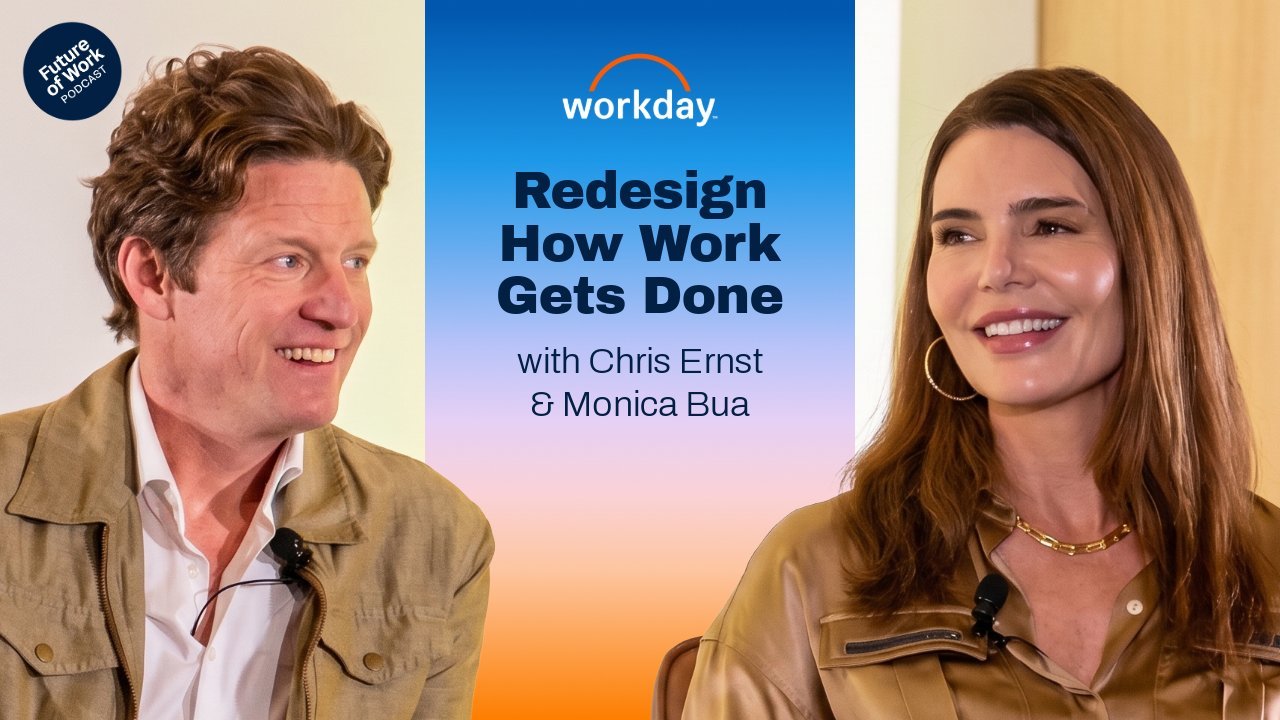
In a recent Future of Work podcast conversation, Workday Chief Learning Officer Chris Ernst and Censia Executive Intelligence President Monica Bua sat down to unpack this exact shift, drawing a sharp line in the sand for modern businesses: the corporate premium has officially moved away from managing information and toward the execution of human judgment.
Report
For over a century, organizations have been designed around the reality of information scarcity. In that older paradigm, data was hoarded, expertise was heavily gatekept, and the ability to process complex analysis served as a primary source of institutional power.
"If you think about how enterprises have been designed for the past one hundred years, it was all about information scarcity,” said Bua. “Expertise was scarce, analysis was power, if you had it. Information was power. And AI has changed all three of those things."
AI has completely transformed these domains, stripping away the competitive advantage of mere data possession. Since information and analysis are no longer scarce resources, Bua argues they’ve lost their edge as the ultimate differentiator.
Instead, modern enterprise demands a new style of leadership. As Bua explained, "The leadership role is less of a commander and more of a systems architect, that person who can take workflows and technology and their teams and processes and really orchestrate the end-to-end process."
This redefinition of value is profoundly altering how companies hire talent. Historically, boards and C-suites evaluated candidates based on concrete, historical data points, the "what" of a resume, such as the scale of a past P&L or the absolute size of a global team. Today, the focus is pivoting sharply toward the "how,” assessing softer, tacit, and highly complex human skills like creativity, systemic thinking, and rapid decision-making.
Bua pointed out the inherent difficulty in this shift: “The idea of having to assess some of those softer skills, some of those leadership skills, the judgment, it's gonna be harder to quantify. So I see that as one of the challenges of the next era."

AI has democratized access to information, stripping away the competitive advantage of mere data possession.
Data from the frontline workforce underscores a sharp tension between the current reality and AI's ultimate potential. Workday research reveals that a striking 62% of employees currently spend more than half of their time operating essentially as "human APIs,” manually transferring information from pile A to pile B.
The collective failure to scale these technologies stems from a historical habit of merely "bolting on" new software tools to old structures, Ernst argues. In reality, true work acceleration requires embedding autonomous, agentic capabilities directly inside the environments where employees already spend their days.
Ernst highlighted a case study illustrating how embedding AI capabilities can have an immediate benefit: Workday’s talent acquisition team cut manual screening volumes by 57% YoY by incorporating tools like Paradox and HiredScore into their processes, and were able to get back 40% of recruiting capacity overall.
He stressed that by incorporating AI, talent acquisition team members are able to elevate beyond being the arbiters of information and data. “They're able to be real talent consultants to the business; that's what they most love and that's the work that's most valuable,” Ernst said.
Sixty-two percent of employees spend more than half of their time operating as "human APIs,” manually transferring information from one place to another.
To bridge the gap between legacy operations and future capability, Bua urged organizations to make a clear pivot.
"I would challenge everyone in this room to stop workforce planning and start capability planning," she insisted. "So really ask yourself, if we were building this organization from scratch in an AI-native world, would we organize work the same way? Would we organize talent the same way? Would we think about leadership the same way we do today?"
She argues that the gap between how you'd design work today and how it's designed now is the space where transformation happens, and where judgment earns its premium.
This forward-looking approach is best understood through the historical lens of modern air conditioning, an analogy Bua highlighted to put the tech wave into perspective.
Air conditioning, first invented in 1902 in Brooklyn, was intended to solve a highly localized problem: controlling humidity so paper wouldn't wrinkle. But over time, it changed where businesses operated, how buildings were designed, and where economic growth could happen. Whole industries moved south because summers became workable. Its ultimate impact had nothing to do with printing efficiency; it fundamentally changed global architecture, altered population demographics, and transformed macroeconomics.
"AI feels very similar," Bua concludes. "Most companies are still looking at AI as an efficiency gain. But I believe that the lasting impact actually is really on reshaping organizations, thinking through leadership, and the way that work gets done."
"The lasting impact of AI is really on reshaping organizations, thinking through leadership and the way that work gets done."
Monica Bua
Executive Intelligence President, Censia
Ultimately, the true paradigm shift lies in recognizing that AI will behave like air conditioning, not merely optimizing existing tasks, but fundamentally restructuring the architecture of human work, corporate strategy, and organizational design.
The future won't belong to the companies that deploy the most autonomous agents or boast the fastest data pipelines; it will belong to the ones that successfully redesign their entire operational model around the irreplaceable power of human intuition, empathy, and critical thought.
As Ernst rallied the audience in his final remarks, “This is our moment to shine. This is our moment to bring the collective intelligence and judgment of the folks in this room to bear and to help steer our organizations ahead." For modern enterprises, the directive is clear: the era of hoarding data is over and the era of scaling human judgment has officially begun.
Report