Audio also available on Apple Podcasts and Spotify.
There’s a lot of big, lofty talk in the business world about what AI will do, what it could do, what it should do. Hearing about ambitious ideas and aspirations is always fun, but what’s most insightful is learning from those leaders who are already putting concepts into practice and seeing tangible results.
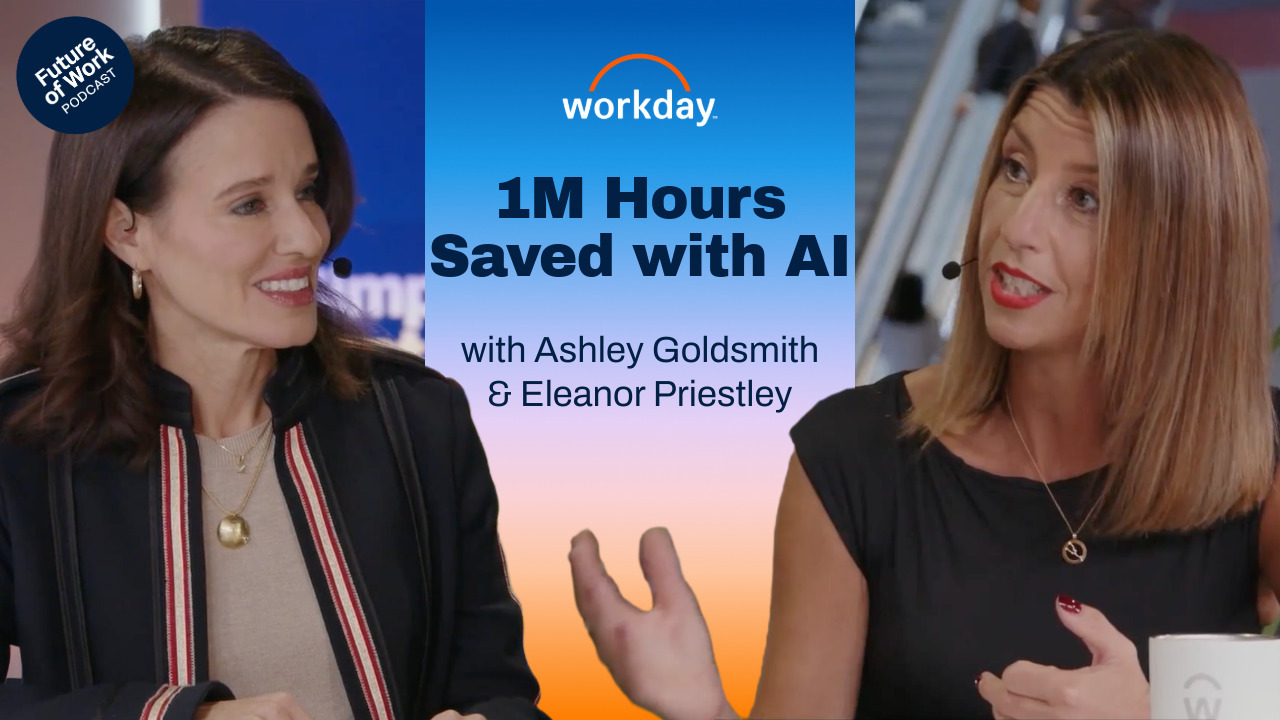
Take, for example, Eleanor Priestley and her team at NatWest Group. They set a goal of giving 1 million hours back to their colleagues in a year, and they didn’t just meet it. “We smashed the target,” she says.
In her conversation with Workday Chief People Officer Ashley Goldsmith for the Future of Work podcast, Priestley opened up about what she’s learned through a unique functional lens, having led NatWest Group’s HR transformation initiative before settling into her current role as group COO capabilities lead.
Let’s dig beneath the numbers to learn what makes a human-AI partnership work.
Report
NatWest Group is a company that’s been around for a long time, with a lineage tracing back nearly 300 years. But they’re never content to stand still, actively investing in their business evolution with help from technology and visionary leadership.
Over the course of a two-year HR transformation, the organization used its people function as a proving ground for what large-scale change could look like—rethinking operating models, redefining value, and simplifying work at its source.
As Priestley explains, the goal was never just modernization for modernization’s sake. They wanted to fundamentally change how work feels for employees.
That mindset took root. HR became the blueprint for showing how intentional design, paired with the right digital foundation, could unlock real momentum across the business.
One of the biggest shifts was structural: moving away from fragmented, siloed processes and toward end-to-end journeys designed around the colleague experience.
Instead of optimizing individual steps in isolation, NatWest Group created journey teams accountable for the full experience, from start to finish. These teams mapped pain points, removed unnecessary steps, and focused relentlessly on simplification before automation.
“From that work, we've really identified where the value is, how we then prioritize the changes that we need to make,” Eleanor says.
It all resulted in smooth coherence. Work began to flow in ways that made sense to the people doing it. And once those journeys were simplified, technology could finally do what it does best: scale what works.
Most transformation programs track progress through system deployments, adoption rates, or cost savings. NatWest Group chose a different measure: time returned to people.
The target of giving 1 million hours back to colleagues each year forced the organization to stay honest about value. Every improvement had to answer a basic question: Does this make work meaningfully easier or better?
The answer, overwhelmingly, was yes.
Manual performance processes were streamlined. Recruitment cycles became 1.7x faster by removing non-value-add steps. Onboarding journeys shifted from manual to digital, rippling out to the customer experience and driving NPS scores north of 85%.
The takeaway: When you free people from busywork, you create space for coaching, creativity, and connection. This is the work that actually propels organizations forward.
“In the recruitment space, we made our end-to-end recruitment process 1.7 times faster by just taking out non-value-add steps in Workday.”
—Eleanor Priestley, group COO capabilities lead, NatWest Group
With those foundations in place, NatWest Group turned to AI, layering technological enhancements on top of a thoughtfully designed base.
Through a seven-week proof of concept, teams tested whether agentic AI could orchestrate across multiple systems to eliminate friction in everyday tasks. They started by listening to colleagues and identifying one of the most time-consuming administrative burdens: booking time off.
Priestley’s team developed a conversational experience that handled requests seamlessly, and then expanded beyond HR. Relationship managers could automatically reschedule customer appointments when colleagues were away, extending the value directly to front-line teams and customers.
“We’ve proven that agentic AI can reduce friction, save valuable time, and create space for more meaningful work,” Priestley shares.
Workday CEO Carl Eschenbach often says that technology doesn’t drive change, people do. That’s a viewpoint that Priestley co-signs wholeheartedly. “We've spent so much time this year on the change management aspects of it,” she says.
NatWest Group has made investments bank-wide and also at the franchise and functional levels, encouraging employees to experiment, play, and build confidence with AI tools. Upskilling efforts focus on not just how to use AI, but how to think about ethics, data, and trust as a natural extension.
Leadership plays a critical role. Executives model curiosity, carve out time to talk about AI in team forums, and even lean into gamification: writing songs, creating art, and learning together in real time through “prompt-alongs.”
Priestley says this approach has helped lower barriers and inspire curiosity, motivating employees to explore AI capabilities proactively. “We’ve definitely piqued people’s interests.”

“The data speaks for itself. Every all-team call that we've done, we've just seen a huge peak in the usage of the tools, and it's not tailed off either. It's started to just kind of reach that steady state.”
—Eleanor Priestley, group COO capabilities lead
NatWest Group’s experience offers clear guidance for any organization navigating AI-driven change. Priestley lays out three top tips for success:
That last point is one she emphasizes: “Storytelling is absolutely king … Being able to tell that very, very clear narrative has secured investment and brought people into the work.”
Giving back more than 1 million hours to colleagues was a huge accomplishment for Priestley and the team. They hope it’s only the beginning. It’s another proof point for what’s possible when organizations design work around people and use AI with intention.
As this story showcases, the future of work is about creating partnerships where technology removes friction and gives people their time back.
That’s a future worth building toward, one hour at a time.
Report