Audio also available on Apple Podcasts and Spotify.
When you think about using AI today, you might picture a blinking cursor waiting for you to draft a prompt, assign a task, and then check the work—a tool that sits idle until you tell it exactly what to do. But imagine a world where the cursor doesn’t just blink; it thinks. Imagine a system that doesn’t just follow instructions but understands your goals, anticipates the next step in a complex workflow, and executes it before you even have to ask.
This is the promise of agentic AI, which represents the next major step forward in the tech revolution. It’s already here, advancing rapidly, and its impact on the future of work will be profound.
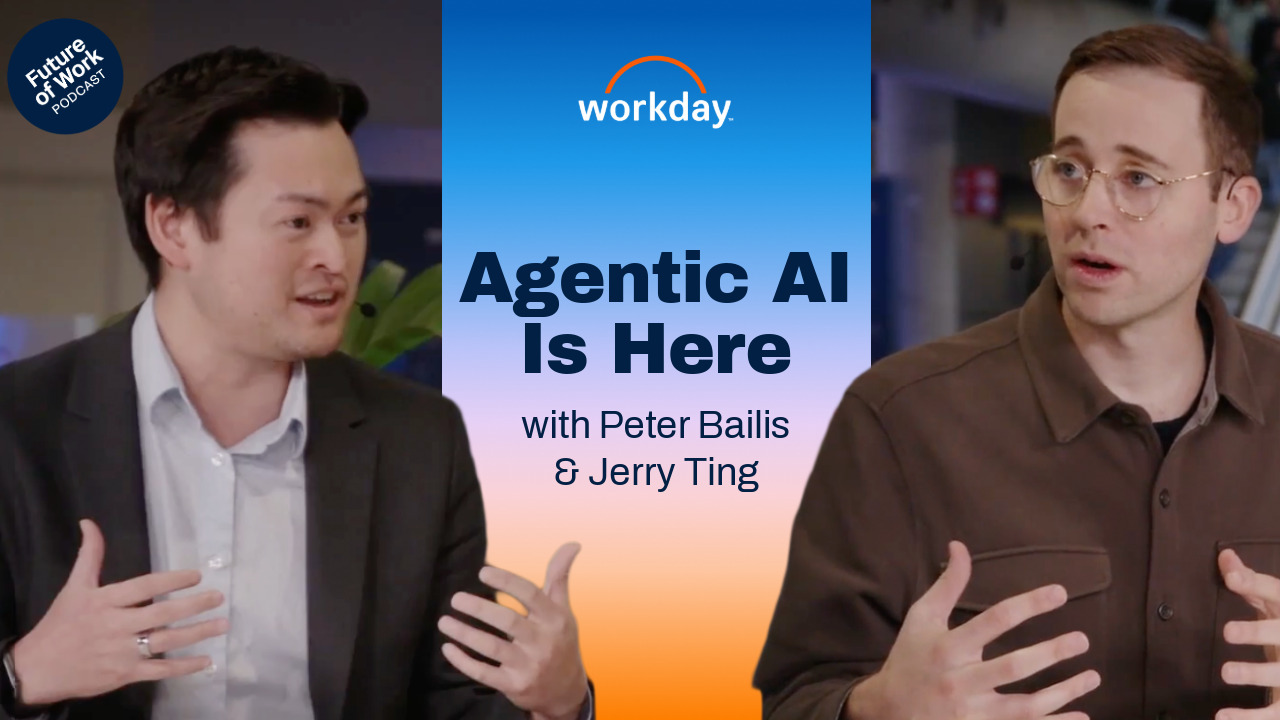
Three leaders from Workday sat down to share their excitement around agentic AI while digging into implications that extend far beyond the technology itself. CTO Peter Bailis and vice president and head of agentic AI and Evisort Jerry Ting spoke with EMEA CTO Clare Hickie about what’s now and what’s next for AI agents.
Report
Agentic AI marks a decisive break from earlier generations of AI. Instead of responding to a single prompt with a single output, these systems can reason through complex goals, break them into steps, and carry out those steps autonomously.
“This is the revolution,” Bailis remarks. “It’s going from much simpler applications to full process transformation driven by complex multi-step workflows.”
When applied to core business functions—payroll, recruiting, accounting, audits, compliance—agentic AI does more than speed things up. It allows organizations to reimagine how work happens end to end.
Bailis elaborated on the technical shift, noting, “We’re moving from very simple prompts…to models that can think about doing very complex tasks and break down those tasks into individual steps and execute them autonomously”
“We’re moving from very simple prompts…to models that can think about doing very complex tasks and break down those tasks into individual steps and execute them autonomously.”
Peter Bailis, CTO, Workday
Gartner projects that by 2028, agentic AI will be built into one-third of enterprise software, quietly handling up to 15% of everyday decisions behind the scenes. Momentum is building, and it’s not hard to see why: AI agents offer a true human-centric vision for the technology, where talent is augmented and capabilities are broadened.
Simply put, agentic AI is about removing friction so people can do their best work. Agents take on repetitive, tedious, and analytical tasks with minimal handholding. They free up energy for creativity and connection.
This “human plus AI” model, as Bailis puts it, shows up most clearly in the employee experience. Instead of navigating complex systems or escalating questions through layers of administration, workers can interact directly with AI agents that understand business context and respond in the flow of work.
The best part? This level of innovation is no longer reserved for technical specialists, says Ting. He encourages those who haven't yet experimented with the technology: “I think for folks who have not played with AI yet, it's time to get started…with Workday's strategy today about opening up our ecosystem and allowing both developers and knowledge workers to build on Workday, anyone can get involved.”
To ground the benefits of agentic AI in a practical, everyday scenario, he shares an example from his own life: building an agent to help automate meal planning at home. As Ting illustrates, this isn’t only about enterprise-scale change. “It really impacts the very fundamental of, what do I do as a person? How do I use AI to make my life better?” he says.
That democratization of building is powerful. It brings innovation closer to real human needs and accelerates learning across organizations, because the people closest to the work can now help shape how it’s done.

“I think for folks who have not played with AI yet, it's time to get started.”
Jerry Ting, VP and head of agentic AI and Evisort, Workday
With all this potential comes responsibility. As organizations deploy more AI agents, those agents need access—to systems, to data, to workflows. Without clear governance, that access can quickly become a risk.
“You wouldn’t onboard human employees, give them access to all of your systems, and not have them show up in your org chart and your security rules,” Bailis notes. Yet, that’s effectively what happens when AI agents operate without structure.
It underscores the need for an agent system of record—a way to apply the same rigor used for managing people to the digital workforce. Identity, permissions, oversight, and accountability all matter just as much for agents as they do for employees.
No single agent will define the future of work. The real value is seen when many agents work together, alongside humans, across complex workflows.
Ting shared what he’s hearing from customers. They’re building agents on multiple platforms and asking a critical question: How do these all work together?
The answer lies in orchestration. Consider employee onboarding: identity, security, learning, role activation, and compliance all need to be connected. Each function may have its own agent, but the experience only succeeds if those agents are coordinated across the journey.
That’s where a unified platform makes a difference. It helps simplify complexity so the interplay feels seamless. As Ting summarizes, the goal is straightforward: “How do you make that employee’s experience easier?”
No single agent will define the future of work. The real value is seen when many agents work together, alongside humans, across complex workflows.
Looking ahead to the next 12-18 months, Ting says there are two concepts that energize him most: memory and context.
“Next year, the agents are going to get smarter,” he says. “They're going to know your personal preference, your department's preference, your organization's preference, and then it's going to have the context and the data that we have to actually make that powerful.”
Agentic AI represents a move from tasks to transformation. It’s about designing systems that are intelligent, trustworthy, and human-driven at their core.
The technology is advancing quickly, with adoption on the rise, but the goal remains unchanged: making work easier, more meaningful, and more joyful.
Report