Audio also available on Apple Podcasts and Spotify.
Most companies hand AI transformation to IT and loop in HR only after the big decisions are made. Atlassian flipped that playbook, placing people at the center of their strategy from day one.
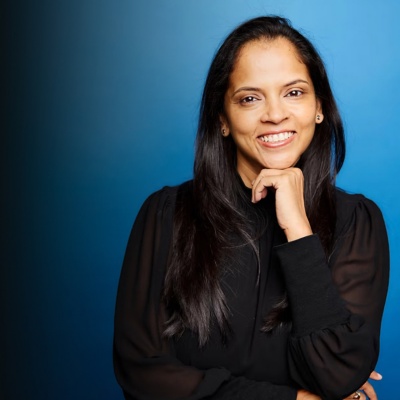
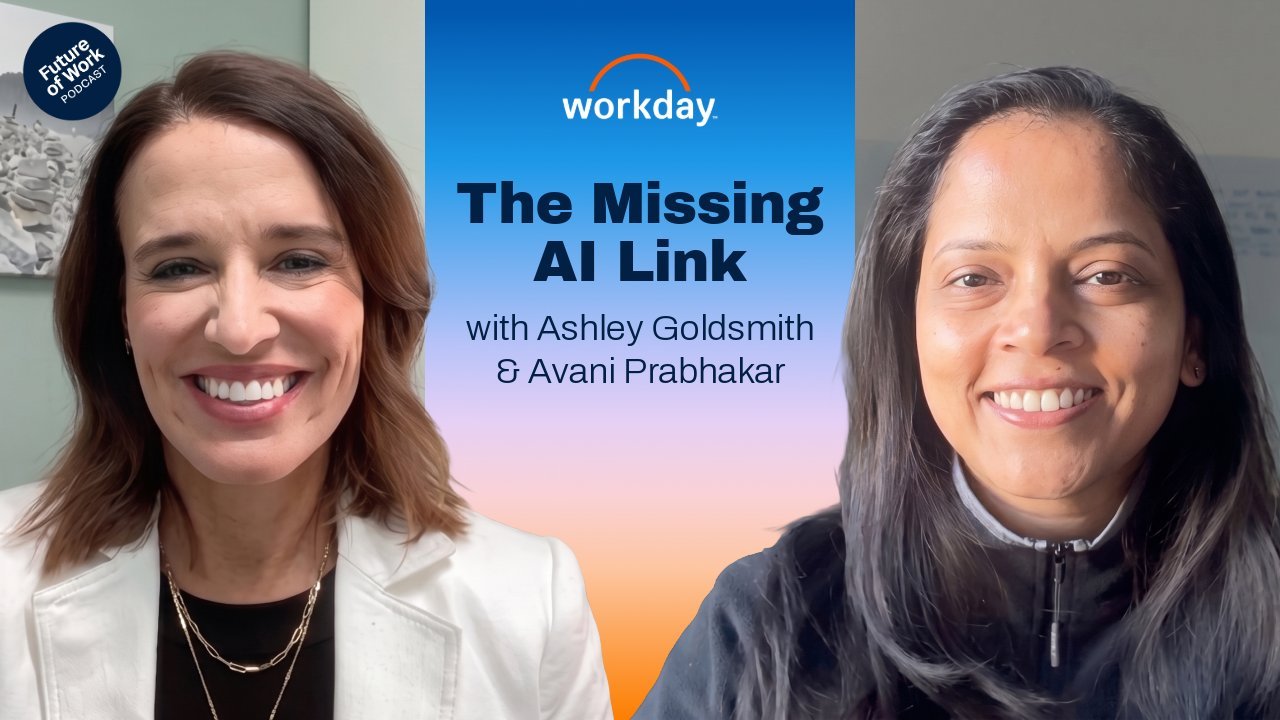
Chief People and AI Enablement Officer Avani Prabhakar, who leads one of the world's first C-suite functions dedicated to driving AI through human-first strategy, joined Workday CPO Ashley Goldsmith on Workday’s Future of Work podcast to share what happens when HR takes the wheel in enterprise AI adoption.
With over 12,000 distributed employees across 15 countries, Atlassian’s strength came from a long-standing, open, written culture—habits that proved to be the ultimate launching pad for AI integration.
Report
When Atlassian began its AI journey roughly three years ago, the work started as a cross-functional effort between the CISO, CTO, CIO, and Prabhakar's team, first tackling security guidelines, then workflow questions. Eighteen months in, the group landed on a shared conclusion.
The technology, it turned out, was the easy part.
The people side, Prabhakar says, is where the real transformation has to happen, echoing a belief held by Atlassian's founders that AI is fundamentally a people-led transformation.
This mindset transformed how both HR and technical teams operate:
HR's Focus: Evolved from simple policy management to designing human-AI collaboration across the entire employee lifecycle.
Tech's Focus: Shifted from just deploying tools to redesigning workflows and building the rich context needed to make AI genuinely useful.
"AI is a people-led transformation—that is where the magic starts happening."
Avani Prabhakar
Chief People and AI Enablement Officer Atlassian
Rather than enforcing top-down AI mandates, Atlassian fostered organic adoption through bottom-up "AI Builder Weeks" and internal super-users. This approach yielded powerful, custom AI agents:
Nora (Onboarding Agent): Built by the onboarding team to solve top pain points for new hires.
Coco (Comp Conversation Agent): Generates personalized context profiles for managers handling tough compensation reviews
“For example, if my managers are having a conversation with me, Avani, they would know exactly what [I] give more importance to, whether it's cash, whether it's equity, what was the conversation we had last time, and what are the key points they need to hit,” Prabhakar says.
It was important that leaders modeled the behavior themselves for employees. Atlassian's Head of People Insights built her own agent alongside her team rather than simply asking them to adopt AI, and Prabhakar built her own AI-assisted operating system to demonstrate what deep AI usage could look like. The results were measurable: one team's confidence using agentic AI grew from 27% to 91% in a single quarter.
Goldsmith points to that peer-learning model as a throughline worth copying. “It’s always been a really key way people learn, and it sounds like it’s been a critical part of how you’re driving this in your organization,” she says.
Prabhakar doesn't buy into claims that AI will let five people do the work of fifty. "Eighty percent of that is BS," she notes.
Atlassian's own data backs up her skepticism. Research with Fortune 500 customers found that individual AI use is generating a 33% personal productivity gain, but that almost none of it is translating into enterprise-level returns, which remain stuck in the low single digits.
Workday research presents a similar phenomenon: roughly 37% of the time employees save through AI use is silently lost to rework, highlighting a critical blind spot in organizational assessment of AI productivity gains.
To close that gap responsibly, Atlassian built a framework that starts at the task level, then moves to skills, and only then to roles. Small, empowered teams of about five people were given greenfield problems and let self-organize; one shipped a major product-conference feature 7.3 times faster than a typical team—not because of raw output, but because role boundaries blurred in productive ways: designers shipped code, engineers prototyped in Figma, and everyone invested heavily in context creation and judgment.
Only after understanding how tasks and skills were shifting did Atlassian begin rewriting job descriptions, starting with design, where AI-forward designers were already shipping more code and warranted a new job family: design technologist.
"We are not saying: will we need this role, will we need less of it, more of it," Prabhakar explains. "Our approach was, let's see how this role is really changing."
Atlassian's first adoption metric—tracking how many employees used any AI feature—hit 90% within three months and told the company almost nothing useful. So the team rebuilt its measurement approach around a maturity model: non-users, simple AI users, strategic AI users, and, at the top, strategic AI collaborators who treat AI as a thinking partner rather than a task-doer.
That distinction matters because it changes what AI can access and accomplish. A strategic AI user might ask AI to draft a market research report. A strategic AI collaborator builds a hypothesis with AI, testing variables and reasoning through open-ended problems, which requires a much deeper context layer connecting product, performance, and workflow data.
The payoff is real: strategic AI collaborators produce roughly 2x the output of simple users. More importantly, they actively unblock AI adoption for the teams around them by building the connections and context that make AI more useful for everyone.
Strategic AI collaborators produced roughly twice the output of simple users.
Looking ahead, Prabhakar believes HR is uniquely positioned to own a question no single function currently answers well: what is the right mix of human talent and agentic capability at every level of the business?
Right now, she says, that responsibility is scattered. IT often owns token spend, the CTO owns productivity, HR owns upskilling, and a separate function typically owns AI transformation ROI. Prabhakar argues HR should be the horizontal thread that connects all four, and Atlassian is already hiring a director of capacity planning for humans and agents to test that belief.
She also expects HR's operating model, talent programs, and even performance management to look fundamentally different within the next six to twelve months—not years—as the function evolves from managing the employee lifecycle to building what she calls the organization's context layer.
HR is uniquely positioned to own a fundamental question: what is the right mix of human talent and agentic capability at every level of the business?
Prabhakar's advice for HR leaders who want to lead rather than react starts with redesigning HR's own work first, and doing it with intention rather than simply chasing recruiter productivity metrics.
She encourages leaders to pick a workflow that touches the whole business, not just their own function, and to build a small peer community for pressure-testing ideas, because, as she put it, no one has fully figured this out yet.
“This is a once-in-a-lifetime opportunity for this craft,” Prabhakar says. [HR] is right at the vortex of where everything is happening.”
The important thing to remember is that Atlassian doesn't claim to have solved AI transformation. It has built a disciplined, human-centered way to keep learning in public, and it is inviting other HR leaders to do the same.
Report