The Changing Frontline: How Economic Realities Are Shaping Worker Expectations
New research reveals what’s driving frontline worker sentiment and how employers can respond.
Joshua Secrest
Head of Paradox Marketing
Workday
New research reveals what’s driving frontline worker sentiment and how employers can respond.
Joshua Secrest
Head of Paradox Marketing
Workday
For organizations that depend on frontline workers, the employee experience has always been tied to the realities of life outside work. Today, those realities include rising living costs, caretaking responsibilities, long commutes, and financial uncertainty.
The Federal Reserve reports that 59% of U.S. adults faced at least one major unexpected expense in the past year, with just 63% able to cover a $400 emergency expense with cash or its equivalent.
New research from DailyPay and Workday, conducted by The Harris Poll among more than 2,200 hourly U.S. workers, offers a closer look at how these broader pressures are shaping the employee experience on the frontline. More than half of frontline employees say schedule flexibility and pay clarity are more important now than 3-5 years ago.
What can at first seem like workers simply demanding more from employers often reflects something more fundamental. For many frontline workers, flexibility, transparency, and access to information directly affect their ability to manage the costs and responsibilities surrounding work.
Changing frontline employee expectations are, in part, a response to changing economic realities.
Report
More than half of frontline employees say schedule flexibility and pay clarity are more important now than 3-5 years ago.
Frontline workers themselves say their priorities are shifting. More than half (51%) say schedule flexibility is more important than it was three to five years ago, while 49% say the same about pay clarity and clear employer communication.
For many frontline workers, the value of an additional shift depends on more than the wages it brings in. More than three-quarters (78%) calculate costs like gas, commuting, and childcare before taking on additional work, while 28% work multiple jobs.
Those calculations matter when household budgets are already stretched. The research shows how closely many frontline workers are managing their finances:
Against that backdrop, flexibility becomes more than just a workplace preference. Workers may need to coordinate shifts around other jobs, commuting costs, childcare, and changing financial needs. And having some control over a schedule doesn't necessarily mean having the flexibility to respond easily when circumstances change.
While 72% of frontline workers say they have a say in creating their weekly schedule, nearly one in four (23%) says it would be difficult to adjust a shift when they experience an unexpected conflict.
Employers can't control economic factors outside of work. But they can make it easier to manage work alongside them with more predictable schedules, flexibility when plans change, and clearer visibility into available hours.
For employers, those same capabilities make it easier to respond to changing coverage needs while supporting recruiting, attendance, and performance.

Employers can't control economic factors outside of work. But they can make it easier to manage work alongside them.
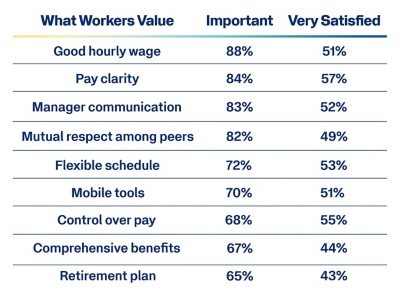
Economic pressure helps to explain why workers increasingly value greater flexibility and control. But the research also reveals a broader challenge for employers: the aspects of work employees consider most important are—in almost all cases—not driving high worker satisfaction.
Across every major job attribute measured in the study, the share of workers who say it is important exceeds the share who are very satisfied with what their employer provides:
Pay clarity and manager communication stand out as particularly important opportunities. Workers want greater transparency into the details that affect their finances, while recognition, coaching, and support from managers can influence how they show up at work.
For employers, closing these gaps means making the everyday experience of work easier to navigate, from understanding pay and schedules to clearly communicating expectations and recognizing good work.
Greater clarity and stronger manager communication can reduce employees’ uncertainty while building the trust and engagement that influence performance.
Leaders should treat changing worker expectations as an input into how the organization designs and manages work at a high level.
The gaps between what frontline workers value and what they experience give business leaders a clearer picture of where changes can have the greatest impact. The goal is to examine how workforce practices translate into the day-to-day employee experience and where greater autonomy, transparency, and support can improve it.
That starts with how work is designed. Frontline roles require structure around staffing, coverage, and availability, but leaders can distinguish between constraints that are operationally necessary and processes that create avoidable friction. Greater adaptability can give employees more agency while still giving the business the consistency it needs.
Several areas deserve particular attention:
These decisions have implications beyond employee satisfaction. Improvements in the frontline experience connect to workforce outcomes, namely recruiting, retention, attendance, productivity, engagement, and wellbeing.
As frontline workers navigate greater financial and logistical complexity, employers have an opportunity to give them more control over the parts of work they can influence. Nearly nine in 10 frontline workers (86%) say the right digital tools make their lives easier, yet only 51% are very satisfied with the technology their employer provides.
Workers' priorities are practical:
For employees who don't spend their days behind a desk, these capabilities can make everyday tasks easier to manage. Workers report digital tools have improved flexibility (37%), productivity (36%), work-life balance (34%), and communication with managers (34%).
AI creates another opportunity to make frontline work easier, with 69% of workers believing AI can reduce daily frustrations and 68% in support of workplace AI when it increases productivity.
Trust will shape how successfully employers can introduce AI tools. Half of frontline workers worry AI will replace their jobs, making transparency about how the technology is used and how it affects employees' roles critical.
For business leaders, the opportunity is to deploy digital tools and AI in ways that give frontline workers greater access, flexibility, and control over their everyday work.
86% say the right digital tools make their lives easier, yet only 51% are very satisfied with the technology their employer provides.
The frontline employee experience is increasingly defined by the moments where work intersects with life outside the job. A schedule change, missed communication, or unexpected life expense can quickly affect whether an employee can show up fully or stay engaged at work.
That makes the everyday systems surrounding frontline work more important than ever. When those systems give employees clarity and confidence, work becomes easier to manage..
For employers, the opportunity is to close the gap between what frontline workers value and what they experience day to day. Organizations that make the frontline experience more responsive to employees’ lives also make it more reliable for the business, establishing a stronger foundation for retention, engagement, and operational resilience.
Report