Finance
The Trust Fall: What Agentic AI Must Prove For CFOs to Take the Leap
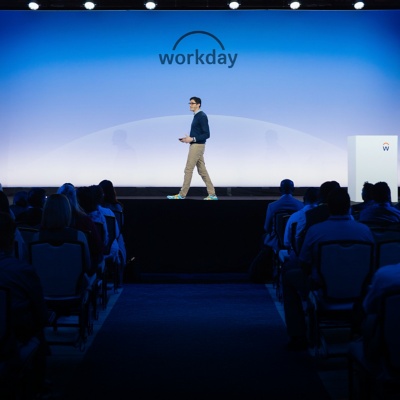
At Workday Rising, leaders agree AI can transform finance—but on four conditions.

Julie Colwell
Principal Strategist
Workday

At Workday Rising, leaders agree AI can transform finance—but on four conditions.
Julie Colwell
Principal Strategist
Workday
Enterprise software is going headless.
AI agents can now do real work in finance without anyone logging in. Autonomous agents can prepare accounting entries and facilitate transactions in the background.
But in finance and payroll, almost right is always wrong.
“There’s zero margin for error,” said Workday CEO Aneel Bhusri during the opening keynote at Workday Rising. “You handle systems, decisions, how people get paid, books closed… AI has to be trusted.”
“There’s zero margin for error. You handle systems, decisions, how people get paid, books closed. …AI has to be trusted.”
—Aneel Bhusri, Co-founder, CEO and Chair, Workday

Report
CFOs have reason to be cautious. Just 14% of finance leaders have fully integrated AI agents, and only 12% say AI outcomes exceeded expectations over the past two years.
Yet the pressure to deliver revenue, profit, and predictability keeps building. AI can help, but on four conditions, underscored by leaders speaking at Rising in Las Vegas this week. For AI to transform finance, it requires: trusted context, autonomous controls, always-on insight, and automated processes.
Headless can’t mean lawless.
Predictability depends on data that AI agents can trust, and a forecast is only as good as the information behind it. Frontier AI agents bring general knowledge, but finance needs agents that understand its business context: full transaction detail, consistent definitions, and controls for how data is used.
“Without the right context, AI doesn’t necessarily give you good decisions. It gives you plausible ones.”
—Max Wessel, SVP Product, Workday
That is harder than it sounds. Many accounting systems strip detail from transactions as they record them, and agents need the full context of each entry, including high-volume events from outside systems. Agents also need the documents, because some critical accounting data sits in contracts, supplier agreements, and invoices that never arrive through a data feed.
“Without the right context, AI doesn’t necessarily give you good decisions. It gives you plausible ones,” said Max Wessel, Workday senior vice president of product, at Rising.
An AI-enabled enterprise runs on two types of context. Governance sets limits on what AI can do, while semantics set shared definitions so all departments and agents are speaking the same language. Without both, an agent has no way of knowing whose number to believe, and finance ends up rechecking everything it produces.
Gartner predicts that by 2028 at least 15% of day-to-day work decisions will be made autonomously through agentic AI and advises CFOs to establish governance early.
For decades, controllers and auditors tested samples, small slices of transactions checked after the fact. Software agents can test every transaction continuously. “This moves controls from reactive to proactive,” Wessel said. “It can catch any issue as it starts to arise.”
Consider a month-end close. Overnight, agents work through routine reconciliations and approve entries that fall within set limits, so that much of the close is done by morning. One item comes back flagged for a person: a customer accepted a milestone for work that was delivered but never billed, so the revenue hasn’t been recognized. The agent proposes an accrual. The accountant reviews the underlying data, the history, and the agent’s reasoning. They then approve the journal, and the close moves forward.
Routine work can run on its own. Judgment calls go to a person.
Where to draw that line depends on the job: planning can tolerate answers that are directionally right, but the ledger has to satisfy an auditor. So agents earn autonomy job by job.
“Before deploying an AI agent, ask: ‘Who is accountable if the agent is wrong?’ If the answer is ‘It depends,’ the agent is a liability,” said Ash Noah, vice president and managing director of AICPA & CIMA, during an interview with Julie Gonzalez, Workday senior vice president of FP&A.
“Before deploying an AI agent, ask: ‘Who is accountable if the agent is wrong?’ If the answer is ‘It depends,’ the agent is a liability.”
—Ash Noah, Vice President and Managing Director AICPA & CIMA
Agents can flag anomalies while accounts are still open, trace a margin shortfall to its cause, and model recovery options side by side. A finance leader chooses, and the decision is recorded with the data and approvals behind it. When a board asks why management made a bet, the CFO can show the path.
James Choi, global head of finance transformation and procurement at Unity Technologies, said this kind of analysis is helping the company close the gap between analysis and execution, from investigating revenue variances to preparing the monthly outlook for the CFO.
Agents can handle information and insight, leaving people to manage with influence and impact. Less time forecasting means more time for strategic capital allocation.
When the compliant route is slow, people find a faster one, and bottlenecks are a leading driver of off-contract buying. “When the compliant route is faster, there’s no reason to go around it,” said Wessel.
For example, he explained travel and expenses make up roughly 10% of an average operating budget and are the second-largest controllable cost after labor. One in five expense reports contains errors or missing information, costing an extra $52 and 18 minutes each to fix. Agents that apply a continuous policy of booking remove the errors and the extra work.
As agents take over routine processes, the job of finance shifts from doing the work to directing it. A controller in order-to-cash might first automate dunning letters and collection calls, then orchestrate the whole flow, and finally decide on credit by assessing customer lifetime value.
This is a big shift.
“AI can automate the mundane, generate novel insight, defend our bottom lines, and help us sleep easier.”
—Max Wessel, SVP Product, Workday
Agents that run on their own, around the clock, change what CFOs oversee as much as what finance does. There are three key consequences:
Accountability stays put. Decisions and responsibility will always rest with people, even when software acts first. Auditors and boards will still ask the CFO what ran overnight and why.
Consistency scales. An agent can repeat a task thousands of times without tiring, applying the same rules the same way every time. When cost, business value, and risk are predictable and clear, finance can expand what agents handle with confidence. Controls that run as continuously as the agents they govern keep that consistency in place.
Oversight becomes exception management. Fewer people do the work, and more review what agents flag. If AI’s biggest benefit is freeing time for strategic work, the payoff depends on people who can judge what an agent surfaces, which requires that they are trained to do so.
To be trusted, context, autonomous controls and always-on insight have to be traced back to the person who approved them. That’s when headless AI for finance works. It’s a future Wessel described: “AI can automate the mundane, generate novel insight, defend our bottom lines, and help us sleep easier.”
Report

A gap between effort and impact is the real ROI problem. Discover the solution.