Chris Humphrey: I've seen people who are capable, even before AI, of creating applications.
Clint Harwood: It makes me happy to see people that never thought they'd be able to code finding the joy in coding without going through the pain and frustration that our generation had to. I don't see the bad here.
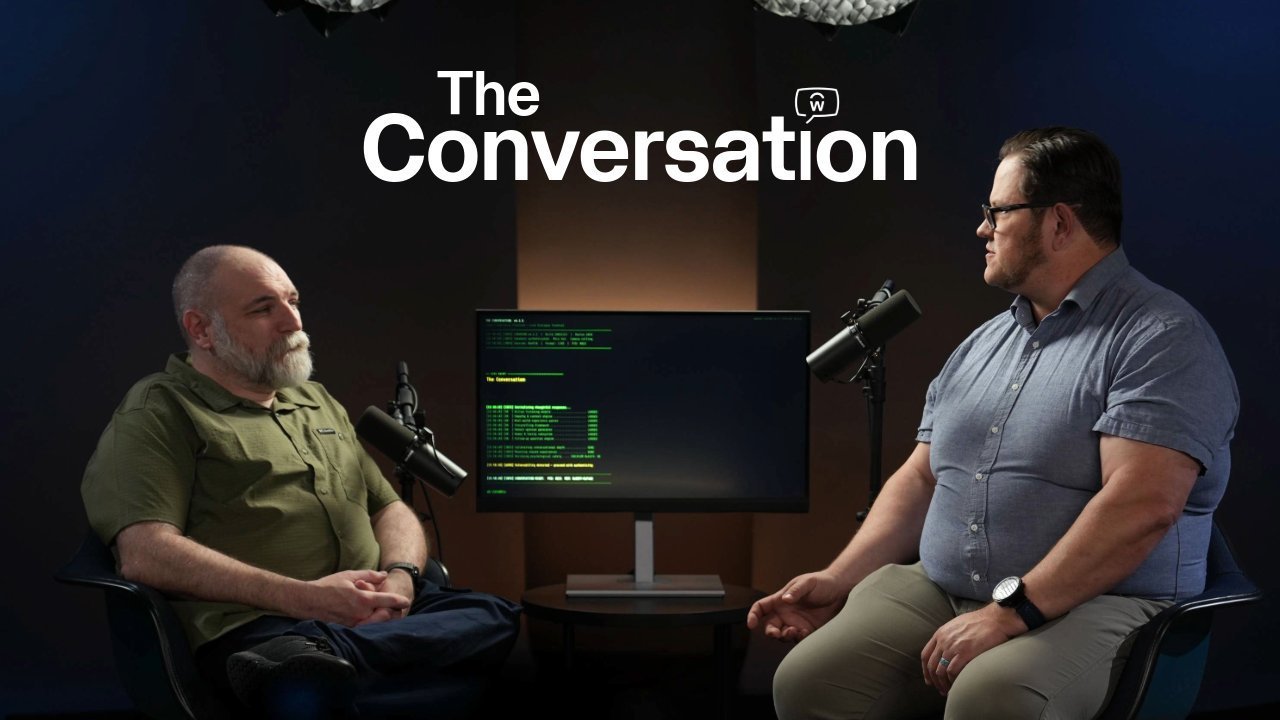
Chris Humphrey: Welcome to The Conversation with Chris Humphrey & Clint Harwood. I'm here with my very close friend and colleague, Clint Harwood. You may or may not know Clint, who was the Advanced Studio trainer long, long ago. Also, amateur space photographer and super cool guy.
Clint Harwood: And I'm here with Chris Humphrey. It would take a while to catalog all the awesome stuff Chris has done in the Workday ecosystem—written connectors, done all sorts of cool Studio coding, the person to call when you need an Extend app built.
Chris Humphrey: People are going to be really mad if we don't talk about it, so we're going to talk about AI. What are you doing to learn the new tools and technology?
Clint Harwood: There's a biology term called punctuated equilibrium. I'm trying to take jumps, get deep on something, and then take another jump. Trying to keep up with everything as it changes so quickly was making me crazy. I pick a project and try to build it. Using AI to handle the fuzzy, uncertain bits and then moving into rule-based systems for the rule systems using AI codegen has been pretty effective.
Chris Humphrey: I'm like the crusty old man shaking his fist at the cloud. I love the technology, but I validate everything—trust but verify, or vibe but verify. I need to go do the thing and then read the book. That's my approach with projects like Arcane Auditor.
Clint Harwood: Let's talk about the way you architected Arcane Auditor.
Chris Humphrey: I start from the bottom up. What does my data model look like? What's the contract to interface with that data model? Then I build unit tests. Then an API layer that the UI will use. Everything is built in layers that can be tested individually.
Clint Harwood: One of the big mistakes I see new people making in the age of AI is trying to build everything all at once with a giant prompt. Getting them to break the problem down using AI for planning is way more effective.
Chris Humphrey: There's a cool skill written called "drillme". It tells the AI agent: ask me every question you need to ask me until we have a deep understanding of the feature I'm trying to build. At the end, you have a product requirement specification.
Clint Harwood: How would you take that and teach someone with basic technical skills?
Chris Humphrey: Use it for something non-technical—like learning to cook an apple pie. It will drive new questions until you circuit-break it. It shows you how to plan for programming and how to use an AI agent, because agents are capable but need to be walked through every piece.
Clint Harwood: Detail is important.
Chris Humphrey: Have you found a way to utilize new AI tools with space photography?
Clint Harwood: Yeah, neural net processing is great for noise reduction in dark sky photography. We also use neural nets to analyze light curves and discover thousands of exoplanets.
Chris Humphrey: Where are you using AI outside of work?
Chris Humphrey: 3D printing. OpenSCAD generates 3D models using code/math, and AI is great at Python and math code. Also slicers like Bambu Studio can turn 2D images into 3D models.
Clint Harwood: How has mentoring changed?
Clint Harwood: Instead of doing boring, repetitive tasks to learn, we're asking for abstract architectural reasoning earlier. The gap in code velocity between a senior developer who can spot errors instantly versus a junior relying on AI debug loops is massive.
Chris Humphrey: Junior roles aren't disappearing, but what it means to be a junior is reshaping. Mentoring now involves coaching architectural thinking rather than just syntax.
Chris Humphrey: Vibe coding lets functional consultants prototype apps without knowing code, which we can then productize.
Clint Harwood: It brings a much bigger audience into building systems effectively.
Clint Harwood: Our gym motto was "when any of us gets stronger, all of us get stronger." That's how we approach the community.
Chris Humphrey: Helping others on forums helps us learn interesting new problems too. All ships rise with the tide.
Chris Humphrey: What keeps you coming back to DevCon?
Clint Harwood: The people and the community. Hallway conversations keep me energized for months.
Chris Humphrey: Brain dates, meeting like-minded nerds, making real friendships. It's my community.