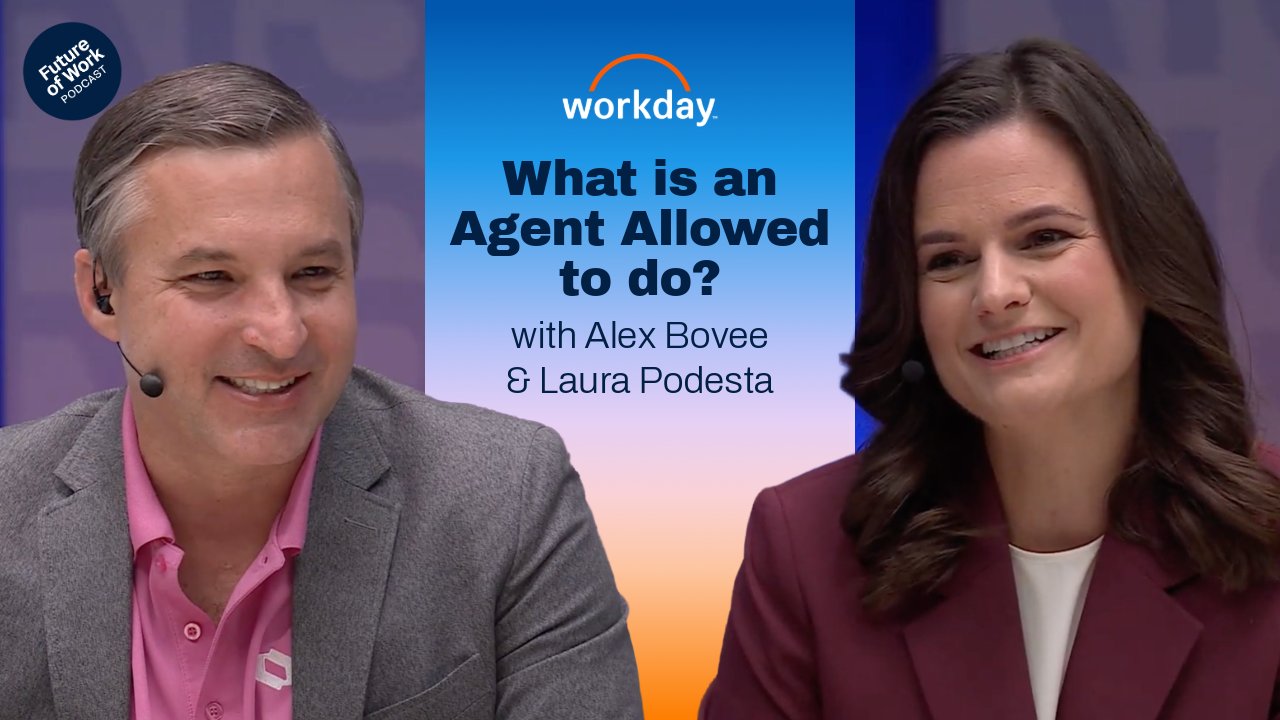
Laura Podesta: Lawful AI begins with a simple question: Who is allowed to do what? Fresh off the announcement that Workday has agreed to acquire C1 AI to bring unified identity governance to both people and agents, I'm here with C1 AI CEO Alex Bovee. Alex, welcome.
Alex Bovee: Thanks, Laura. Thanks for having me.
Podesta: So, my first question for you is: what did you see happening internally in companies that made you realize "I need to build a product that C1 is offering"?
Bovee: So we're in the identity space. Our platform is a unified identity and access governance platform. And what we saw was that, despite having a plethora of identity tools in the enterprise, nobody felt like identity was a solved problem, in part because the solutions were siloed, they didn't work well together, and nothing was really built to kind of drive automation and have policy-driven access control that could run in real time, even for humans. And so we wanted to really reinvent the identity category from a bottom-up perspective on first principles, building a best-in-class technology platform that solved problems across identity and access management, governance, and privilege management. And so that's what C1 is.
Podesta: Can you clarify for me exactly what you mean by identity? Is this human identity? This is making sure the right person is getting access. Or is it an AI agent?
Bovee: It's both. Yeah. So I mean, that's what's interesting, right? Identity is definitely humans, but now with agents kind of coming onto the scene, those agents need identities as well. And it's really the root, if you will, of how you do access management control and governance: you have to understand who are the humans, what are they trying to access, to what do they need access to, how do they get that access? You have to answer those exact same questions for agents that you do for humans. You just have to answer that for agents a lot faster and in real time because they're basically machines that run at machine speed. And so that's what I mean by identity: it's really about the humans and the agents and how do you secure and control what they do.
Podesta: I found this statistic really interesting. Your company released research showing that 95% of companies in the US are already running autonomous agents, which is an incredible number to me—it's nearly 100%. Then Deloitte's research found that only 21%—so about one in five—of those companies has a mature way to govern them. So what is driving that gap, and also can you define what is a mature way to govern AI agents?
Bovee: Sure. I can tell you what's driving it, and it's competitive pressure and board pressure. So as AI really started happening and LLMs got really good, the pressure from boards onto executive teams to adopt AI, to move faster, to be competitive with it, has never been so intense. And I think that's in part what drove the massive diffusion of AI into large enterprises and basically all enterprises, frankly. And so we had a massive push from the executive teams to drive AI and to get AI adoption by their teams, but no one really had tools or platforms to govern that, to secure it, to put it on the rails. So what you ended up with is a team that largely is using a mixture of different AI tools—personal agents and assistants, different LLM and inference providers—and it's created basically a mess. So I think that's where you see the spread there: 95% of companies, people are using AI, they're deploying agents, they're running personal assistants, but the programs to actually govern that and give people the guardrails to use it securely and safely are very, very, very far behind.
Podesta: So what's going to happen to the 80% of companies that are using autonomous agents and not governing them correctly? I mean, what could happen?
Bovee: Well, I hesitate to fear-monger about security, but there's definitely security issues. I think there's data sovereignty issues. I think the right perspective, though, to take on it is: look, the best way to actually enable your team to be productive, to move fast, and to use AI tools effectively is to just give them very clear swim lanes, strong governance, make it very accessible, make it easy to use the AI tools, govern the spend, govern the agents, have the right access controls in place. And then that actually lets companies move super fast because they can do it in a way that they're confident, and they're not worried about the security outcomes or data loss or things like that.
Podesta: Okay. And it's so exciting, this announcement that you've been acquired by Workday. Why Workday? Why did it make sense for C1 to join Workday?
Bovee: It made total sense. As we chatted with Aneel and Gerrit and really understood the vision of Workday, which is to be the place where work gets done across HR, finance, and IT, identity is just such a critical part of how you power that. It's really the infrastructure layer of how do you authorize, create identities, digital identities, create accounts across the different systems. And Workday is the book of record for humans, you know? It is the canonical source of truth of who are the humans within your organization. And now with Agent System of Record, it's a system of record for agents in the organization, and then C1 is really the access control, governance, permission management control plane.
Podesta: Well, congratulations! It's an exciting future. And as we talk about that future, fast forwarding a few years, what's it look like if every person and every agent in an enterprise had exactly the right access automatically?
Bovee: I think we're approaching a world where the productivity of human beings that are AI-enabled is probably not really fully understood today. I think if you look at very AI-enabled teams and just how fast they move, you can have an engineer who's traditionally what you'd call a 10x engineer—they're like 10 times the engineer—they could be 10, 100 times more productive with AI tools. So I think it really is a force multiplier for productivity within the enterprise. And I think the future's really bright just in terms of how productive teams are going to be, the amount of work that we're going to be able to get done. It's just... I think it's really exciting.
Podesta: So, is there going to be any problem in the future that a CIO would lose sleep over, or is everything going to be perfect and—
Bovee: I mean, I'm sure there's always new problems.
Podesta: We'll be dancing with the AI agents.
Bovee: There's always the next problem, but yeah, it's going to be exciting.
Podesta: All right. Well, it was so nice to have this conversation with you. It's such an exciting time. Welcome to the Workday family, and can't wait to see what's next.
Bovee: Thanks, Laura.