Artificial Intelligence
AI Adoption Is Moving Faster Than Employee Trust
Workday’s new monthly survey of workers worldwide

Amanda Wowk
Senior Research Writer
Workday
Workday’s new monthly survey of workers worldwide
Amanda Wowk
Senior Research Writer
Workday
TL;DR: New Workday data reveals the more employees use AI, the more likely they are to see it as both an opportunity and a threat. Lack of trust—in AI output, workplace use, and employer intent—might be to blame.
According to an August 2026 survey of 5,944 employees across the globe, more than 80% say they’ve received training in how to use AI at work. Among frequent users, 69% expect AI to create new career opportunities over the next 12 months, while over half (54%) also expect AI to make the skills they use today less valuable.
The dissonance between threat and opportunity is most pronounced among the heaviest AI users. That is, employees who use AI the most are also the most likely to believe it will reshape their careers in both positive and negative ways.
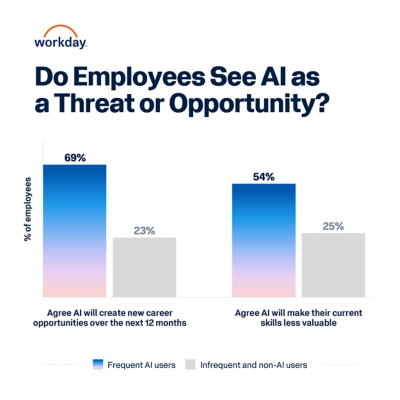
High AI usage does not simply make employees more optimistic or more fearful. Instead, it appears to make them more aware of AI’s dual impact: it can open doors while also changing the value of the skills that got them there.
Manager conversations—or, lack thereof—likely feed these complex attitudes. Many employees say they are not talking to their managers about AI and its implications. More than a third (37%) of employees say their manager hasn't talked with them at all in the past three months about how AI is changing their role (the largest single group). Only 14% get regular conversations with their boss. This leaves employees vulnerable to misinformation, fear, and filling in the blanks themselves.
Individual contributors are the least likely to hear from their managers about AI: 53% have had no conversations, and only 7% have had regular conversations. They’re also the lowest AI-usage cohort (61%), and the data suggests manager communication may be part of the reason.
Is a lack of trust rampant? Our data suggests so. Let’s take a closer look:

Report
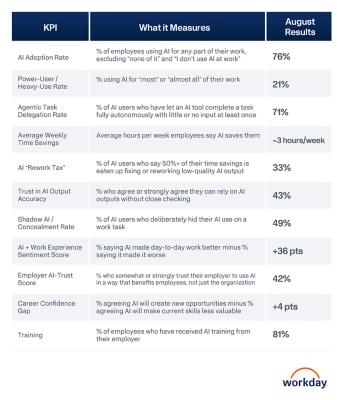
AI is helping many employees move faster, but its outputs are not yet trusted enough to stand on their own. Over half of employees (57%) say they can’t rely on AI outputs without checking them closely. Many also lose time to correcting AI slop: 33% say at least half of the time they “saved” by using AI is later consumed by correcting or reworking low-quality AI outputs. For most workers, AI still requires human review before its work can be used confidently.
The shift: The opportunity for employers is to evolve the conversation from “use AI more” to “use AI well,” with clearer guidance on where AI is reliable, where review is required, and how to spot errors.
One of the clearest signals that workplace norms have not caught up with AI adoption is the amount of concealed use. Half of respondents say they deliberately hid their use of AI at least once during the past month—suggesting psychological safety and policy gaps around AI disclosure.
When employees feel the need to hide AI use, it suggests uncertainty about what is acceptable, fear of being judged, or concern that using AI will be seen as cutting corners rather than working smarter.
However, employees could also be taking cues from leadership. According to our data, between 58% and 61% of manager and leadership groups report concealed AI use, compared with just 35% of individual contributors.
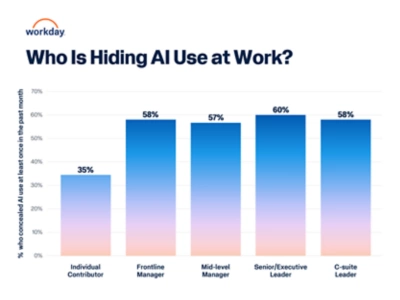
The shift: Managers and leaders must set the example for responsible AI use. That way, employees can learn to not only trust AI tools, but also feel psychologically safe to disclose AI use in the workplace.
Employees are also divided on whether they trust their employer to deploy AI in a way that benefits employees, not just the organization. Only 42% say they trust their employer on this point. A quarter (25%) say they distrust their employer, while one-third (33%) remain neutral.
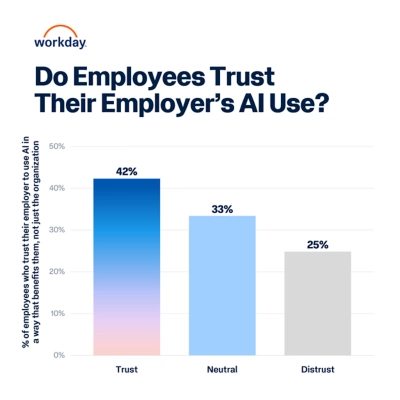
Employees who haven’t made up their minds yet may still be shaped by what employers do next: whether AI is introduced transparently, whether employees have a voice in how tools are used, whether training is practical, and whether AI is positioned as a way to support workers rather than intensify workloads.
The shift: The call to action here is clear: close the employer trust gap. Communicate what AI will and will not be used for, invite employee feedback before and after rollout, and equip managers to talk openly about how AI is changing roles, expectations, and opportunities.
Here’s what else we’re tracking month over month. Come back in October for new insights and trends.
Report

A gap between effort and impact is the real ROI problem. Discover the solution.