Artificial intelligence has changed how companies think about technology. Only a few years ago, digital transformation was about improving processes, connecting teams and making work flow more smoothly across the business. Today, the conversation often starts somewhere else. Give employees an AI assistant, and better performance will follow.
The idea sounds simple. Whether it works is another question.
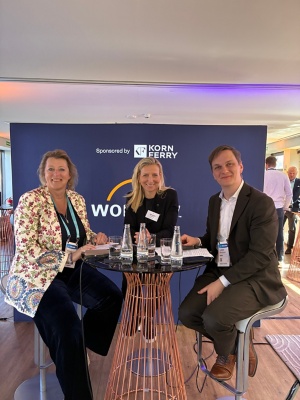
In this Executive Conversation, recorded live at Workday Elevate Berlin, host Lasse Rindom speaks with Angelique de Vries, President EMEA at Workday, and Alex Kuchta, Senior Client Partner at Korn Ferry, about what happens when AI moves beyond helping people with their work and begins carrying out parts of it.
The discussion points to a shift that many organisations are only starting to see. AI is moving beyond drafting emails, summarising meetings and handling individual tasks. It is becoming part of how companies run their day-to-day operations. That changes what businesses should expect from enterprise software. The question is no longer how many features a platform offers. It is whether it helps people make sound decisions inside real business processes.
That depends on context. HR and Finance operate within defined processes, permissions and governance requirements. The quality of the data matters just as much as the quality of the model. In these environments, an answer that is only partly correct may not be good enough to support action. As AI becomes more capable, attention shifts from the model itself to the business environment in which it is used.
The panel also challenges a common assumption about AI. Saving time does not automatically create value.
If people spend the time they save checking AI-generated work, the benefit quickly disappears. The technology may produce more output, but the organisation gains little if nobody is willing to act on it. Trust becomes a practical business issue. Leaders need to know when AI can support a decision and when human judgement still matters.
That is why adopting AI is only one part of the job. Companies also need to rethink how decisions are made, how work is organised and how people develop new skills as their roles change.
One idea runs through the entire conversation. The companies that get the most from AI will not necessarily be those using the latest models. They will be the ones with clear processes, high-quality data and the confidence to put AI to work where it can make a measurable difference.