Evaluate
Pigment vs Adaptive Planning: An FP&A Software Comparison
Governed planning at scale, AI that runs on your data wherever it lives, and a track record that goes beyond the demo. Chosen by 7,000+ finance teams that agree.
Planning more than budgets and forecasts? Adaptive Planning lets finance, HR, and operations plan together across workforce, sales, supply chain, and more. Compare Pigment vs. Adaptive Planning on AI, modeling, scalability, integrations, governance, and security.

Why finance teams choose Adaptive Planning over Pigment
Workday Adaptive Planning, a Leader in the Gartner Magic Quadrant for 4 straight years, puts AI at the core of enterprise FP&A for finance teams from the mid-market to the Fortune 500.
Three capabilities do the heavy lifting: Adaptive Decision Intelligence for exploratory modeling, our MCP Server for connecting Adaptive models to the agents already running in your enterprise, and the Adaptive Data Foundation (powered by Incorta) for live operational data. Together they forecast, detect anomalies, perform root cause analysis, run scenarios, and drill into source detail, with permissions enforced throughout. AI you can audit, end to end.
Pigment is built to win the demo. Adaptive is built to win at scale.
Pigment vs Adaptive Planning: Feature Comparison
How Adaptive Planning and Pigment compare across modeling, AI, integrations, scalability, and governance
| Capability | Pigment | Workday Adaptive Planning |
|---|---|---|
| Flexible integration across enterprise systems and data sources |
Pigment
30+ native connectors including Salesforce, NetSuite, Snowflake, BigQuery, BambooHR |
Workday Adaptive Planning
350+ native integrations, pre-built blueprints for top ERP, HCM, and CRM systems (Workday, Oracle, NetSuite, Salesforce). Adaptive Data Foundation extends reach across cloud and data warehouses, and Adaptive Data Integration (powered by Pipedream) connects virtually any other source into governed planning. |
| Customer base |
Pigment
~600 customers |
Workday Adaptive Planning
7,000+ customers, with 52% in the mid-market space |
|
AI on data where it lives (no data movement) |
Pigment
Pigment AI requires data ingestion into Pigment |
Workday Adaptive Planning
Run data exploration, variance analysis, and more on data in Snowflake, Databricks, or Incorta via CDC. No ingestion required. |
|
Multi-agent open standards (MCP + A2A) |
Pigment
Has MCP Server capabilities |
Workday Adaptive Planning
MCP Server and A2A access |
| Zero-retention AI policy |
Pigment
Nothing explicitly listed in Pigment’s trust center |
Workday Adaptive Planning
Customer data never used to train core models |
| Board reporting in Excel, Word, and PowerPoint |
Pigment
Excel, Google Sheets, and PPT connectors; no documented Word equivalent |
Workday Adaptive Planning
OfficeConnect with one-click refresh and write-back, Workday for Google Sheets with reports, write-back, hierarchy exploration, and natural-language analysis/agentic capabilities. |
| Non-production sandbox testing |
Pigment
No sandbox, only dev environments available |
Workday Adaptive Planning
Dedicated sandbox tenants with Preview Tenants also available |
| Multidimensional modeling engine |
Pigment
Elastic Canvas: Flexible modeling architecture for connected planning |
Workday Adaptive Planning
Elastic Hypercube Technology: multidimensional calculation engine for scaling complex FP&A models, real-time data processing, and governed performance |
| Driver-based what-if scenarios |
Pigment
Real-time, flexible |
Workday Adaptive Planning
Real-time, governed with AI-insights, including private and shared scenarios |
| Strategic Workforce planning |
Pigment
Flexible headcount planning, but not Workday HCM-native for approvals and execution. |
Workday Adaptive Planning
Scenario modeling for future workforce structure, composition, capacity, cost, skills based workforce planning, business transformation initiatives and organizational design decisions. |
| Headcount Planning |
Pigment
Configurable workforce scenarios, but not as robust for governed org design. |
Workday Adaptive Planning
Governed, HCM-connected planning between HR, Finance and Operations for hires, attrition, transfers, compensation, benefits and headcount cost. |
| Organizational Design & Scenario Modeling |
Pigment
Flexible for custom HR and workforce scenarios, but more model-builder driven than purpose-built for org design workflows. |
Workday Adaptive Planning
Purpose-built for modeling org changes, comparing workforce scenarios, and translating structural decisions into financial impact and governed action. |
| Global data residency |
Pigment
Production data and analytics hosting in the EEA and US, with additional support, AI, and operational processing across multiple regions; customers with strict residency needs should validate their exact deployment requirements. |
Workday Adaptive Planning
Data residency in US, CAN, EU, UK, Japan, India, Singapore, and Australia for full platform customers. |
| Multi-entity, multi-GAAP consolidation |
Pigment
Offers financial consolidation capabilities, unclear if multi-GAAP depth available |
Workday Adaptive Planning
20+ years; intercompany eliminations, journal entries, currency translation |
| FedRAMP Authorization |
Pigment
Does not have FedRAMP authorization |
Workday Adaptive Planning
FedRAMP Authorization at the Moderate Impact Level |

“I think implementing Workday Adaptive Planning has been a significant step forward for our company. To automate planning in a comprehensive manner across the company is setting the foundation for growth.”
—Vice President of IT Business Applications
Why finance teams choose Adaptive Planning over Pigment
Explore how Adaptive Planning leads on AI, modeling, integrations, scale, and partnership—from running AI on your data wherever it lives to delivering governed planning trusted by thousands of finance teams.
Adaptive Planning runs AI on your data, wherever you want it to live. Pigment AI requires data to move into Pigment.
You decide what belongs inside Adaptive Planning and what stays in your source systems. Adaptive Decision Intelligence connects directly to your data where it lives — Snowflake, Databricks, Adaptive Data Foundation, Workday HCM, or Workday Financials — powering AI-driven analysis and planning without forced ingestion, duplication, or governance risk.
Adaptive Decision Intelligence layers on top for exploratory modeling, ingesting and merging any source a scenario calls for — CRM, HCM, operational systems — with full lineage intact. Pigment AI runs only on data already imported into Pigment. A second data movement. A second reconciliation. A second system of record to govern.
Adaptive's open-standard agent architecture (MCP + A2A) connects to Claude, Gemini, ChatGPT, or whatever AI you already run.
“Adaptive Decision Intelligence lets us take the manual work out of month‑end while keeping a clear human check on the numbers. Finance still owns the story, but AI helps us get from data to decisions much faster.”
—Corporate FP&A Leader at a large global media company
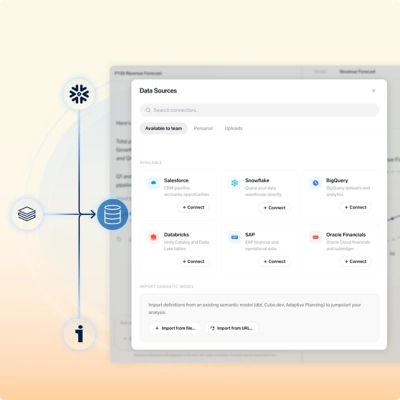
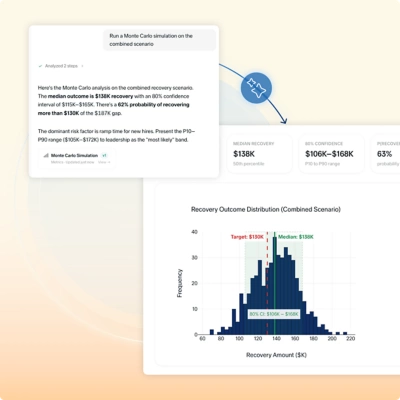
Adaptive Decision Intelligence can be your modeling agent for ad-hoc, what-if work.
Adaptive Decision Intelligence handles the strategic, exploratory work that usually lives in shadow spreadsheets: M&A modeling, pricing scenarios, capacity planning, root cause analysis, Monte Carlo simulations, and ad-hoc executive requests.
Use Adaptive Decision Intelligence to test assumptions and reshape dimensions mid-analysis, then commit finalized results into your governed plan with full lineage intact. Every output is explainable, auditable, and grounded in live data.
ADI can be your workspace for ad-hoc what-if questions without rebuilding your governed plan.

“We never really had a very robust planning capability before. Workday Adaptive Planning opened our eyes to what’s possible.”
— Director of Business Systems Process and Strategy, Enmax
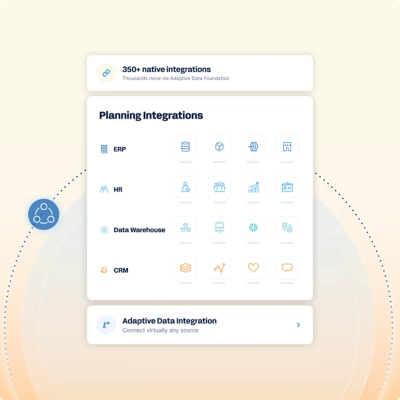
Adaptive Planning integrations cover any ERP, HR system, or data warehouse. Not just Workday.
The strength of Adaptive Planning integrations is breadth:
- 350+ native integrations in addition to pre-built blueprints for systems like Workday Financials, Oracle, SAP, NetSuite, and Salesforce.
- Adaptive Data Foundation, created in partnership with Incorta, offers thousands of additional connectors across cloud and data warehouse platforms, no IT required.
- Adaptive Data Integration, powered by Pipedream, connects virtually any other source into the governed planning process.
Pigment offers 30+ native connectors. Most finance teams run a heterogeneous stack. For them, Workday Adaptive Planning means one planning platform across every source system.

“Using a shared platform with a single source of truth for financial data has transformed the efficiency and accuracy of our planning and budgeting processes.”
—Denis Kavaliou, Data Governance and EPM Manager, Doctolib
Adaptive Planning is intentional and road-tested.
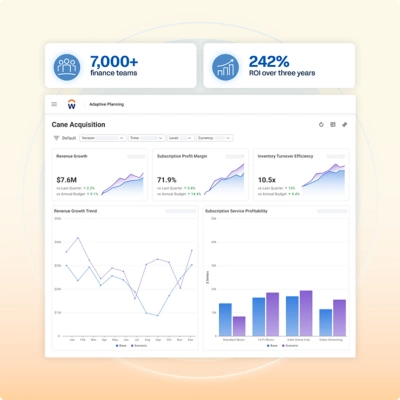
7,000+ finance teams chose Workday Adaptive Planning, more than the next five competitors combined.
Pigment's product demos well with a polished, modern UI. But a great demo isn't a great deployment. Our refreshed planning experience — now in customers' hands alongside Adaptive Decision Intelligence — is turning heads of its own, narrowing the "modern UI" gap that's long lived inside Pigment's demo environment.
With the demo gap closing, what's left is the deployment gap — and that's where Pigment's track record gets short. A modern interface is easy to render for 50 users. The real question is what happens at 1,000 users, 5,000 users, and multiple legal entities.
Apollo.io asked that question. They chose Adaptive Planning.

“Workday Adaptive Planning has been a game-changer in our global operations, uniting HR and finance under one platform and providing the foundation for better forecasting and decision-making.”
—Global Director HRIS, Philips
Adaptive Planning treats every customer relationship as a long-term partnership.
You see it in the details. Every customer gets production and development environments by default, plus non-production sandbox tenants and preview tenants for safe testing and early access to what's coming.
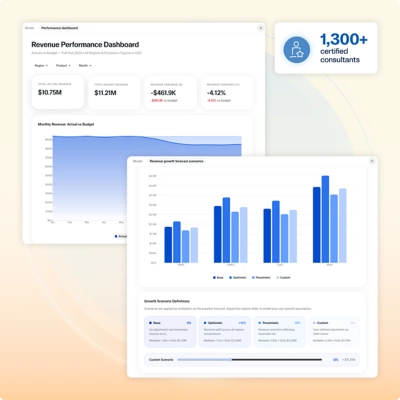
You also get access to 1,300+ certified consultants across the partner ecosystem and Adaptive Decision Intelligence that works turn-key from day one. We're here to help you in the AI era and every era after.
“Workday Adaptive Planning has unleashed the power of our revenue planning and connected us even further with our business partners.”
—AVP, Financial Systems Governance, CNA

“Workday Adaptive Planning has put us in a great place to grow and have clean, easy, real-time access to data.”
— Director of Financial Transformation and Systems
See for yourself how Workday Adaptive Planning compares to Pigment.
There's a reason 7,000+ finance teams chose Adaptive Planning over the alternatives.
Book a demo and put Adaptive Planning against your actual use cases. Your data, your consolidation requirements, your scenario models. Not a tailored demo tenant.
FAQs.
Are you scaling planning across the business?
Adaptive Planning is the stronger fit if you:
Need governed, audit-ready FP&A with full traceability across multiple legal entities
Plan to grow beyond 1,000 employees, or already operate at that scale
Run data-heavy operations in manufacturing, retail, healthcare, or other industries where model size and performance matter
Need planning that extends well beyond budgeting and forecasting — operational planning, workforce planning, sales and supply chain planning, all on one platform
Want AI that runs on trusted, governed data with explainable outputs
What's the difference between Pigment and Workday Adaptive Planning?
The core difference is what each platform is built for. Workday Adaptive Planning is an enterprise FP&A platform designed for governed, audit-ready planning across mid-market and Fortune 500 organizations, with AI that runs on data wherever it already lives and native integration into any ERP, HR system, or data warehouse. Adaptive Decision Intelligence handles exploratory modeling, data exploration and variance analysis, and the Adaptive Data Foundation (powered by Incorta) brings in live operational data. The calculation engine runs on patented Elastic Hypercube Technology — one in-memory system for planning, modeling, and reporting. It adds memory and compute as your models grow, so multidimensional plans run fast at any scale. No re-platforming. No hidden storage costs. Pigment is a modeling platform known for flexible multidimensional modeling, a polished UI, and 30+ connectors. Adaptive Planning is the stronger fit for finance teams that need governed planning at scale.
Which is better for mid-market and enterprise FP&A teams: Workday Adaptive Planning vs Pigment?
Workday Adaptive Planning. The same platform serves finance teams from mid-market through the Fortune 500 — 52% of our customers are in the medium enterprise space— using one governance framework end-to-end. Mid-market teams get enterprise-grade audit trails, role-based access, and OfficeConnect reporting from day one. Enterprise teams get the same controls extended to complex financial and workforce planning across dozens of legal entities. The platform grows with the business. No re-platforming when you cross the next size threshold.
What Adaptive Planning integrations are available with Snowflake, Databricks, and Microsoft Fabric?
Cloud Data Connect creates direct pipelines into Incorta, Snowflake, and Microsoft Fabric, and the Adaptive Decision Intelligence runs AI on that data without requiring ingestion into Adaptive Planning.
Does Adaptive Planning work if we don't run Workday Financial Management or Workday HCM?
Yes. Adaptive Planning is platform-agnostic. Adaptive Planning integrations connect natively to any ERP or HR system, as well as NetSuite, Salesforce, Snowflake, Databricks, Microsoft Fabric, and any database via APIs and the Adaptive Data Foundation. Finance teams running heterogeneous stacks use Adaptive Planning as their single planning platform across every source system, with Pigment-comparable connector breadth and deeper drill-through into source transactions.
Does Pigment offer multi-GAAP consolidation?
Pigment offers financial consolidation capabilities, but public materials reviewed do not clearly confirm full multi-GAAP consolidation depth, including IFRS, US GAAP, local statutory GAAP, XBRL, or GAAP-specific reporting. Workday Adaptive Planning supports multi-entity consolidation with intercompany eliminations, currency translation, adjusting journal entries, and GAAP/statutory reporting workflows.
Pigment AI vs Adaptive Planning AI, which is stronger for FP&A?
Adaptive Decision Intelligence runs on data wherever it lives — Snowflake, Databricks, or Incorta via Cloud Data Connect — with Skills for data exploration, variance analysis, scenario planning, and self-service. Adaptive Decision Intelligence adds a workspace for exploratory modeling (M&A, pricing, capacity planning, root cause analysis, scenario analysis) that ingests and merges any data source while preserving full audit trails. Predictive Forecaster and Anomaly Detection round out the production AI surface. All of it runs inside a governed tenant with existing permissions enforced, so every AI-generated forecast, scenario, and variance explanation is traceable back to its source — the kind of audit trail finance leaders need when the board or an auditor asks how a number was produced.
Can finance teams maintain Adaptive Planning models without IT or consultants?
Yes. Adaptive Planning is click-not-code and finance-owned. Once implemented, business users build and maintain models without coding, using structured sheets, dimensions, attributes, accounts, levels, and the formula assistant. Pigment positions itself similarly, though community feedback notes a steeper learning curve and a stronger dependence on implementation partner quality for long-term maintainability.
Who are the main Adaptive Planning competitors and Pigment software competitors?
The most frequently evaluated Adaptive Planning competitors and Pigment software competitors include Workday Adaptive Planning, Pigment, Anaplan, Oracle EPM Cloud, and Planful. Each makes a distinct tradeoff. Pigment leads with flexible modeling and a modern UI. Anaplan targets cross-functional connected planning. Oracle EPM suits Oracle ERP environments. Planful focuses on mid-market ease of use. Workday Adaptive Planning differentiates through governed enterprise FP&A, broad integration, and the largest verified peer review base in cloud FP&A.
Can Adaptive Handle Revenue Modeling and Expenses by Vendor as well as Pigment?
Yes. Workday Adaptive Planning supports flexible revenue modeling and vendor-level expense planning using configurable dimensions such as customer, product, region, channel, project, and vendor. Finance teams can model recurring revenue, usage-based revenue, pipeline, bookings, and other driver-based revenue streams using modeled sheets, cube sheets, formulas, assumptions, and CRM integrations such as Salesforce. For expenses, Adaptive can plan, report, and analyze at the vendor level when vendor data is included in the planning model or available through source-system drill-through. As with any FP&A platform, the usefulness of vendor-level planning depends on consistent actuals coding, clean vendor master data, and upfront data governance. Once that foundation is in place, Adaptive provides scalable revenue and vendor-level expense modeling within a governed planning environment.
Is Pigment FedRAMP certified?
Pigment’s public trust materials do not list FedRAMP in the materials reviewed, while Workday Adaptive Planning is FedRAMP certified for civilian agencies with U.S. public-sector or regulated cloud security requirements.
Gartner Magic Quadrant for Financial Planning Software, Regina Crowder, Sid Sahoo, Mike Lashinsky 1 December 2025
Gartner does not endorse any vendor, product or service depicted in its research publications, and does not advise technology users to select only those vendors with the highest ratings or other designation. Gartner research publications consist of the opinions of Gartner’s research organization and should not be construed as statements of fact. Gartner disclaims all warranties, expressed or implied, with respect to this research, including any warranties of merchantability or fitness for a particular purpose.GARTNER is a registered trademark and service mark, and MAGIC QUADRANT is a registered trademark and THE GARTNER PEER INSIGHTS CUSTOMERS’ CHOICE badge is a trademark and service mark of of Gartner, Inc. and/or its affiliates in the U.S. and internationally and are used herein with permission. All rights reserved. Gartner Peer Insights content consists of the opinions of individual end users based on their own experiences and should not be construed as statements of fact, nor do they represent the views of Gartner or its affiliates. Gartner does not endorse any vendor, product or service depicted in this content nor makes any warranties, expressed or implied, with respect to this content, about its accuracy or completeness, including any warranties or merchantability of fitness for a particular purpose.
All statements in this report attributable to Gartner represent Workday interpretation of data, research opinion or viewpoints published as part of a syndicated subscription service by Gartner, Inc., and have not been reviewed by Gartner. Each Gartner publication speaks as of its original publication date (and not as of the date of this [presentation/report]). The opinions expressed in Gartner publications are not representations of fact and are subject to change without notice.