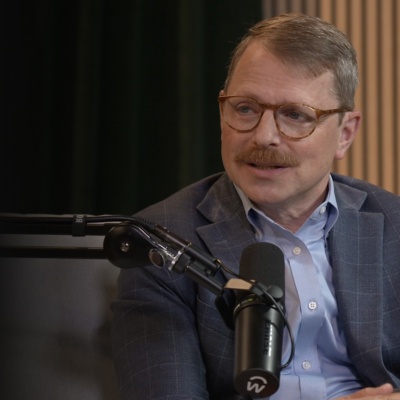
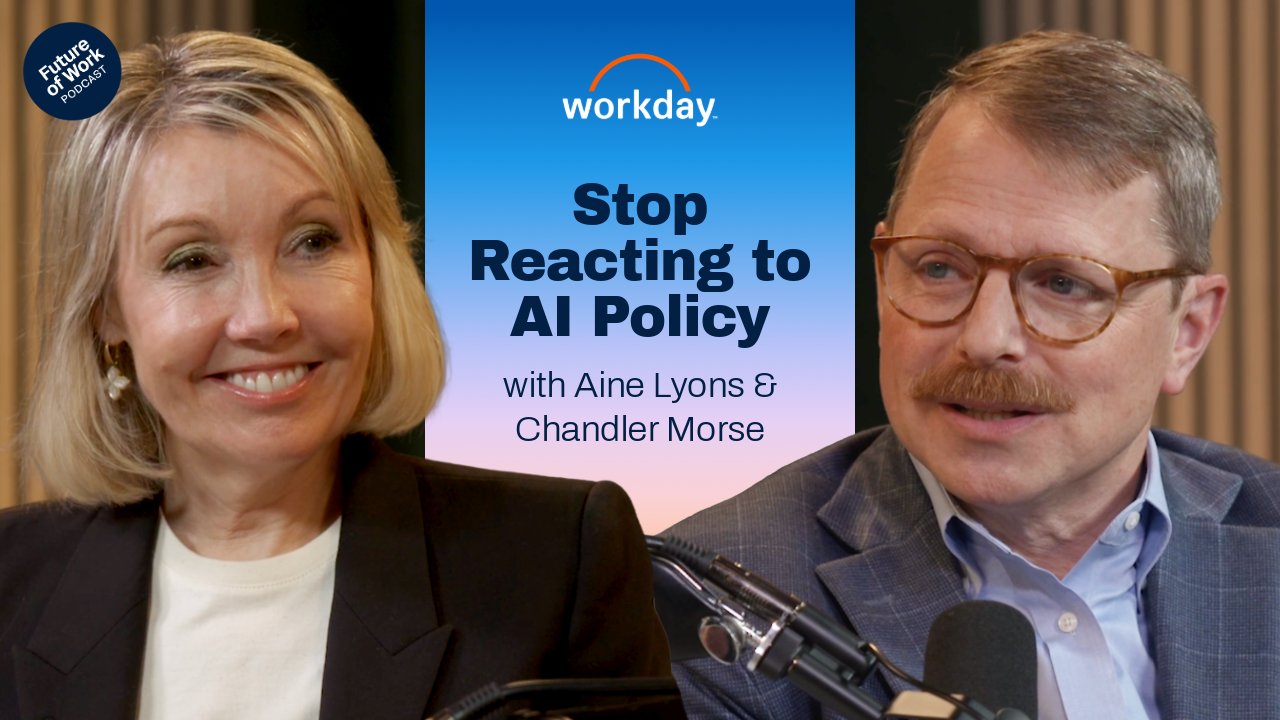
Aine Lyons: AI policy is moving fast, and most businesses are reacting instead of leading. Welcome to the Future of Work Podcast. I'm Aine Lyons, Senior Vice President and Deputy General Counsel at Workday, and I'm joined by my colleague Chandler Morse, Workday's Chief Corporate Affairs Officer. We're going to talk about what the regulatory landscape actually looks like right now and how enterprise leaders can stay ahead of it.
Let's dive in. Welcome, Chandler.
Chandler Morse: How's it going? Great to be here.
Lyons: Your team really sits at the intersection between corporate strategy, public policy and brand trust. And right now, from a regulatory perspective, it's a fast race course. Maybe tell us a little bit about what your team and you are working on from an advocacy perspective right now.
Morse: The corporate affairs team at Workday, we really are focused on leveraging advocacy and partnerships and thought leadership to drive policy outcomes, to shape the business environment and help us better serve our customers. And our really our north star for that, in terms of how we go about that is we are really looking to to build trust, unlock human potential and again focus on what our customers need and how we can better serve them.
It is a rapidly evolving, that's the word I keep using to describe sort of it's a rapidly, and every time I think we've sort of seen the peak of the rapid evolution, it sort of evolves a little bit faster. but the tech policy arena globally is rapidly evolving, particularly when it comes to AI. My team is we have a footprint that is both we are working in the federal space in the US as well as the state and local space.
We have team members in Brussels interacting with the European Commission and the European Union countries, as well as in the UK and in Singapore. And this year we'll be expanding our footprint to Canada, which we're super excited about.
Lyons: So your appointment as Chief Corporate Affairs Officer at Workday is a big milestone for us. I wanted to just take us back a little bit and talk about your career and how you got here.
Morse: So my first job was actually a farmhand on a horse farm. and I knew I wanted to do public policy, but I didn't know exactly what that meant. And so I studied some policy in my undergrad experience, got some technical experience in a graduate education for environmental science and really cut my teeth on environmental issues. Ended up in DC working for a trade association, which I dearly love trade associations.
We hire almost exclusively out of them because there is this sense of having internal stakeholders that have expectations. And then was very fortunate to land in an office on Capitol Hill in Washington DC and I spent about thirteen and a half years there. And on Capitol Hill I had exposure to working on technology policy and I really enjoyed it. And so when it came time to transition off the hill, people who knew workday
said, Hey Chandler, you should look at this company. You would be really happy there. And what they were really saying was, I know values are important to you and values are important to work day and you'll be really happy there. And that was eight years ago. And have been really happy here. It's been really terrific.
Lyons: Chandler, you talked about trust and when we examine AI in the workplace, trust is really the ultimate currency. What was Workday's first step in building a deterministic foundation for our responsible AI program?
Morse: I think the first step was to establish principles, was to really align on kind of what the North Star for the company is in terms of how we're gonna leverage AI and those did also positively impact society, unlock human potential, make good on our privacy and security commitments. I think the next step was then to operationalize those principles in a very real way. So having a responsible AI program, dedicated staff, company-wide buy-in, thinking about how we were developing products in a risk setting, like really scrutinizing those that we thought were high risk, kind of having a different set of models for those that are low risk.
The example I use all the time is if Netflix gets wrong that I like Downton Abbey because I watch Peaky Blinders, and to be totally honest, it's not wrong because I like both of them, but let's say for the for the example it's wrong, does that matter as much as, you know, a piece of an AI SKU that's operating in a in a hiring process?
Different risk profiles and so different levels of scrutiny, different levels of testing. We established all of that with policies and protocols and guidelines. That really became the basis then for the advocacy that we launched into at a global level as the policy environment has sort of been fashioning safeguards. We've long been supportive of smart regulatory safeguards.
Certainly again, Workday's approach to responsible AI has been driven by our values, but driven by how we want to show up for our customers. At the same time, there is a level of trust that a governmental structure around what people can expect. I think at the end of the day, the maxim is true, people don't use technology, they don't trust. And we want we we are very bullish on AI unlocking human potential. We've seen it, we know it can happen, and we're excited about it. And to really see that unlock happen, as many avenues of trust building as possible need to be in the milieu and certainly policy plays a huge role.
Lyons: Yeah. And I think we were very fortunate that we started building our responsible AI program many years ago. A hundred percent. And so all of that groundwork has enabled us to reassure our customers that we can comply, particularly with laws that are coming now like the EU AI Act.
Morse: A hundred percent. And one of the things we're seeing across the landscape, kind of anyone that we talk to is the appetite for adoption, the forward lean on how to think about safeguards. You know, there's really a range. Like some companies, some institutions, stakeholders, they're very far out, very interested, very forward leaning. Some are not so much, they haven't thought about it as much.
And so we really play a role in kind of best in class and and this is how when you've got executive buy-in, we've got the company behind you when you really are thinking about how when you are a values driven entity in the space, this is what this looks like. And we're really excited because we have partnered with others in the landscape. We're working with the Future Privacy Forum right now, where we think there's a lot of value in getting as many corporate interests around the table to say what is everyone doing?
Like what are the emerging best practices? And the great example is we don't know anyone in the kind of HR AI end of things that is applying AI in a hiring process and keeping that a secret. It's it's a it's a it's a classic business practice now that you're transparent, you let the applicant know, you let the applicant, you know, here's how it's being used, here's the data that's coming in, here you know, that's being leveraged, here's how it's being leveraged.
And so that's becoming again a piece of the AI governance policy that we advocate for is to say, Hey, government officials, I know there's, you know, some thoughts about how we should move forward on governance. There are a number of these practices that are already being implemented, already being applied, and we should look at some of those as we think about what those should look like long term.
Lyons: Absolutely, and transparency is key to building trust and explainability of how you came to those decisions on those hiring decisions. A lot of use of AI is also linked to what's going to happen around the future of work. How is this automation going to impact jobs? When you talk to policymakers, what is top of mind for them on that topic right now?
Morse: This is part of that rapid evolution. We really leaned heavily into how we could support the development of smart AI safeguards, really starting in 2019, when the EU started to think about the coming EUI act EU AI Act. That work on safeguards is around a set of policy principles. You know, we love a risk-based approach, we love leveraging tried and tested.
tools for accountability like impact assessments. We really like government, you know, inner global harmonization. Not all the frameworks have to be alike, but if they can interact. That was the focus of the conversation for a number of years. Conversation in Washington, DC, state capitals, European Union, Australia, Korea, Japan.
That conversation's pretty rapidly shifting where policymakers are now very interested in AI governance, but they're also very interested in what is AI gonna do to the workforce? What's the future of work gonna look like? And when it comes to that, our view from a policy lens is we need to get the policy right. We need to get a framework around which workers, job seekers, and employers can have the agility to respond to what happens next.
I think we are at the inflection curve of AI adoption. Everyone wants to adopt AI. Everyone wants to see how they can use it. Everyone across the economy is looking at ROI and how they can implement these tools. And at the same time, we're not entirely sure what that future work impact is exactly going to look like. And so trying to sort of whack a mole with different individual problems is less effective from a f policy framework perspective than putting in place really how everyone can have the agility to respond.
And what that looks like from a policy perspective, from our perspective, is one, we we are very focused on modernizing labor market data. At the moment, particularly in the US, the data that we get in terms of hiring, skills, what's coming and going in the economy, it's dated at best. It's six months old, it's quarterly, and things are changing so fast. We're also very focused on expanding and taking to scale a skills based approach to talent. That skills based approach really enables
Morse: We love higher ed, we love degrees will always play a role. And for incumbent workers and new job seekers, the ability to quickly pick up new skills in a rapidly evolving future of work is super important. And then finally, we're very invested in policy frameworks that incentivize employer reskilling. There will always be training provider environment that'll do great work.
In addition, employers are increasingly closer to the demand signal for what skills are needed in a rapidly changing environment. And so really incentivizing employers to have skin in the game and how to upskill and reskill their workers is key.
Lyons: And I think our responsible AI program, our workdays reskilling program, we've made a huge investment in skills. Every workmaid has a skills contribution goal. There's so many training and many, many courses that people can avail of. Do you think we can be a guide to our customers about how to navigate both using AI responsibly, but also thinking about how to look at their workforce and make sure that they're making the right skilling investments.
Morse: A hundred percent. We absolutely can be a model for our customers, both in the way that we've moved to being an AI first company in terms of AI adoption as well as AI innovation. In addition, our product suite provides the tools to take that skills-based approach to talent to scale. So we have tools that can help suggest skills for worker profiles, for job recs, that really starts to lead to a talent marketplace approach where
Gaps can be identified and ways of filling those gaps. And the tools that I am the most excited about and that in the policymaker conversations I have, they get the most excited about is our data-driven career planning. So Career Hub can look at your profile and suggest some roles that you might be interested in. If you're interested in those roles, here's some learning, here's some
classes that you can take, here's some openings that might be available. And the part that I love is it also will say, here's some folks that have have, I'm I'm a relationship lobbyist, right? So at the end of the day, this is like a barber telling you to get a haircut. But like in our tool suite it'll recommend mentors. Here are people you can go talk to that have gone down that path. And so our tool suite not only really we can lead by example in the way that we are conducting ourselves in our own reskilling, but then also provide the tools to really escalate that. In addition to that, we are trying to build a policy environment that really incentivizes those kinds of ways of thinking about the future of work.
Lyons: Yeah, and I agree. It's so impactful because we're using those tools ourselves. You know, we're using Sana, it'll recommend coaches, it'll recommend new skills you should learn. Yep. which is really helpful because it's putting in employees' hands the tools to reskill. And rather than them being reactive, they can be proactive about reskilling and their careers in general.
Morse: It's an interesting thing that we are working to discuss with policymakers, which is there is this sense that AI is gonna cause a lot of change, and there is some angst about that, you know, th and and and we're feeling it and we're having these conversations and we're seeing a lot of that angst directed towards well, what are these future of work impacts?
And we then kind of shift the conversation and say, this is not the first technological elevation evolution we've seen. It won't be the last. However, this one's a little unique in that the same tools that are driving some of that change are the tools that will be useful in mitigating that change. Meaning, how you know, suggested skills or or data-driven career planning or these different ways where AI can come in and also, you know, what AI is best at is driving inferences from very noisy data.
And what I can tell you, from a national level, labor market data and shifting skills and different openings and different emerging roles, it's very noisy. And so we are working to really get in place a policy environment where the best of AI can be used to not only be thought of as this thing that's causing these changes, but can also be viewed as a tool that can help folks really thrive in the coming future of work.
Lyons: That's a great way to look at it because it democratizes training in a way. Access to training, access to reskilling. Many of our tools are just so good at that. I really navigate like almost chart out your career path for you.
Morse: A hundred percent. And I think it resonates with policymakers and policy stakeholders. The things that resonate the most are the things that everyone has experience with. And one thing that everyone has experienced is that we've all looked for a job. And often that career advice has been anecdotal. My cousins, buddies, friends, sister said nursing is big. Now they might be right in that specific instance, but it's tough to really plan out an entire career based on
kind of anecdotal and not and what AI can do is really come in and provide some data-driven basis on which to make really important decisions. If you have time and energy and thought and want to go get reskilled, the question that we need to be able to answer at our fingertips is what should I go get reskilled in? Workday’s tools can do that. We can help provide a policy environment that can do that. And that's really what we're oriented.
Lyons: And the regulatory landscape is so frothy right now. It's keeping a lot of our customers, I'm sure, up at night, just like it is us too, you know, trying to keep pace with that regulation. How do you think we can partner more with our customers to help them on that front?
Morse: I think the first thing that we recommend for all of our customers is whether it's in the financial services or whether it's in manufacturing or whether it's in healthcare or whether it's in education, all of those sectors have trade associations, representation in the global capitals, and should be and likely are part of the conversation.
And so what we really encourage everyone is access to tools, access to trusted tools, the unfolding regulatory environment, it will all benefit from as many voices engaged in that conversation as possible. And so we regularly talk to customers about how we would recommend you plug in. Like your voice is important.
You wanna have access to these tools, your your employees, your management, your executives wanna feel good about applying them, and you also want to be able frankly just to and and it's not workable regulations come from industry showing up and saying these are the things that we can we can do, these are the things that we can't do. And so everyone should have a voice in that at the moment. I think I'm one hundred percent biased, but I think it is the most important conversation that's happening right now.
Every time you open a newspaper or turn on the news, you know, there's some story on there you you don't tend to see in my line of work you know evening news highlighting you know this policy was just adopted when it comes to AI governance and we're seeing it all the time and so really what we are kind of begging everyone is is to have a voice in in this process and there are lots of ways to to engage there and we're happy to help our customers figure out how to plug that in.
Lyons: That's great because I think the more we can encourage customers to lean in with your team to engage in those policy debates and those discussions, we can really influence AI and make it something that the opportunity of innovation isn't stalled, but it when we do have that innovation, it's going to be done in a trusted and responsible way. And that's what good regulation does.
Morse: I think every iteration of a technological evolution has had some form of regulatory, statutory, legislative response. AI is happening in a little bit of a different way. One, it's happening very quickly. And two, we're having these conversations around what the safeguard should look like at the same time we're having the conversations of what the innovation will look like and what the ROI is and where we'll see them adopted.
Lyons: Restrictions that need to be there to protect.
Morse: And so you don't typically see those two conversations going hand in hand. And now we've got kind of this third conversation of, okay, well what are gonna be the future of work implications? It tends to be that the policy environment lags very far behind the action. And to your point at the beginning of the conversation, not only are some companies reacting, but it tends to be that governments end up sort of being in that reaction.
And we are seeing a very forward lean from governments. In that forward lean, there is a very real appetite for what does industry need? How are you thinking about this? A very real appetite around the world we're seeing, and frankly, I would focus on the Asia Pacific region of how they are starting the conversation with: we need to put safeguards in place, but we need to balance innovation.
We don't want to miss out on the benefits of AI, but we also need to make sure that it doesn't have unintended consequences. And that is a very real opportunity for stakeholders to engage. And I I would say our influence has been a little bit stronger than I thought it would be, but mostly it's because, you know, we are knocking on an open door, walking in and saying, hey, here's what we're doing, here's our responsible AI program, you're thinking about a regulatory landscape.
Here's what we're already doing, here's what we think is working. And frankly, I'll be totally honest, a number of pieces of feedback we can't say that's not gonna work. Like you can't scale that. And so could we have it look like this and get to the same goal? But there really is an opportunity in front of us all to participate and have that voice.
Lyons: Yeah. And to help iterate regulation to make it workable. Workable for specific industries, workable in practice, because sometimes the early drafts, when industry sees them, and policymakers are open to the feedback of what would make this still have the safeguards but be workable in practice and can scale.
Morse: We're seeing that conversation in Europe right now where the EU AI Act is on the books, it's passed, it's been adopted. We've just seen a delay in some of the requirements, not because they're not good requirements, but because the underlying standards weren't in place and that whole conversation that's happening right now around the EU AI Act in Europe is entirely focused on workability. How do we get these pieces of the policy in place in a way that that industry can respond to them, have the time and meet the goals?
Lyons: And can operationalize them in practice. A hundred percent. So give us some examples of you know, your team is active around the world in the US and in Europe and and also in Asia Pacific, some examples of the current advocacy work.
Morse: Yeah. We have a very fulsome agenda that I think separates us a little bit from other corporate entities. and we've really leaned in to build that policy framework that we mentioned. So what does that actually mean when it comes to modernizing labor market data, we actually put together a draft bill. That's a tool we use pretty regularly where we kind of do some of the legwork to put together a legislative proposal and our labor data act was at the federal level in the US.
We socialized that and and have been really pleased that there have been portions of that that we've now seen introduced. So we're working with Senator Hickenlooper and Senator Marshall on a piece of legislation that would expand state capacity for labor market data reporting. Mm often in the US much of that data starts from the state and goes up and and many of the states are in need of some technical capacity.
I think similarly in Ireland, your home country, we're very proud to be working with Skillnet Ireland. Their skills development agency in the Irish government, as well as TU Dublin and Trinity University on some origin we're gonna help them roll out some original research on what is the ac impact of AI on the Irish workforce and what are some policy implications that could be looked at there. So kind of moving forward on some of those pieces
On taking a skills-based approach to talent to scale, similar just as we did with the labor market data, we put together a model bill, our skills act, and we've been working with state governments. Around half state governments in the US have removed degree requirements from their job postings. And then it kind of grinds to a halt where it's sort of like, we don't need degrees, but then how to actually operationalize that. So we put together some policy ideas on how to take those practices to scale inside states.
And we are currently having productive conversations with North Carolina, Georgia, Virginia, Texas, Connecticut, California, and Washington. So there's a real appetite in how we expand that. And in terms of incentivizing labor, incentivizing employers to reskill their we've regularly endorsed legislation at the federal level in the US around tax incentives for employers to reskill.
Morse: And we're really excited to be working in Singapore, for example, with their Gov Tech Digital Academy. We're a content provider, a content partner that's providing them some e-learning opportunities. So it's a lot, and that's actually only a small portion of the of the of the motions that we have, and much of it is really attributed to how much interest there is.
Whether it's partnering with the US tech force or we're gonna help with the Department of Labor's AI workforce hub, like we're working with the government aus of Australia, update their national skills taxonomy. I mean, there's just so much interest that there's a lot of ways that we can plug in and really try to move the needle.
Lyons: And I think for customers, you know, how can they partner with you on that advocacy? Because I think a lot of our customers are also thinking they want to transition to a very modern skills based talent pool and a talent market that's very skills based. How d how do you see that opportunity for customers to tap into what we're doing? I
Morse: I would say we actually meet a number of them in these conversations and and we are more than happy to talk to any customer that wants to engage and and help find a way to plug in, whether it's through a coalition or whether it's through a a trade association that we mentioned or through some of these governmental partnerships. There's just there again, many of them are already there. We're bumping into them, which is amazing. And we are also more than happy to help point to the win.
Lyons: And there's a lot of power in the more voices we can get to the table for these discussions so that innovation is balanced with that human piece, which is that the human skills are still so relevant in addition to using AI that we're gonna elevate humans, not marginalize them. And I think that's why there's so much interest, because this fear in a way is having a positive impact in another sense in that we're mobilizing. And I think workday is leading the charge there.
And you and your team, Chandler, it's incredible the impact that you're having. Chandler, thank you so much for being here for a great conversation. And thank you for everything you're doing for Workday.
Morse: Aine, thank you so much. Really a pleasure being here with you today.
Lyons: To everyone listening, thank you so much for joining us. If you enjoyed today's chat, please subscribe to the Future of Work podcast, wherever you get your shows. There is so much more to learn and explore.